NSFW means “Not Safe For Work.” It’s a warning label attached to links, images, videos, and messages that shouldn’t be opened at your desk, on a school computer, or in front of family. The tagged content usually involves nudity, graphic violence, strong profanity, or anything else that would make a coworker, teacher, or parent uncomfortable catching you looking at it.
The label started on internet forums in the early 2000s as a polite heads-up before sharing a risky link. Two decades later, NSFW is one of the internet’s oldest surviving slang tags, built into the moderation architecture of Reddit, X (formerly Twitter), Discord, and Tumblr. It’s one of the few internet acronyms that made it into the Merriam-Webster dictionary, which added the entry in 2015.
Whether you’re decoding a Reddit tag, receiving a flagged message in a group chat, or wondering whether to click a blurred post, NSFW is the internet’s way of saying check your surroundings before you look.
What Does NSFW Mean In Text?
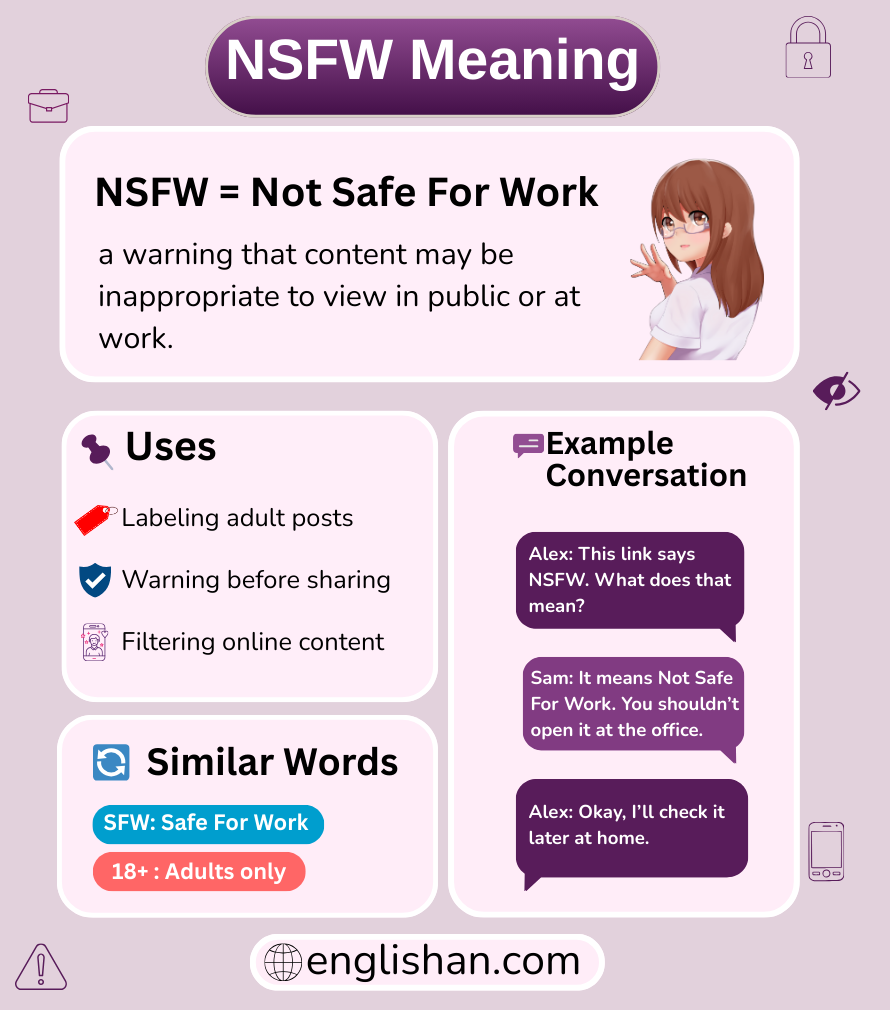
NSFW means “Not Safe For Work.” It warns that the content attached to a message, link, or post isn’t appropriate for a workplace, a school, or any public setting.
The warning works two ways. As a label, it tags content before anyone opens it: a Reddit post title reading “NSFW” or a message starting with “nsfw ⚠️” before a link. As a spoken shorthand in casual chat, it describes content after the fact: “that video was fully nsfw.”
The label says nothing about legality. NSFW content is legal adult material, graphic journalism, or edgy humour that wouldn’t survive an HR review. Illegal content is a separate category entirely, and no warning label makes it acceptable.
What Counts As NSFW Content?
NSFW covers a wider range than most people assume. It’s not limited to sexual content.
Sexual or nude content is the meaning most people reach for first: full or partial nudity, explicit sexual material, suggestive imagery. Real, but only one slice.
Graphic violence or gore is the second slice: footage or images of real violence, severe injury, or death. War journalism, crime-scene documentation, and graphic accident footage all land here.
Beyond those two, the label stretches further than most people expect. Text, audio, or video dense with profanity or slurs qualifies because it would draw stares in a shared office. Politically or socially charged material qualifies because opening a heated meme or protest video at work invites an unwanted conversation. Even a sex-education diagram, a Renaissance nude, or a mastectomy recovery photo can trigger the same platform filters as an explicit film still. The label doesn’t judge the purpose of the content, only its surface risk in a professional setting.
| NSFW category | What it covers | Real example |
|---|---|---|
| Sexual or nude | Full nudity, explicit imagery, suggestive poses | Blurred Reddit post in an adult subreddit |
| Graphic violence | Real injury, gore, war footage | Uncensored conflict journalism |
| Strong profanity | Heavy swearing, slurs, offensive language | Comedy clip dense with profanity |
| Sensitive material | Politically charged, confrontational, or disturbing | Protest footage, graphic political satire |
| Edge case | Medical, artistic, or educational content with nude or graphic elements | Anatomy textbook illustration, art museum nude |
How To Use NSFW As A Content Warning
NSFW works as both a label and an adjective. The placement depends on where you’re sharing.
Before a link in a message: “nsfw ⚠️ [link]”
In a Reddit post title: “[NSFW] Close-up surgery footage from a veterinary clinic”
In an email subject line: “Forwarded article (NSFW, view after work)”
As an adjective in conversation: “That meme is extremely nsfw.” “Don’t open it, it’s nsfw.”
Asking about content before clicking: “Is this nsfw?” “Is that link sfw or nsfw?”
“Heads up, nsfw link below.” ✅ “Here’s a link.” (with no warning before explicit content) ❌
The label is a courtesy, not a permission slip. Tagging something NSFW doesn’t make it appropriate to send to everyone. Read the recipient, the platform, and the setting.
NSFW Vs SFW Vs NSFL: What’s The Difference?
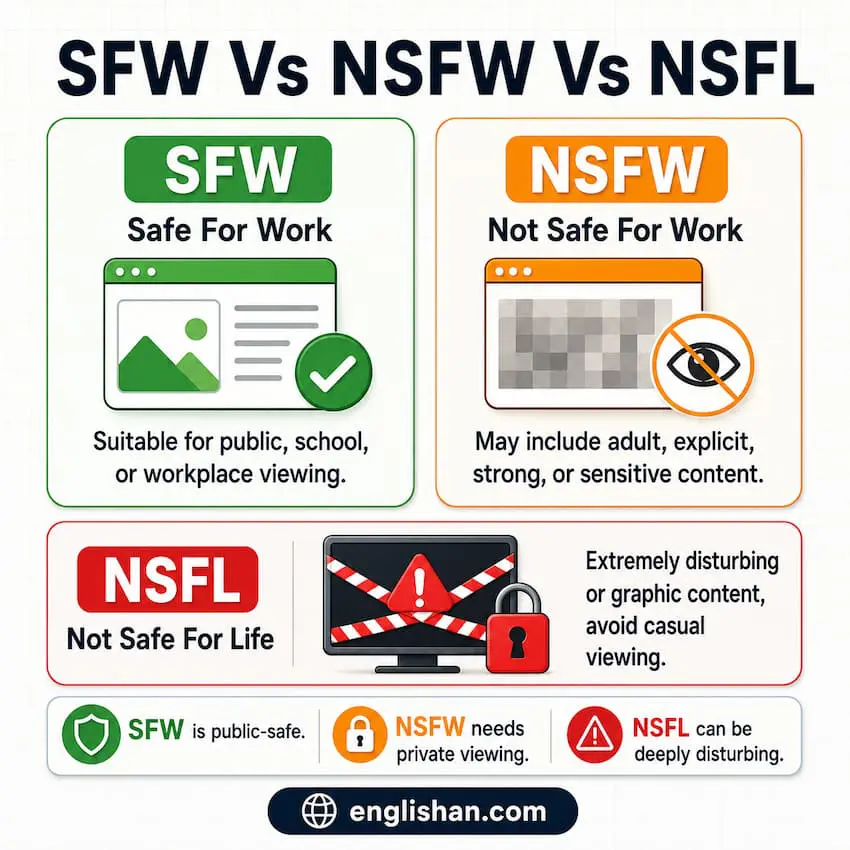
Three labels form the internet’s content-warning spectrum. Each one flags a different threshold.
| Label | Full form | What it flags | How platforms treat it |
|---|---|---|---|
| SFW | Safe For Work | No risk. Appropriate anywhere | Default state, no filter |
| NSFW | Not Safe For Work | Nudity, violence, profanity, sensitive material | Blurred, age-gated, or hidden behind a click |
| NSFL | Not Safe For Life | Extreme gore, fatal accidents, animal cruelty, execution footage | Takedown on most mainstream platforms |
SFW is the default. If no label appears, the assumption is that the content is fine to open at your desk.
NSFW is a warning. It tells you the content exists and gives you the choice to engage or scroll past.
NSFL is a harder tier. Where NSFW blurs an image and waits for your click, NSFL signals content disturbing enough to upset viewers regardless of setting. Most mainstream platforms remove NSFL material outright rather than tagging it.
Related labels worth recognizing:
- TW (Trigger Warning): Flags content around trauma, assault, self-harm, or mental health crises. Often paired with a specific topic: “TW: eating disorder.”
- CW (Content Warning): A broader version of TW. Used on Mastodon, Tumblr, and academic spaces.
- MDNI (Minors Do Not Interact): Common on X and Tumblr. Warns that the account or post is 18+ only.
- 18+ and the 🔞 emoji: Platform-neutral age markers.
- ⚠️ emoji: General caution flag, often placed before an nsfw link in casual chat.
How NSFW Works On Reddit, Twitter, TikTok, And Discord
Every platform handles NSFW differently. The label is the same three letters, but the enforcement, controls, and defaults shift from one site to the next.
Reddit: NSFW runs at two levels. Entire subreddits can be tagged NSFW, which puts an age gate in front of the community. Individual posts within any subreddit can also be tagged NSFW by the author or moderators. The content blurs by default and only reveals after a confirmation click. Reddit’s system is the most mature NSFW infrastructure on the internet and the one that popularized the label.
X (formerly Twitter): X uses a profile-level “sensitive content” toggle plus per-post sensitive-media flags. Users opt in to seeing NSFW content through their account settings. X has publicly allowed users to post voluntarily produced NSFW content (including AI-generated material) with labelling since mid-2024. Without opting in, sensitive posts appear blurred with a click-through warning.
Discord takes a different approach. Server owners tag entire channels as NSFW, and entering a tagged channel triggers an age-gate prompt confirming the user is 18+. Individual messages inside non-NSFW channels don’t have a per-message toggle, so the moderation responsibility stays at the channel level.
TikTok and Instagram share an even stricter model: neither platform officially supports an NSFW tag at all. Their community guidelines remove explicit content outright rather than labelling it. Creators on both platforms sometimes write “nsfw” in captions as a courtesy warning for edgy (but not explicit) material, but the platform’s own moderation works by takedown, not by tagging.
Tumblr’s story is its own. The platform banned all NSFW content in December 2018, displacing a large adult-creator community overnight. Tumblr later walked the policy partly back, allowing mature content with age verification, but the NSFW landscape there is still far more restricted than Reddit’s or X’s. The ban remains a landmark moment in how platforms handle adult material online.
| Platform | Official NSFW tag | How it works | User control |
|---|---|---|---|
| Yes (subreddit + post level) | Blurred content, age gate | Opt in via settings | |
| X (Twitter) | Yes (profile + post level) | Sensitive media toggle | Opt in via settings |
| Discord | Yes (channel level) | Age-gate prompt | Server owners tag channels |
| TikTok | No official tag | Explicit content removed | No user-facing NSFW filter |
| No official tag | Explicit content removed | No user-facing NSFW filter | |
| Tumblr | Restricted since Dec 2018 | Mature content with age verification | Limited after policy change |
How People Use NSFW In Real Chats
Five exchanges covering the typical shapes: warning before a link, asking before clicking, describing something after the fact, ironic Gen Z humour, and a workplace-adjacent heads-up.
Warning before a link (group chat):
Alex: nsfw ⚠️ don’t open at work
Alex: [link]
Sam: noted, saving for later
Asking before clicking (DM):
Jordan: sent you something on reddit
You: is it nsfw?
Jordan: yeah, pretty graphic surgery video
You: opening later then
Describing content after the fact (text):
Sam: did you see that meme in the group chat
You: the one with the uncensored clip? fully nsfw
Sam: yeah, someone should’ve tagged it
Ironic Gen Z use (TikTok comment):
@user1: NSFW: I just ate the best sandwich of my life
@user2: the content warning we actually needed 😂
The ironic shape tags inoffensive content with the NSFW label for comedic effect. The joke works because everyone knows what NSFW actually warns about. If someone labels a sandwich photo as NSFW, they’re saying the sandwich is unreasonably good, not that it contains explicit material.
Workplace-adjacent heads-up (email):
Subject: FW: Article on workplace harassment policies (NSFW images in the linked report, open at home)
The email version is the oldest form of the warning, dating back to the early 2000s when office workers forwarded links without knowing who would open them on a shared computer.
How To Reply When Someone Sends NSFW Content
The response depends on context: who sent it, what platform you’re on, and whether the content was welcome.
- If you received a tagged warning and you’re at work: Reply that you’ll look later. A quick “noted, opening later” tells the sender the warning registered. Friend: nsfw link, don’t open at the office You: appreciate the heads-up, checking tonight
- If the content was more intense than expected: Respond honestly without drama. “That was rougher than I expected, thanks for the warning though” gives genuine feedback. Friend: did you watch the clip? You: yeah, that was more intense than I was ready for
- If someone sent NSFW content without a warning: Call it out so they tag future sends. “Heads up, that was definitely nsfw” is enough. Friend: check out this video lol You: bro that was fully nsfw, warn me next time
- If you don’t want NSFW content at all: Set the boundary once. “Keep it sfw for me” is direct and clear. Friend: want to see something wild? You: keep it sfw for me, thanks
- If you’re fine with it and want to acknowledge: A short “lol nsfw but worth it” or “wild but fair warning was accurate” keeps the conversation moving.
Where NSFW Came From
The abbreviation traces back to internet forum culture in the late 1990s and early 2000s. Before NSFW existed, a similar tag circulated on message boards: NFBSK (“Not For British School Kids”), which appeared online around the year 2000.
NSFW itself entered the internet vocabulary through email chains and forum threads where office workers shared links. The first Urban Dictionary entry for NSFW dates to 2003. By the mid-2000s, Reddit had built NSFW tagging into its community infrastructure, giving the label formal platform-level status for the first time.
Dictionary recognition followed. Oxford Dictionaries Online added NSFW in 2011. Merriam-Webster added it in 2015, the same year the dictionary brought in meme, photobomb, and WTF. The Oxford English Dictionary followed in 2016, citing earliest evidence from 2002.
A major inflection point came in December 2018, when Tumblr banned all NSFW content. Overnight, a large community of adult creators lost their primary platform and scattered across Twitter, Reddit, and newer sites. The ban reshaped the online NSFW landscape and accelerated the conversation about how platforms should handle adult material.
Today, the label is 25 years old and more embedded than ever. AI-generated NSFW content has added a new policy layer since 2023, with X formally allowing labelled AI-generated adult material in mid-2024 and other platforms still deciding where to draw their lines.
Is NSFW A Bad Word Or Just A Warning?
NSFW is a warning label, not a slur, not an insult, and not a judgment. Typing “nsfw” before a link is a courtesy, the same way marking a hot pan with a warning sign is a courtesy. The label describes the content’s setting risk, not its moral status.
The register is entirely casual. NSFW doesn’t appear in professional writing, formal documents, or spoken workplace communication. In those settings, people say “explicit content,” “sensitive material,” or “not appropriate for a professional audience.” NSFW stays in the texting, forum, and social-media lane where it started.
One nuance: NSFW is neutral when used as a tag, but it takes on connotation when used as a descriptor. “That account is nsfw” reads as a factual content warning. “You’re being nsfw” directed at a person in conversation reads more like a judgment of behaviour. Same letters, different tone depending on what they’re pointed at.
When To Use NSFW And When To Skip It
NSFW fits anywhere casual digital communication runs: group chats before sharing a risky link, Reddit post titles when content involves nudity or violence, Discord channel tags for 18+ content, X/Twitter posts with the sensitive-media toggle, informal email subject lines between colleagues, and meme captions or TikTok comment sections.
Skip it in job applications, cover letters, résumés, company-wide emails, LinkedIn posts, academic writing, spoken workplace conversation (saying “en-ess-eff-double-you” out loud sounds awkward in most offices), and messages to older family members who don’t recognise internet acronyms.
“NSFW heads-up: this link has graphic content.” ✅ “Please be advised that the attached document contains material not suitable for professional environments.” (overkill for a group chat) ❌
The professional swap: write “sensitive content,” “explicit material,” or “not appropriate for a work setting” when the reader is a boss, a client, a professor, or a hiring manager. NSFW stays in the chats, forums, and feeds where it was born.
FAQs
Nudity, explicit sexual material, graphic violence, heavy profanity, and politically or socially charged content that would be inappropriate to open in a workplace or school setting. NSFW is broader than pornography alone. Medical images, artistic nudes, and graphic journalism can also qualify.
Not always. Pornography is NSFW, but NSFW is not always pornography. Graphic violence, strong profanity, disturbing imagery, and sensitive political content are all NSFW without being sexual. The label describes setting risk, not content type.
On Reddit, NSFW is an official content tag. Entire subreddits can be marked NSFW, which puts an age gate in front of the community. Individual posts can also carry the tag, which blurs the content until the user clicks through. Reddit’s NSFW system is the most developed of any major platform.
The same as from anyone else. It means “Not Safe For Work” and warns about content that shouldn’t be opened in public. Gender doesn’t change what the label means. Context and tone decide whether the content behind it is flirty, funny, shocking, or genuinely disturbing.
No. NSFW is a warning label for legal content that isn’t appropriate for a professional or public setting. Illegal content is a separate category entirely, and no warning label makes illegal material acceptable. NSFW flags risk to your reputation or comfort, not risk to your legal standing.
On Reddit, go to Settings → Feed Settings → toggle off “Adult Content.” On X, go to Settings → Privacy and Safety → Content You See → toggle off “Display media that may contain sensitive content.” Both platforms hide NSFW material by default; these settings control whether blurred content appears at all.
You May Also Like