You see DM me in a text, comment, or bio, and the meaning is usually straightforward. DM meaning in text is direct message, a private message sent from one person to another instead of something posted where everyone can see it.
That meaning stays the same, but people use DM in more than one way. Sometimes it names the message itself, as in I sent you a DM. Sometimes it works like a verb, as in DM me later. In both cases, the idea is the same: move the conversation into a private space.
That is why DM shows up so often across texting, social media, online business, and creator culture. The examples and usage ahead show when it points to a private reply, how it sounds in conversation, and what people usually mean when they use it.
What Does DM Mean in Text?
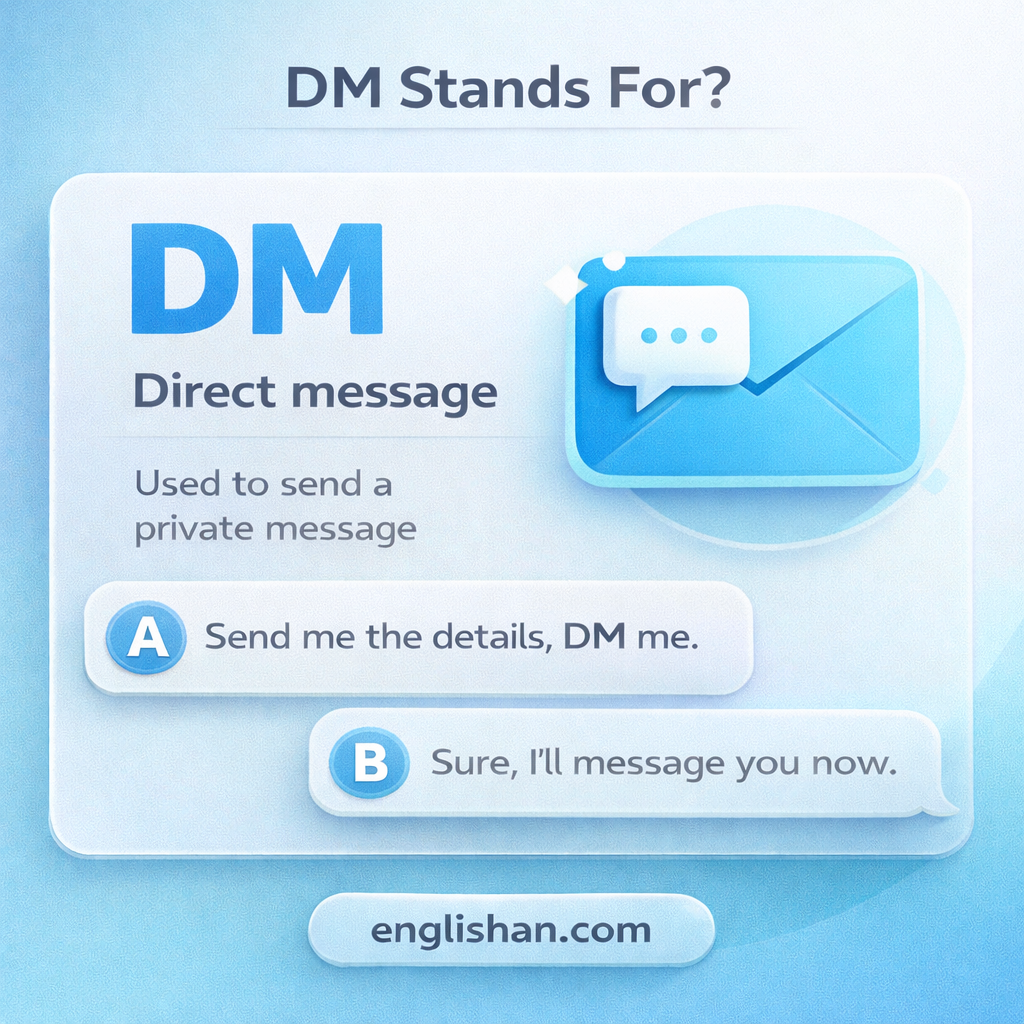
In text and online conversation, DM means direct message. It points to a private message sent on a platform rather than a public comment or post.
A line like DM me the details means the person wants the information sent privately. A line like check your DMs means they have already sent a message and want the other person to look for it.
The meaning is straightforward, but the way people use it can shift with tone and setting. In one chat, it may sound casual. In another, it may sound professional. In marketing, it can even act like a call to action.
DM Meaning at a Glance
| Term | Meaning | What It Usually Refers To |
|---|---|---|
| DM | Direct Message | A private message on a platform |
| DM me | Send me a private message | A request to continue privately |
| DMs | Direct messages | More than one private message |
| Check your DMs | Look at your private messages | A message has already been sent |
The core idea does not change. DM always points back to private communication.
What a DM Is and What It Is Not
A DM is private, but it is still platform-based. That matters because people often mix it up with other types of messaging.
A DM is:
- a private message on a social or messaging platform
- something sent directly to one person or account
- a way to move from public interaction to private conversation
A DM is not:
- a public comment
- a caption
- a group reply
- standard SMS texting by default
That difference helps explain why someone might comment publicly first, then say DM me afterward. The public message starts the interaction. The DM moves it into a private channel.
DM as a Noun and a Verb
One reason DM feels so natural in text is that people use it in more than one grammatical role.
DM as a noun
Here, DM means the message itself.
Examples:
- I sent you a DM
- Your DM came through
- I missed your DM earlier
DM as a verb
Here, DM means the act of sending a direct message.
Examples:
- DM me later
- I’ll DM you the address
- Can you DM them for pricing?
This is one of the most useful parts of the term. It is short enough to work both ways without sounding awkward.
What “DM Me” Usually Means
When someone says DM me, they are usually asking to continue the conversation privately. The reason behind that request changes with context.
They may want to:
- share contact details
- discuss something personal
- send a file, link, or address
- talk business
- avoid posting publicly
- move a casual or flirty conversation into a private space
So DM me is not just a definition phrase. It usually signals a shift in the conversation. The public side is done. The private side starts now.
Common DM Phrases People Use
Some DM phrases appear again and again online. A strong article should decode them directly because these are the forms people actually see.
Check your DMs
This means a private message has already been sent.
Example:
- I just sent the link. Check your DMs.
Send me a DM
This is a direct request for private contact.
Example:
- Send me a DM if you want the full details.
My DMs are open
This means the person is available for private messages.
Example:
- My DMs are open for questions or collabs.
Slide into DMs
This usually means starting a private conversation, often with a casual, bold, or flirty tone.
Example:
- He slid into her DMs after seeing the post.
These phrases all sit inside the same meaning family, but they do not sound identical. Some are practical. Some are casual. Some are playful.
Where DMs Are Used Most
DM is widely used, but the tone changes a little from platform to platform.
Instagram and X
On Instagram and X, DMs often work as the private side of a public interaction. Someone comments, follows, reacts, or posts, then moves into DMs for details or conversation.
Facebook and Messenger
Here, direct messaging often feels more established and less tied to public posting. It can be casual, social, or business-related.
On LinkedIn, a DM often sounds more professional. It may be used for networking, hiring, collaboration, or follow-up after a public post.
WhatsApp and Snapchat
These feel more personal. On WhatsApp, the term DM may still be used casually, even though people often just call it messaging. On Snapchat, it usually feels more direct and social.
The platform does not change the meaning of DM, but it does change the expectation behind it.
Why People Move a Conversation to DMs
Moving into DMs usually means one thing: the person wants privacy, focus, or a more direct exchange.
That happens for several common reasons:
- the topic is personal
- the details are too long for comments
- contact information needs to be shared
- a business inquiry is starting
- a customer issue needs private handling
- someone wants a one-to-one conversation
In creator and brand communication, this move is especially common. A public post may bring attention, but the DM is where the actual exchange happens.
Related Abbreviations: DM, PM, IM, SMS, and MMS
These abbreviations overlap, but they are not the same.
| Term | Meaning | How It Differs From DM |
|---|---|---|
| DM | Direct Message | Private message sent on a platform |
| DMs | Direct Messages | The plural form of DM |
| PM | Private Message | Older or broader term, often used on forums or older platforms |
| IM | Instant Message | Focuses on live online messaging rather than platform-private messaging specifically |
| SMS | Short Message Service | Standard phone text message, not an in-platform message |
| MMS | Multimedia Messaging Service | Phone message with media, still different from a platform DM |
DM vs PM
They are close in meaning. DM sounds more current and platform-based. PM is older and often associated with forums or older community spaces.
DM vs texting
A text message usually means SMS or a phone-based message. A DM is sent inside an app or platform.
DM vs group chat
A group chat includes multiple people in the same conversation. A DM is private between accounts or users.
How to Use DM in Casual Conversations
DM works well in casual conversation when you need privacy or when a public thread is no longer the right place for the topic.
Examples:
- DM me your number
- I’ll DM you the address
- Let’s talk in DMs
- Check your DMs when you get a minute
These sound natural because they are direct and low-effort. They tell the other person exactly where the conversation should go next.
How DM Works in Business, Marketing, and Customer Support
DM is not only social slang anymore. It also plays a big role in business communication.
Brands and creators use DMs for:
- customer support
- order questions
- pricing
- lead generation
- collaborations
- influencer outreach
- private follow-up after comments
Examples:
- DM us for pricing
- DM for collaboration details
- Please DM your order number
- DM me if you want the media kit
This is one reason the term matters so much now. It no longer belongs only to casual chat. It also belongs to sales, service, outreach, and online business.
DM Etiquette and Safety
Sending a DM is easy. Sending a good DM takes a little more judgment.
What makes a good DM
A good DM is:
- respectful
- direct
- short enough to read quickly
- specific about the reason for the message
A message like Hi, I saw your post and wanted to ask about your service works much better than a vague Hey with no context.
Common DM mistakes
These are the habits that make DMs weak:
- sending spam
- sending repeated messages with no reply
- being too vague
- sounding too aggressive
- asking for too much too fast
When a DM feels intrusive
A DM starts to feel intrusive when it crosses boundaries. That usually happens when someone:
- messages without context
- pushes too hard for attention
- ignores social cues
- sends overly personal content too early
- treats private access like permission for anything
That is why DM etiquette matters. A private space still needs respect.
Examples of DM in Real Messages
Here are a few natural examples that show how DM works in different situations.
Casual
- DM me when you’re free
- I’ll DM you the photo
- Check your DMs, I sent it already
Social media
- DM me for details
- My DMs are open if you have questions
- If you want the link, send me a DM
Professional
- Please DM us your order number
- Can I DM you about a possible collaboration?
- I’ll send the proposal in a DM
Playful or flirty
- He slid into my DMs after the story
- You can always DM me
- Don’t just like the post, DM me
The meaning stays the same in all of these. The tone and intent are what shift.
Final Takeaway
DM means direct message, and in text it refers to private messaging on a platform rather than public conversation. That part is easy. What makes the term more useful is understanding how people actually use it.
A DM can be a message, an action, a request, or a signal to move a conversation into a more private space. Once that is understood, phrases like DM me, check your DMs, or my DMs are open become much easier to read in context.
FAQs About DM Meaning
It means direct message, which is a private message sent from one person to another on a platform.
Not exactly. Texting usually points to SMS or phone-based messaging, while a DM happens inside a platform or app.
It means send me a private message or continue this privately.
They are very close. DM is the more current, platform-based term. PM is older and broader.
Yes. Businesses, creators, and professionals use DMs for support, inquiries, networking, and collaborations.
It means starting a private conversation, often in a casual or flirty way.
You May Also Like