You’re texting someone, they answer your message, then add HBU at the end. The meaning is simple: HBU meaning in text is usually how about you, a quick way to return the question and keep the conversation moving.
That is why it shows up so often in chats. Instead of typing the whole question again, someone can share what they are doing, feeling, or thinking, then add HBU to bring your side into the exchange.
The meaning is easy, but the tone is not always the same. HBU can sound friendly, casual, flirty, routine, or even a little low-effort depending on the message around it. This article breaks down the meaning, tone, and real texting use so you can read it the right way each time.
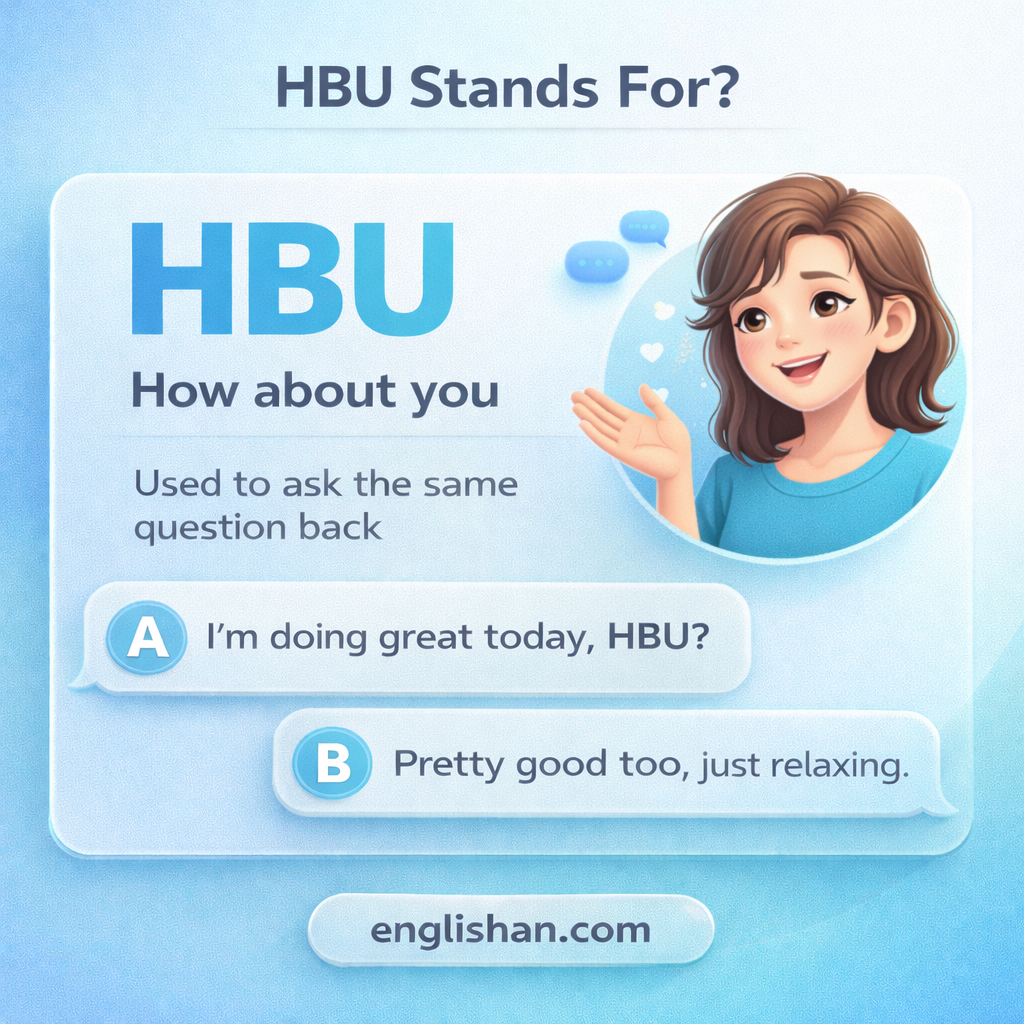
What Does HBU Mean in Text?
In text messages, HBU means how about you. It is a short way to return the same question or topic to the other person.
A few common examples make that easier to read:
- I’m doing good today, hbu?
- I had pizza for dinner, hbu?
- I’m free this weekend, hbu?
In each case, the speaker shares something first, then invites you to answer from your side. That is the whole point of HBU. It keeps the exchange moving and makes the chat feel two-sided.
HBU at a Glance
| ✦ Part | What it means |
|---|---|
| Full form | How about you |
| Main job | Turns the conversation back to the other person |
| Tone | Casual, friendly, sometimes playful |
| Best fit | Texts, DMs, group chats, casual online conversation |
| Less suitable for | Formal emails, professional writing, serious messages that need fuller language |
HBU is small, but it does an important job. It keeps the conversation open.
How HBU Works in a Conversation
HBU usually comes after someone shares something. That detail matters because it explains why the phrase feels so natural in chat.
A typical structure looks like this:
statement + HBU
Examples:
- I just got home, hbu?
- I love that song, hbu?
- I’m tired today, hbu?
That pattern makes HBU feel like a conversation bridge. One person says something first, then hands the moment back to the other person. It is not only a question. It is also a way of showing interest without sounding too formal.
That is one reason it stays popular. It is quick, but it still keeps the chat balanced.
What Tone Does HBU Carry?
The basic meaning stays the same, but the tone can shift depending on the chat, the relationship, and the way the message is written.
Friendly and Interested
Most of the time, HBU sounds open and friendly. It gives the other person room to join in.
Examples:
- Had a good day at work, hbu?
- I’m watching a movie tonight, hbu?
This version feels relaxed and easy.
Casual and Neutral
Sometimes HBU is just routine conversation. It does not sound especially warm or especially cold. It simply keeps things moving.
Examples:
- I’m okay, hbu?
- Just finished lunch, hbu?
This is probably the most common everyday use.
Flirty or Playful
In the right chat, HBU can feel playful. That usually happens when the conversation already has a little chemistry.
Examples:
- I’m free tonight, hbu? 😉
- I like coffee dates, hbu?
Here, HBU still means the same thing, but the setting adds more energy.
Dry or Low-Effort
HBU can also feel flat if the rest of the message is short or detached.
Examples:
- I’m fine. hbu
- Nothing much, hbu
This version is not rude by default, but it can feel less engaged if the conversation already feels weak.
Where HBU Fits Best
HBU works best in places where short, informal replies feel natural.
Text Messages and Group Chats
This is where HBU fits most easily. It helps casual chats move along without making the message longer than it needs to be.
Examples:
- I’m heading out now, hbu?
- We’re ordering food, hbu guys?
Social Media and DMs
On Instagram, Snapchat, WhatsApp, or private DMs, HBU keeps conversations light and fast.
Examples:
- Nice trip, hbu?
- I’m online now, hbu?
Dating Apps and Casual Online Chats
HBU is common in early-stage chats because it keeps the focus shared instead of one-sided.
Examples:
- I like staying in more than going out, hbu?
- I’m into thrillers, hbu?
It works here because it sounds interested without sounding heavy.
How to Use HBU Naturally
The easiest way to use HBU well is to say something first, then pass the topic back.
That works best when:
- you have already answered a question
- you want the other person’s opinion
- you want to keep the chat moving
- you want to sound casual rather than formal
A few natural patterns:
- I’m doing better today, hbu?
- I usually wake up early, hbu?
- I’m in the mood for pasta, hbu?
What makes HBU feel natural is not the abbreviation itself. It is the rhythm. Share first, then ask back.
How to Reply to HBU
A good reply does not need to be complicated. Since HBU asks for your side, the best response is usually direct and conversational.
Casual replies
- I’m good too
- Pretty tired, honestly
- Just relaxing right now
- Not much, just got home
Friendly replies that keep the chat going
- I’m doing well. Just finished work.
- Pretty good. Thinking about ordering food.
- Good actually. Been a nice day so far.
Flirty replies
- Better now that you asked 😄
- Doing good. Maybe better if you keep texting me.
- Not bad. What are you up to later?
The stronger reply is usually the one that gives a little more than a one-word answer. That gives the conversation somewhere to go next.
HBU vs Similar Abbreviations
HBU sits close to a few other texting shortcuts, but the intent is not exactly the same.
| Term | Meaning | How it differs from HBU |
|---|---|---|
| HBU | How about you | Returns the same question or topic |
| WBU | What about you | Very close to HBU, slightly different wording |
| HMU | Hit me up | Asks someone to contact you, not answer the same question |
| WYD | What you doing | Asks about current activity |
| HRU | How are you | Focuses on how someone feels |
| And you? | Full phrase version | More natural in fuller writing |
If the goal is to bounce the same topic back, HBU fits well. If the goal is to start a fresh question, another phrase may work better.
Related Abbreviations and Terms
A few nearby shortcuts often appear in the same kinds of chats:
- WBU for what about you
- HMU for hit me up
- WYD for what you doing
- HRU for how are you
- TTM for talk to me
These do not all do the same job, but they live in the same casual-texting space. That is one reason people sometimes mix them up.
Common Mistakes With HBU
The biggest mistakes are usually about tone or placement.
Using it without saying anything first
A message that only says HBU? can feel a little empty if there is no earlier topic to return to.
Using it in formal settings
HBU is too casual for:
- work emails
- school assignments
- client communication
- formal requests
Repeating it too often
If every message ends with HBU, the chat starts sounding mechanical.
A better rhythm is to use it when it genuinely fits, not as a habit in every exchange.
Is HBU Formal or Informal?
HBU is informal. It belongs in casual online conversation, texting, DMs, and relaxed group chats.
It does not belong in polished business writing or formal communication. In those cases, writing how about you in full is usually the better move.
That does not mean HBU is sloppy. It just belongs to a lighter style of communication.
Examples of HBU in Real Messages
Here are some fuller examples that feel natural in everyday conversation.
Friendly
- I had a great weekend, hbu?
- I finally watched that series, hbu?
- I’m staying in tonight, hbu?
Casual
- Just got back from class, hbu?
- I’m eating lunch now, hbu?
- I’m feeling okay today, hbu?
Flirty
- I’d rather hang out than stay home, hbu?
- I like late-night talks, hbu?
- I’m free later, hbu?
Low-energy
- I’m fine, hbu
- Nothing much, hbu
- Still here, hbu
The phrase stays the same. The tone shifts with the wording around it.
FAQs About HBU Meaning
What does HBU mean in text?
It means how about you. People use it to return a question or topic back to the other person.
Is HBU formal or informal?
It is informal and fits casual texting, DMs, and social chats much better than formal writing.
Is HBU the same as WBU?
They are very close. HBU means how about you, and WBU means what about you. In most chats, they work almost the same way.
Can HBU sound flirty?
Yes. In the right conversation, it can sound playful or interested, especially on dating apps or in a light one-to-one chat.
Why do people use HBU so often?
Because it is short, easy to type, and keeps conversations balanced without needing a full sentence every time.
Can I use HBU in group chats?
Yes. It works well in group chats when you want others to jump in and share their side too.
Final Takeaway
HBU means how about you, and its main job is to turn the conversation back to the other person. That is why it keeps appearing in texts, DMs, group chats, and casual online replies. It is quick, familiar, and useful without sounding stiff.
The phrase itself is not complicated. What matters more is the tone around it. In one message, it sounds friendly and open. In another, it can feel playful, routine, or flat. Once that part clicks, HBU becomes easy to read and easy to use naturally.