You open a message and see WYD. The sender might just want to talk, check whether you are free, or test the waters for plans. The phrase is short, but the tone changes with context, timing, and who sent it.
In text messages, DMs, and comments, WYD usually means “what are you doing?” People use it as a fast check-in instead of typing the full question. It often starts a conversation without sounding formal or heavy.
Once you know the tone behind it, WYD is easy to read. Sometimes it is friendly. Sometimes it is flirty. Sometimes it is just boredom in three letters. Here is what it means, how people use it, and how to reply without sounding stiff.
What Does WYD Mean?
The direct meaning of WYD
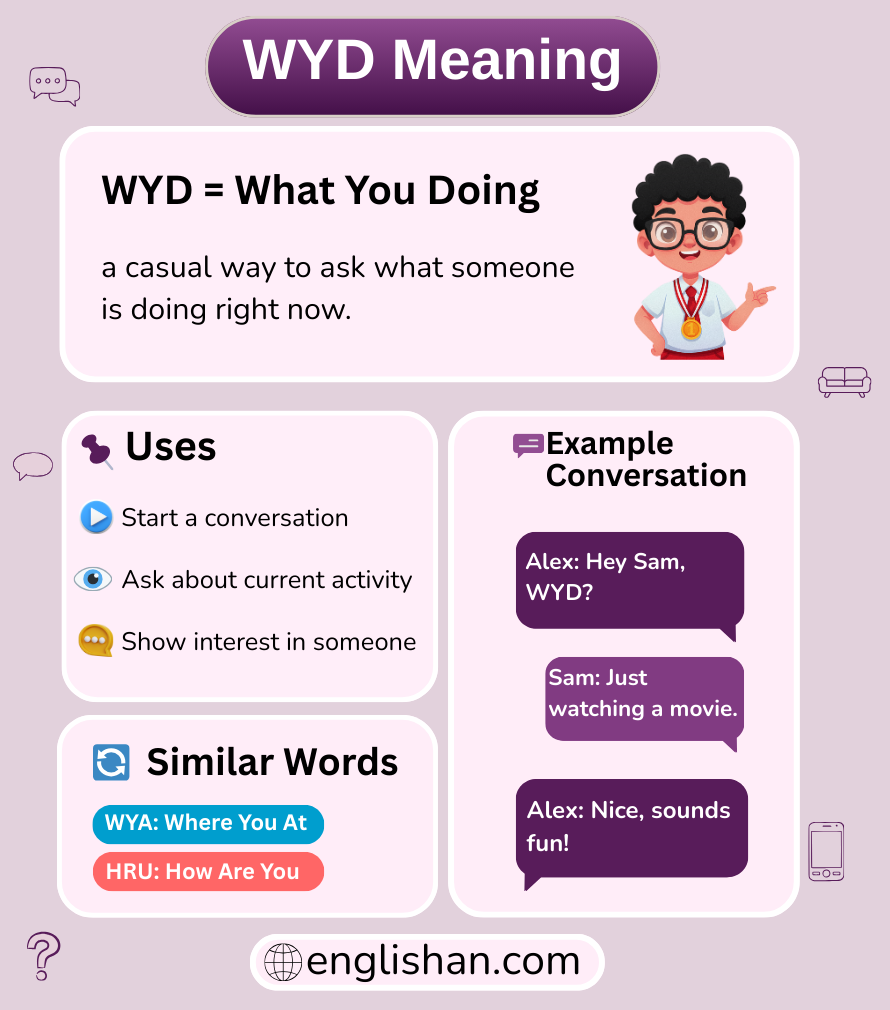
WYD means what are you doing. It asks about what someone is doing right now, what they are about to do, or whether they are free to talk.
You will usually see it in:
- text messages
- Instagram DMs
- Snapchat chats
- TikTok comments
- casual group chats
It is one of the fastest ways to start a conversation because it feels light and low-pressure.
What someone usually means when they text WYD
Most of the time, a person who sends WYD means one of these things:
- What are you doing right now?
- Are you free?
- Do you want to talk?
- Do you want to hang out later?
That is why the same message can feel different depending on the situation. A close friend may send WYD just to chat. A crush may send it to open the door for something more personal.
When WYD is just a casual check-in
Not every WYD carries deep meaning. In many chats, it works like:
- what’s up
- how’s it going
- you around?
- free right now?
A lot of people send it when they want to keep the conversation moving without writing a long opener. It often means nothing more than “I felt like texting you.”
Can WYD mean what would you do?
Yes, but that is a secondary use.
In posts, captions, memes, or hypothetical situations, WYD can mean “what would you do?” For example:
Your friend cancels five minutes before the trip. WYD?
In that sentence, WYD is not asking what someone is doing right now. It is asking how they would react in a situation. In regular texting, though, the main meaning is still what are you doing.
What Does WYD Stand For?
WYD as what are you doing
The standard meaning of WYD is:
- W = what
- Y = you
- D = doing
In everyday texting, people read it as what are you doing even though the exact shorthand drops the word are.
Why people type “what you doing” instead of the full phrase
Text slang often cuts small words to save time and match casual speech. That is why people type things like:
- wyd
- wya
- idk
- hmu
- brb
The goal is speed and tone, not grammar. In a relaxed chat, nobody expects textbook wording. WYD feels natural because it sounds like the way fast conversation works online.
How WYD Is Used in Texts and Online
To start a conversation
WYD is often just a conversation starter.
Instead of saying “Hello, how are you, and what are you doing at the moment?” someone sends wyd and waits for your reply. That makes the message feel easy and informal.
Example:
A: wyd
B: just got home. you?
That one short message starts the whole exchange.
To ask what you are doing right now
Sometimes the sender wants a direct answer about your current activity.
Example:
A: wyd
B: making dinner
That use is literal. They are asking what you are doing at that exact moment.
To check if you are free
A lot of WYD messages are really about availability.
The sender may not care whether you are watching TV or folding laundry. They want to know whether you are free enough to talk, call, or meet up.
Example:
A: wyd later
B: not much, why?
A: want to grab coffee?
In this kind of chat, WYD works like a soft lead-in to plans.
To make plans
WYD often appears right before an invitation.
You will see it in messages like:
- wyd tonight
- wyd after class
- wyd this weekend
- wyd later
The sender uses it to test the mood before asking the real question.
As a reaction to something surprising
WYD also appears when someone reacts to behavior that looks strange, funny, reckless, or embarrassing.
Example:
bro wyd
That version often sounds playful, annoyed, shocked, or teasing. Tone matters a lot here. Depending on the relationship, it may sound like:
- what are you doing?
- why are you acting like this?
- what is going on with you?
In comments, captions, and meme posts
On social media, WYD often appears in short punchy lines such as:
- me staring at the fridge at 2 a.m. wyd
- when your friend says they are “five minutes away” and it has been thirty
- your crush likes your story after six months. wyd?
Here, the point is engagement. People use WYD to invite reactions, jokes, or opinions.
Is WYD Flirty?
When WYD feels friendly
WYD feels friendly when:
- the sender is a friend you already talk to often
- the message comes during normal daytime conversation
- the tone stays casual and neutral
- the person follows up with ordinary chat
Example:
A: hey wyd
B: working on a report. you?
That feels like normal conversation, not flirting.
When WYD feels flirty
WYD feels flirty when it carries extra attention, timing, or suggestive energy.
Signs include:
- the message arrives late at night
- the sender is someone you like or someone who likes you
- they use softer or playful wording around it
- the chat quickly turns personal
- the message feels like a lead-in to private plans
Example:
A: wyd tonight
B: nothing much
A: come over
The message itself is small, but the direction of the chat changes the meaning.
How timing changes the tone
Timing shapes WYD more than most people realize.
- Afternoon WYD often reads like casual small talk
- Evening WYD may hint at plans
- Late-night WYD often feels more personal or flirty
That does not mean every late-night WYD is romantic. It means people often read more into it because the timing shifts the vibe.
How to read the sender’s intent
To figure out what WYD means in your chat, look at:
- who sent it
- when they sent it
- how often they text you
- what the next message says
- whether they are asking for plans or just talking
Do not judge the message by the letters alone. Judge it by the full context.
How to Reply to WYD
Casual replies
If you want to keep it easy and natural, short replies work best.
You can say:
- just relaxing
- working right now
- heading out soon
- not much, you?
- making dinner
- watching a movie
These replies sound natural because they answer the question without doing too much.
Flirty replies
If you like the person and want to lean into the tone, you can reply with something a little warmer.
You can say:
- thinking about you
- waiting for you to text me
- nothing interesting until now
- just chilling, what are you up to?
- missing me?
- depends, are you asking casually or with plans?
A flirty reply works best when the chat already has that energy. Forcing it too early can make the exchange awkward.
Replies when you are busy
If you are busy, answer honestly and keep the tone polite.
You can say:
- at work right now
- studying at the moment
- in the middle of something
- kind of busy, text you later?
- tied up right now, what’s up?
That gives the other person a response without leaving them hanging.
Replies when you want to keep the conversation going
If you want the chat to continue, answer and return the question.
Good examples:
- just got home. what about you?
- finishing dinner. what are you doing?
- not much right now. what’s going on?
- taking a break. you free?
The easiest way to keep the conversation alive is to give them something to work with.
Replies when you do not want to continue the chat
You do not need a dramatic response. A short polite answer does the job.
You can say:
- busy right now
- about to sleep
- got a lot going on today
- not free at the moment
- I’ll catch up later
That closes the door without starting an argument.
WYD Examples in Conversation
Friend to friend example
A: wyd
B: just finished lunch. you?
A: heading back to class
This is the most common kind of WYD exchange. It is casual, fast, and low-pressure.
Crush example
A: hey, wyd tonight
B: nothing planned yet
A: want to go out?
This version uses WYD as the setup for plans. The tone turns more personal once the second message lands.
Late-night example
A: wyd
B: still awake, why?
A: couldn’t sleep and thought of you
Late-night WYD often feels more charged because people expect a more personal reason for texting at that hour.
Social media example
Caption: your friend says “I’m outside” but has not left the house yet. wyd?
This is the “what would you do” version. It invites reactions, jokes, and shared frustration.
Where WYD Came From
How texting culture made abbreviations common
WYD grew out of texting culture, where short forms became common because people wanted speed. Phones were slower to type on, messages felt more limited, and shorthand turned into everyday habit.
That culture gave rise to messages like:
- lol
- brb
- idk
- ttyl
- hmu
- wyd
Over time, these short forms stopped feeling like shortcuts and started feeling like normal digital speech.
Why WYD became popular
WYD spread because it does three things at once:
- asks a question
- opens a conversation
- keeps the tone casual
That mix made it stick. It is easy to send, easy to answer, and flexible enough to fit friendship, flirting, boredom, and planning.
Why it still feels common in chats today
WYD still works because people want fast conversation openers. A long opener feels heavy in casual chat. WYD feels light, direct, and familiar.
Even as apps change, the need stays the same. People still want a quick way to ask, “Are you around, and what’s your vibe right now?”
WYD vs Similar Text Terms
WYD vs WYA
- WYD = what are you doing
- WYA = where are you at
WYD asks about activity. WYA asks about location.
Example:
- wyd = what are you doing?
- wya = where are you?
WYD vs WSP
- WYD asks what you are doing
- WSP means what’s up
WSP feels broader. WYD is more specific.
WYD vs WSG
- WYD = what are you doing
- WSG = what’s good
WSG sounds more like a vibe check or casual greeting. WYD asks for an update on what you are doing.
WYD vs WUD
WUD is usually just a spelling variation of WYD.
- WYD = what you doing
- WUD = what u doing
The meaning stays basically the same. The difference is spelling style.
What “wyd rn” means
wyd rn means what are you doing right now.
The letters rn stand for right now, so the message becomes more immediate.
Example:
A: wyd rn
B: driving home
What “wyd later” means
wyd later asks about future availability.
It often means:
- are you free later?
- do you have plans later?
- want to do something later?
This version often points toward making plans.
What “wyd nm” means
This usually combines two chat ideas:
- wyd = what are you doing
- nm = not much
In conversation, it often reads like:
what are you doing? not much here.
Sometimes people send both ideas in a short back-and-forth:
A: wyd
B: nm, you?
When Not to Use WYD
WYD at work
WYD is too casual for most workplace communication, especially with managers, clients, teachers, or people you do not know well.
Instead, say:
- what are you working on right now?
- are you available for a quick call?
- do you have a minute?
- what’s your schedule looking like today?
Those versions sound more respectful and appropriate.
WYD in email
Do not use WYD in email unless you know the person very well and the tone is already extremely casual. In most cases, it looks lazy and out of place.
Email usually needs fuller wording.
When it can sound lazy or too vague
A single-word or three-letter message sometimes annoys people because it feels low-effort. If the other person values direct communication, WYD may come across as:
- vague
- dry
- lazy
- random
- attention-seeking
That does not mean you should never use it. It means tone and relationship matter.
Better alternatives in more formal chats
If you want the same idea without the slang, try:
- what are you up to today?
- are you free right now?
- what are you doing later?
- do you have time to talk?
- are you available this evening?
These options work better when you want to sound a little more polished.
Key Takeaway
WYD means what are you doing in most texts and DMs. People use it to start a conversation, check availability, make plans, or test the tone of a chat. It may feel friendly, neutral, curious, or flirty depending on who sends it, when they send it, and what comes next.
The best way to read WYD is to read the full situation around it. The best way to answer it is to keep your reply natural, match the tone, and say only as much as you want to say.
FAQs
No, WYD is not rude by itself. It is a casual message. Some people dislike it because it feels too short or too lazy, but the phrase itself is not offensive.
Yes. In memes, captions, and hypothetical posts, WYD sometimes means what would you do. In normal texting, though, people usually mean what are you doing.
That is usually a bad idea. WYD is too informal for most professional situations. Use a full question instead.
That is the main meaning, but context may shift it. On social media, it may ask for a reaction or opinion instead of asking about your current activity.
People usually say the letters W-Y-D or speak the full phrase “what you doing” when reading it aloud.
No. Most of the time, WYD is just a casual check-in. It turns flirty when the context, timing, and follow-up messages push it in that direction.
You May Also Like