HMU means “hit me up.” It’s a short, casual way to tell someone they can text, call, or message you whenever they feel like it. You see it in group chats, Instagram captions, Snapchat stories, sale posts, and at the tail end of conversations that neither person wants to fully close.
The phrase came out of 1990s pager and hip-hop culture, where hitting someone meant paging their beeper. Phones changed, the slang stuck, and HMU is now one of the most recognizable sign-offs online. It can sound friendly, flirty, or just bored, depending on who sends it and when.
What Does HMU Mean In Text?
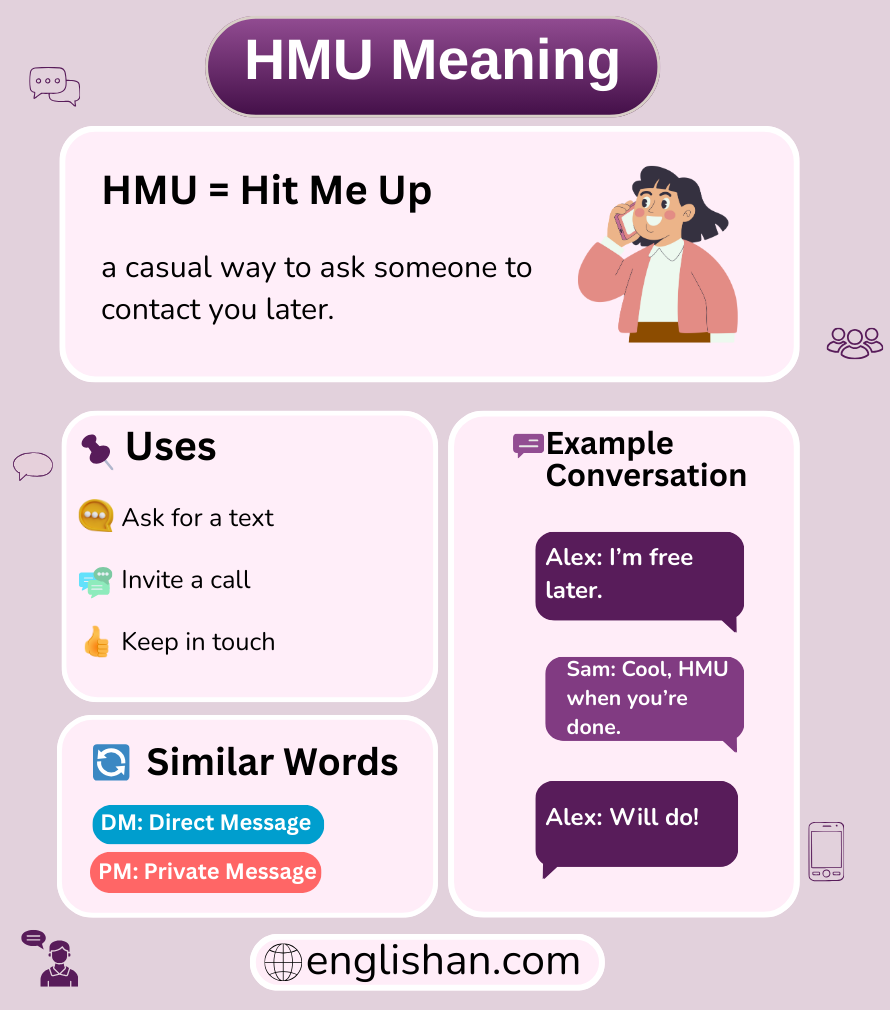
HMU means hit me up. In plain speech, it’s someone saying message me, call me, or get in touch when you can. No fixed time, no pressure, just an open door.
HMU is spoken letter by letter: H, M, U. No one says it as a single word. If you’re new to the acronym, reading it as aitch-em-yoo is correct.
What Does HMU Stand For?
HMU has one dominant meaning and one secondary one worth knowing.
Hit Me Up is the meaning behind nearly every HMU you’ll read. Someone wants you to contact them, by text, DM, or call. “Free Saturday, hmu if you want to grab food.”
Hook Me Up is the secondary reading. It’s a request to be connected with something or someone. “My cousin is selling concert tickets, hmu if you want in.” Context almost always tells you which one is meant.
A joke meaning, Hold My Unicorn, appeared on Urban Dictionary around 2010 as a spoof poking fun at how many meanings slang acronyms can carry. It still surfaces in memes but is never used seriously.
Where HMU Came From
The phrase hit me up predates texting. It has roots in African American Vernacular English and 1990s hip-hop, where hit was already slang for contact. In pager days, hitting someone meant paging their beeper with a phone number so they would call back.
When AOL Instant Messenger and early SMS took over in the late 1990s and early 2000s, the full phrase started appearing online. HMU as an acronym showed up on slang dictionary sites around 2009 and spread through MySpace, early Facebook, and text culture. Facebook itself reported a sharp spike in HMU usage in status updates around 2010, which is part of why it feels so tied to that era.
The acronym has survived longer than most slang from the same period. BRB, TTYL, and LMK are the only abbreviations from that generation with similar staying power.
How People Use HMU Across Platforms
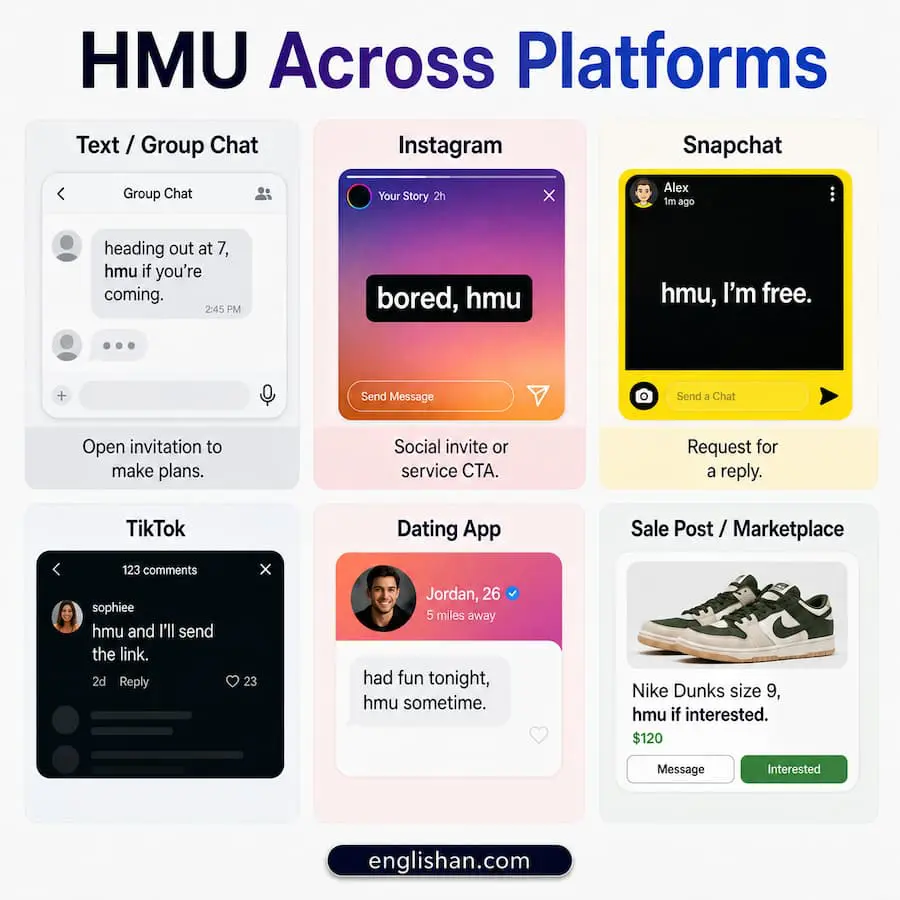
The core meaning stays the same everywhere. What shifts is the tone and the expectation behind it.
In text messages and group chats: The most common use. Someone drops HMU at the end of a message to say reach out when you want to. “Heading to bed, hmu tomorrow.” In group chats, it signals the sender is free and hoping someone suggests plans.
In Instagram captions and bios: HMU works as a social signal. A story that says “bored, hmu” is an open invite for anyone watching to start a chat. In bios, it reads as a soft call to action: “freelance designer, hmu for collabs” or “DJ bookings, hmu.”
On Snapchat stories, HMU is shorthand for message me back on this. On TikTok and Instagram comments, it moves a public thread into DMs: “same thing happened to me, hmu and I’ll explain.”
In DMs and on dating apps like Tinder, Hinge, and Bumble, HMU reads differently. “Had fun tonight, hmu sometime” after a date is a low-pressure way of showing interest without committing to a second meetup. Late-night HMUs to a crush almost always carry a flirty undertone.
Sellers and resellers also use HMU to invite private messages about a deal. “Few things for sale, hmu if interested.” “Two spare tickets for tonight, hmu.” It’s a cleaner way of saying DM me for details without sounding salesy.
| Where HMU appears | What it signals | Typical example |
|---|---|---|
| Text / group chat | Open invitation to make plans | “heading out at 7, hmu if you’re coming” |
| Instagram caption or bio | Social invite or service CTA | “freelance photographer, hmu for bookings” |
| Snapchat story | Request for a reply | “bored, hmu” |
| TikTok / IG comments | Moving a public thread into DMs | “hmu and I’ll send the link” |
| Dating apps / flirty DMs | Low-pressure romantic interest | “had fun tonight, hmu sometime” |
| Sale or ticket post | Invitation to inquire privately | “Nike Dunks size 9, hmu if interested” |
Uppercase HMU Or Lowercase hmu?
Both carry the same meaning. Lowercase is more common in casual texts and DMs. Uppercase is more common in captions and posts where it needs to catch the eye. The one register note that matters: a standalone all-caps “HMU” with nothing else in the message can read blunt or aggressive. Pair it with context or a follow-up line, and the tone softens.
Is HMU Flirty, Friendly, Or Neutral?
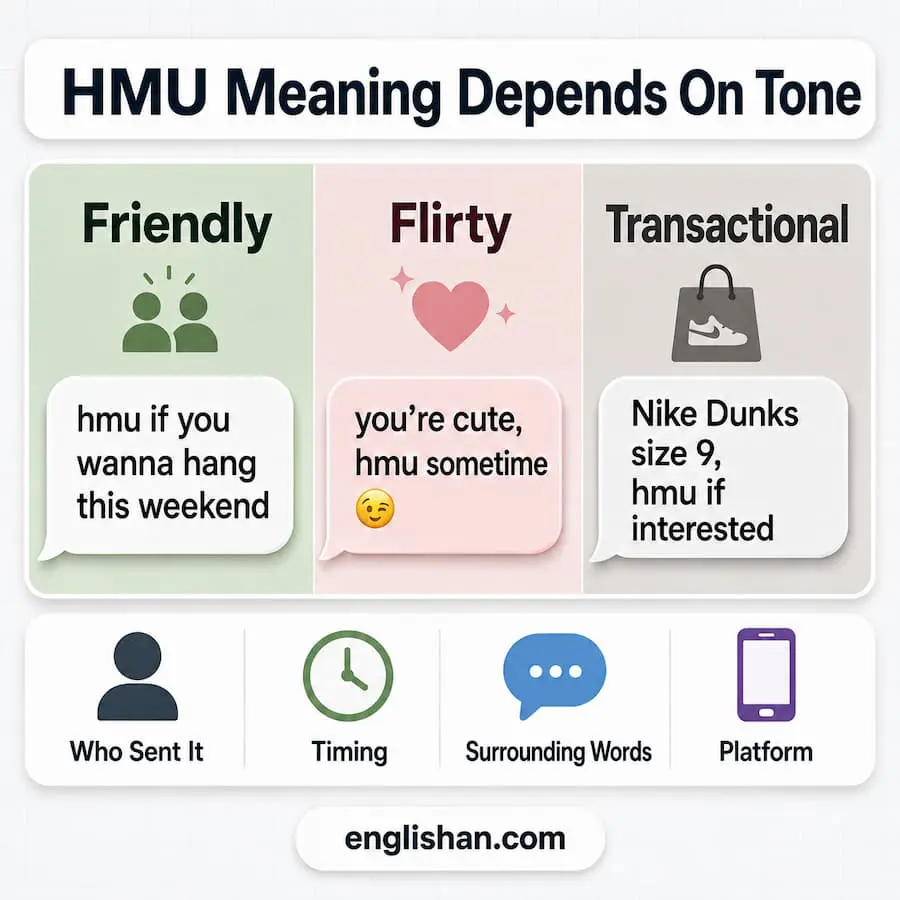
HMU on its own is neutral. The tone comes from four signals:
Who sent it. A close friend is almost always casual. A crush or someone you recently matched with is almost always flirty.
Timing. A midday HMU reads as social. A 1 a.m. HMU almost always carries intent.
What surrounds it. Heart emojis, winks, or “thinking about you” shift it flirty. “For prices” or “if interested” keep it transactional.
The platform. An HMU in a dating app DM is almost never just friendly. An HMU in a group chat usually is.
If you’re not sure how it was meant, read the last few messages between you. HMU rarely arrives out of nowhere. The conversation before it tells you what it’s really asking.
How To Reply When Someone Sends HMU
The right response depends on who sent it, why, and what you actually want out of the exchange.
When a friend sends it: Match their energy. If they said “bored, hmu,” a quick “what are you up to?” or “on my way home, call you in ten” keeps the door open. If you want to plan something, propose a time: “free after 6, want to grab dinner?”
When a crush sends it: An HMU from someone you’re interested in deserves a warmer reply than a flat ok. Try a question that continues the chat: “hey, what are you getting into tonight?” or “was just thinking about you, what’s up?”
When it’s a sale or offer post: Be direct. Ask the practical question first: “still available?” or “what’s the price?” Sellers get dozens of vague HMUs, so a specific question gets a faster reply.
When you’re not interested: A polite close works. “Thanks, all good for now” or “appreciate it, not my thing” ends it without being cold. If it’s a person rather than an offer, “busy this week, catch up soon” reads as a soft pass.
Real HMU Conversations
A casual weekend plan:
Jason: heading to the mall later if anyone wants to join
Mike: might be free after my shift ends at four
Jason: cool, hmu when you’re off
Catching up with an old friend:
Sarah: haven’t seen you in forever
Emily: I know, we need to fix that
Sarah: hmu this week and we’ll grab coffee
A sale post on Instagram:
Caption: cleaning out my closet, barely worn Nike Dunks size 9, hmu if interested
Comment: still available?
A late-night DM:
Alex: you up?
Alex: hmu if you’re around
A freelance bio:
graphic designer, logos and brand kits, hmu for rates
HMU Vs DM Me, Text Me, And Other Similar Phrases
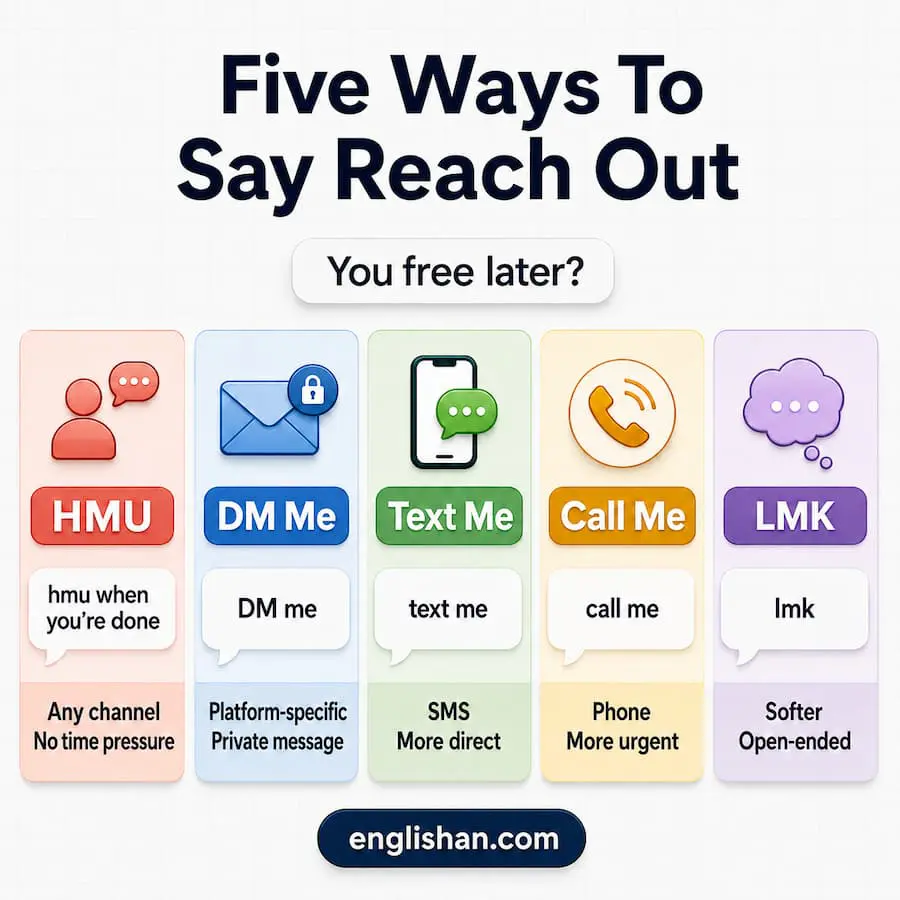
These all overlap with HMU in meaning. The difference is register, specificity, and platform.
| Phrase | How it differs from HMU |
|---|---|
| Text me | Specifies SMS. More direct, less open-ended |
| DM me | Specifies a platform direct message. Common on Instagram and X |
| Call me | Specifies a phone call. More urgent than HMU |
| Hit me back | Asks for a reply or follow-up, not a fresh outreach |
| HML (hit my line) | Specifically means call my phone |
| Ping me | Casual, often used in Slack and work chats |
| Get at me | Slangy, a bit bolder, same meaning |
| Reach out | Slightly more formal, safe for professional settings |
| LMK (let me know) | Softer, open-ended, less directive than HMU |
| TTYL (talk to you later) | A sign-off, not an invitation to reach out now |
HMU is the broadest of the group. It doesn’t specify a channel, a time, or a level of urgency. That flexibility is exactly why it has lasted longer than most texting slang from the same era.
When Not To Use HMU
HMU belongs in casual conversation. Skip it in these situations:
- Work emails, even to colleagues you know well
- First messages to clients, recruiters, or people in formal roles
- LinkedIn messages
- Academic or professional writing
- Any reply to someone who might not know the slang (older relatives, non-native speakers, people outside Gen Z and millennial circles)
“Contact me,” “reach out,” “let me know,” or “drop me a line” all carry the same invitation without the casual register.
FAQs
No. HMU is casual and friendly by default. It can feel blunt if sent alone with zero context (a bare “hmu” with nothing before or after it reads dry), but it almost never carries rudeness. Adding even one word of context (“hmu later,” “hmu if you’re free”) softens the tone.
No. Hit here is slang for contact. The term goes back to pager culture, when hitting a beeper meant paging someone with your phone number.
No. It’s too casual for email, client work, or formal communication. Write “reach out” or “contact me” instead.
Yes. HMU is one of the most stable slang acronyms online. It has been in regular use for more than fifteen years and shows no sign of fading. Merriam-Webster lists it as an established abbreviation under its slang entries.
DM me specifies a direct message on the platform you’re on. HMU is broader and can mean any contact method, unless a channel is added, like hmu on WhatsApp.
On Instagram, HMU usually means DM me. It shows up in captions, stories, and bios as an open invitation to start a private chat, book a service, or ask about a sale.
The same as from anyone else: contact me, text me, reach out. Gender doesn’t shift the meaning. If the message was flirty, her HMU carries that flirty tone. If it was about plans or a sale, it’s just an invitation to get in touch. Read the context before and after the HMU, not the sender’s gender.
You May Also Like