

DOA usually means dead on arrival. In literal use, it refers to someone who was already dead when arriving at a hospital or when emergency responders took over care. In everyday language, it can also describe a product that never worked properly or a plan that had no real chance from the start.
That mix is why the phrase shows up in very different places. You might see it in an emergency report, a product return policy, a political headline, or a casual text about a party that went flat. The setting tells you which meaning fits.
This article breaks down the main meanings first, then shows how DOA is used for products, work, news, and everyday conversation, with examples that make the tone easier to read.
What Does DOA Mean?
DOA means dead on arrival. It is used in three main ways.
In medical and emergency use, it refers to a person who was already dead when arriving for treatment or when emergency responders took over.
In product use, it refers to an item that never worked properly in the first place, often from the moment it was opened, powered on, or set up.
In figurative use, it describes a plan, idea, proposal, launch, or event that was doomed from the start.
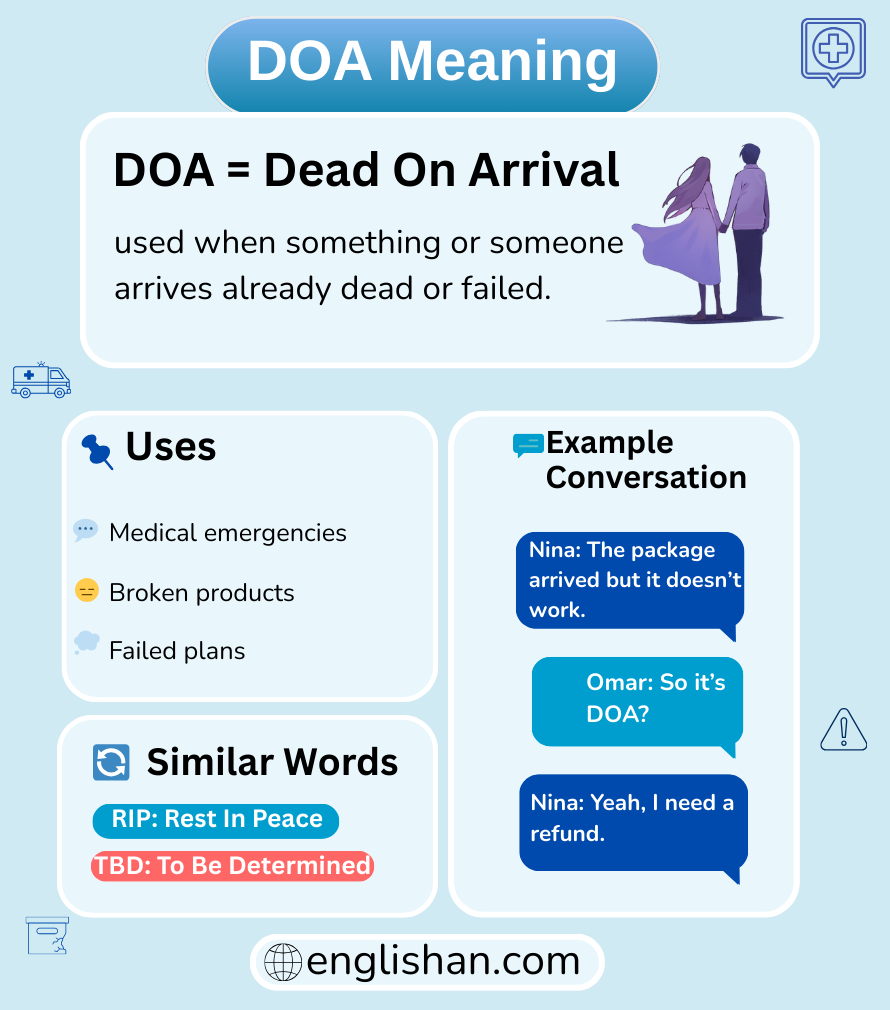
DOA Meaning at a Glance
Medical or emergency meaning: already dead at the time of arrival or first emergency assessment.
Product meaning: defective from the start or non-working at first use.
Everyday, work, or political meaning: something with no real chance of succeeding.
What Does DOA Stand For?
DOA stands for dead on arrival. The phrase is most serious in medical settings, but people also use it more broadly when they want to say something failed immediately or had no path forward from the beginning.
That wider use is why you may hear someone say a laptop was DOA, a bill was DOA, or a party was DOA. The subject changes, but the basic idea stays the same.
DOA in Medical and Emergency Use
In medical and emergency contexts, DOA keeps its literal meaning. It is used when a person is already dead upon arrival for treatment or when responders reach the scene and there is no sign of life to revive. In that setting, the phrase is clinical and matter-of-fact.
Because this is the original meaning, DOA can sound heavy outside that setting too. Even when people use it for products or failed ideas, the wording still carries the force of something ending before it could begin.
What DOA Means for Products
In product and warranty talk, DOA usually means a device or item was faulty from the beginning. It may not turn on, may fail during setup, may refuse to boot, or may stop working before normal use even starts.
A phone that never powers up, a monitor with no display on first connection, or a laptop that crashes during initial setup may all be described as DOA.
This use matters because many sellers treat DOA differently from a later breakdown. If a product fails right away, the buyer may be eligible for a direct replacement instead of a standard repair process.
What to do if a product is DOA. If you think an item is DOA, stop using it, keep the packaging, record the issue with photos or video if needed, and contact the seller or manufacturer quickly. Many DOA policies are time-sensitive, so waiting too long can make the claim harder.
Can something still count as DOA if it worked once? Sometimes it can, but that depends on the seller’s policy. Some companies focus on first-use failure, while others use a short reporting window for products that fail almost immediately after delivery.
DOA in News, Politics, and Work
Outside literal medical use, DOA often means certain to fail.
In politics, a bill or proposal may be called DOA if it has no support, no votes, or no practical way to move forward. In business, a pitch, rollout, or strategy may be described as DOA if it is rejected immediately or has no chance of succeeding.
This use is common because it says more than “weak” or “unlikely.” It suggests the idea was finished before it ever had momentum.
Examples of this kind of use include:
- a tax plan that is DOA in the senate
- a marketing pitch that was DOA in the first meeting
- a product launch that felt DOA after poor reviews and no demand
DOA Meaning in Text and Everyday Conversation
In casual conversation, DOA often means dead, flat, lifeless, or obviously not going anywhere.
Someone might say a party was DOA if nobody was dancing, talking, or staying long. A date might be called DOA if the chemistry disappeared in the first few minutes. A group project might be described as DOA if it fell apart before the work even started.
This everyday use is still figurative, but it keeps the same core idea: the thing failed too early to come alive.
Examples:
- “That party was DOA by nine o’clock.”
- “The whole plan was DOA the second the budget got cut.”
- “Our group chat went DOA after one awkward message.”
Is DOA Too Harsh?
Sometimes, yes.
In emergency reporting and product support, DOA sounds normal because it belongs to established use. In workplace feedback or personal conversation, though, it can sound blunt. Calling someone’s idea DOA can feel sharper than saying it needs work or probably will not move forward.
If the tone matters, softer alternatives may work better:
- unlikely to move forward
- not viable yet
- probably will not pass
- needs more support
- failed immediately
- not working from the start
These options keep the point without sounding as final.
DOA vs Similar Terms
DOA is often confused with other short forms, but the meaning usually becomes obvious from context.
DOA vs defective on arrival: These are very close in product use. Both point to an item that failed from the beginning, though “defective on arrival” sounds more formal and product-specific.
DOA vs BID: Both can appear in medical settings, but DOA moved much more strongly into product, workplace, and figurative everyday use.
DOA vs ETA: ETA means estimated time of arrival, which is about timing. DOA is about condition or outcome, not arrival time.
Other Meaning of doa
In some faith-related writing, doa may appear as a spelling connected to dua, meaning prayer or supplication in Islam. That is a different usage from DOA meaning dead on arrival.
When the topic is religion, prayer, or Quran-related discussion, the spelling belongs to a different meaning family.
Key Takeaway
DOA usually means dead on arrival. In literal use, it applies to emergency or medical situations. In product use, it describes something that failed from the start. In figurative use, it describes a plan, proposal, launch, event, or conversation that had no real chance of succeeding.
The best way to read DOA is to check the context first. In emergency settings, it stays literal. In product talk, it points to immediate failure. In work, politics, and everyday speech, it usually means something was over before it ever got going.
FAQs
DOA stands for dead on arrival.
In text, DOA usually means something is flat, failed, or not going anywhere. It can describe a weak event, a dead conversation, or a plan that never had a chance.
For products, DOA means the item was faulty from the start, such as not powering on or failing during first use or setup.
It means the bill is expected to fail and has no realistic path forward.
Not by itself, but it can sound harsh when used about a person’s idea or effort. In product or emergency use, it sounds more standard.
Yes. In everyday speech, people may say a relationship was DOA if it had no chemistry or no chance from the beginning.
Contact the seller or manufacturer quickly, keep the packaging, document the problem, and check the return or replacement window.
You May Also Like