A joke lands in a group chat, and the reply comes back before you even think. It is not a full sentence, just a quick reaction that keeps the mood light and shared without slowing the conversation down.
Online, LOL often stands for laughing out loud, but its use is broader. It can show real laughter, soften a comment, or signal friendliness when nothing else fits, depending on tone and timing in casual chats and fast replies.
Here, we will explain LOL meaning and how people use it in messages, comments, and posts. You will see examples, short exchanges, and close alternatives, so the reaction feels natural and never overdone across different moods and moments.
LOL Meaning
LOL is a universally recognized acronym used in digital communication to express amusement or laughter. It signals to the recipient that the sender finds a specific statement or image funny. While it originally meant actual audible laughter, it now often functions as a polite acknowledgement of a joke.
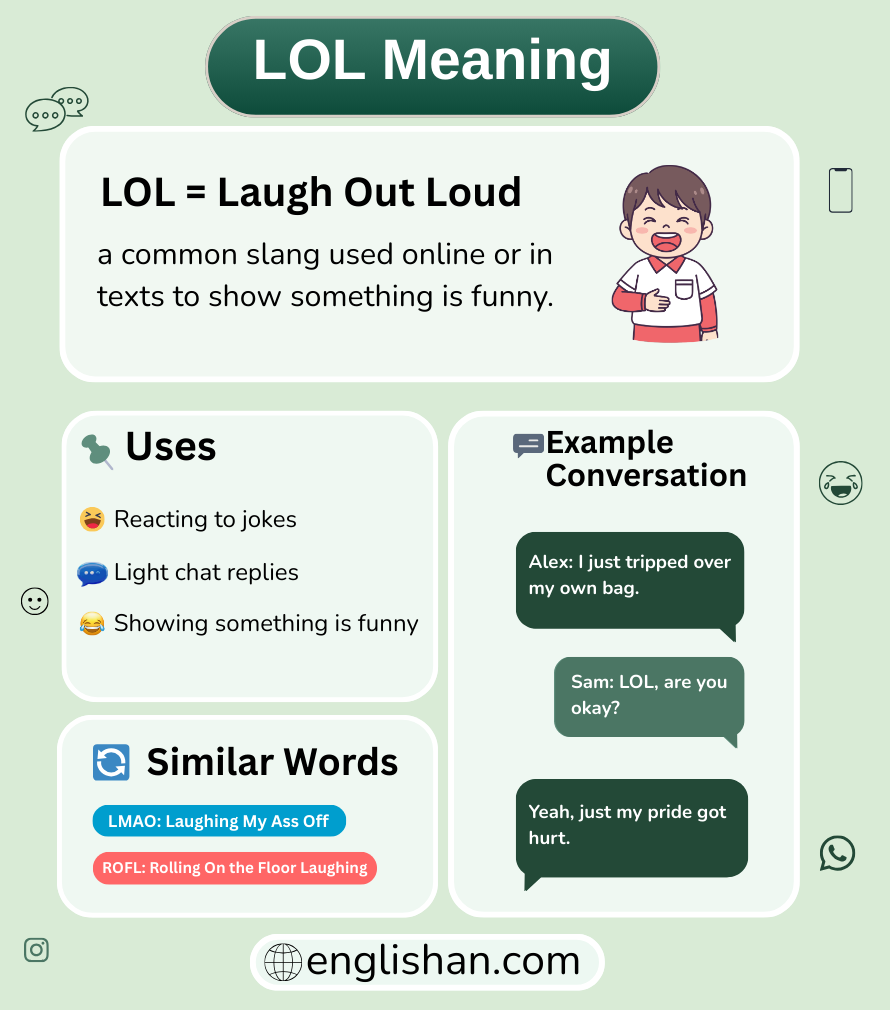
What Does LOL Stand For?
This three-letter code stands for the phrase Laughing Out Loud. It serves as a direct textual substitute for the sound of laughter, which is missing in written messages. The abbreviation allows users to convey a physical reaction instantly without typing a full sentence.
When To Use LOL
People use this term in almost any casual digital setting to react to humor. It is also frequently used to soften the tone of a potentially harsh or serious message, making it feel more friendly. Users rarely use it in formal business emails unless the workplace culture is very relaxed.
LOL In Comments And Captions
On public posts, users type this acronym to show public appreciation for funny content. It serves as a quick shorthand for validation, showing the creator that their joke landed successfully. Influencers and friends alike use it to boost engagement on entertaining media.
LOL In Spoken Talk
Surprisingly, this digital term has crossed over into face-to-face speech. Some people say the letters “L-O-L” or pronounce it as the word “lawl” to verbally acknowledge something funny or ironic. This usage often carries a hint of sarcasm or dryness compared to real laughter.
LOL Example Conversations
Here are a few ways friends use this slang to react to jokes and ease tension.
Jordan: I just tripped over my own feet in the middle of the hallway.
Casey: LOL that sounds exactly like something you would do.
Sam: Are you actually going to wear that hat to the party?
Taylor: No, I was just kidding LOL, it is way too ugly.
Alex: I accidentally sent a heart emoji to my boss.
Jamie: Oh no LOL, how are you going to explain that one?
LOL Origin
The term emerged in the early 1980s on pre-internet bulletin board systems (BBS) as a way to express laughter in text-only environments. It gained massive popularity through chat rooms in the 1990s and became one of the first pieces of internet slang to enter mainstream dictionaries. It has survived decades of digital change.
LOL Variations
Users have developed several creative spellings to match different distinct tones:
- Lul: A casual, often dismissive variation used in gaming.
- Lel: A playful or ironic version, often used on image boards.
- Lawl: A phonetic spelling that mocks the idea of laughing.
LOL Vs lol
The capitalization of this word drastically changes its perceived meaning. A capitalized LOL usually signals genuine, loud amusement or surprise at a good joke. In contrast, a lowercase lol is often just a casual sentence filler or a polite nod to a mild comment.
LOL Vs LMAO
While both terms express amusement, they differ in intensity and vulgarity. LOL is a standard, polite laugh, whereas LMAO (Laughing My Ass Off) implies a much stronger, gut-busting reaction. LMAO is also considered less appropriate for polite or mixed company.
LOL Vs ROFL
ROFL stands for “Rolling On the Floor Laughing” and represents a physical action that is more extreme than just laughing out loud. While LOL is for everyday humor, ROFL is reserved for hilarious moments that supposedly knock the user over. It is less common today than it was in the early 2000s.
LOL Key Takeaways
We have explored how this iconic acronym serves as the internet’s default laugh track. LOL stands for Laughing Out Loud and allows users to instantly share amusement or soften the tone of a digital message. While it has many variations, its core purpose remains connecting people through shared humor.
LOL FAQs
It stands for Laughing Out Loud and shows the sender thinks something is funny.
No, it is generally polite, but using it during serious moments is disrespectful.
Rarely; it usually functions as a polite signal of amusement rather than real laughter.
Avoid it in formal emails; it is too casual and may seem unprofessional.
You can say the letters “El-Oh-El” or pronounce it as the word “Lawl.”
You May Also Like