A discussion pops up, and everyone has something to say. You want to share your thought without sounding pushy or shutting others down, so you add a small signal before your comment and hit send. That small signal can turn a potential argument into a conversation.
Online, IMHO is a quick way to soften what you are about to say. It stands for in my honest opinion, letting readers know you are sharing a personal view, not stating a fact. It says: this is my genuine take, not a challenge. That is why it often keeps replies calmer and more open.
Here, we will explain IMHO meaning and how people use it in chats, comments, and threads without sounding heavy handed. You will see how it fits into sentences, short exchanges, and similar phrases. By the end, you will know when it feels natural to use and how it shapes the tone.
IMHO Meaning
This internet slang term signals that a statement is a personal viewpoint rather than a hard fact. Users add it to the beginning or end of a sentence to sound less aggressive or authoritative. It functions as a digital courtesy marker to show modesty during debates or feedback sessions.
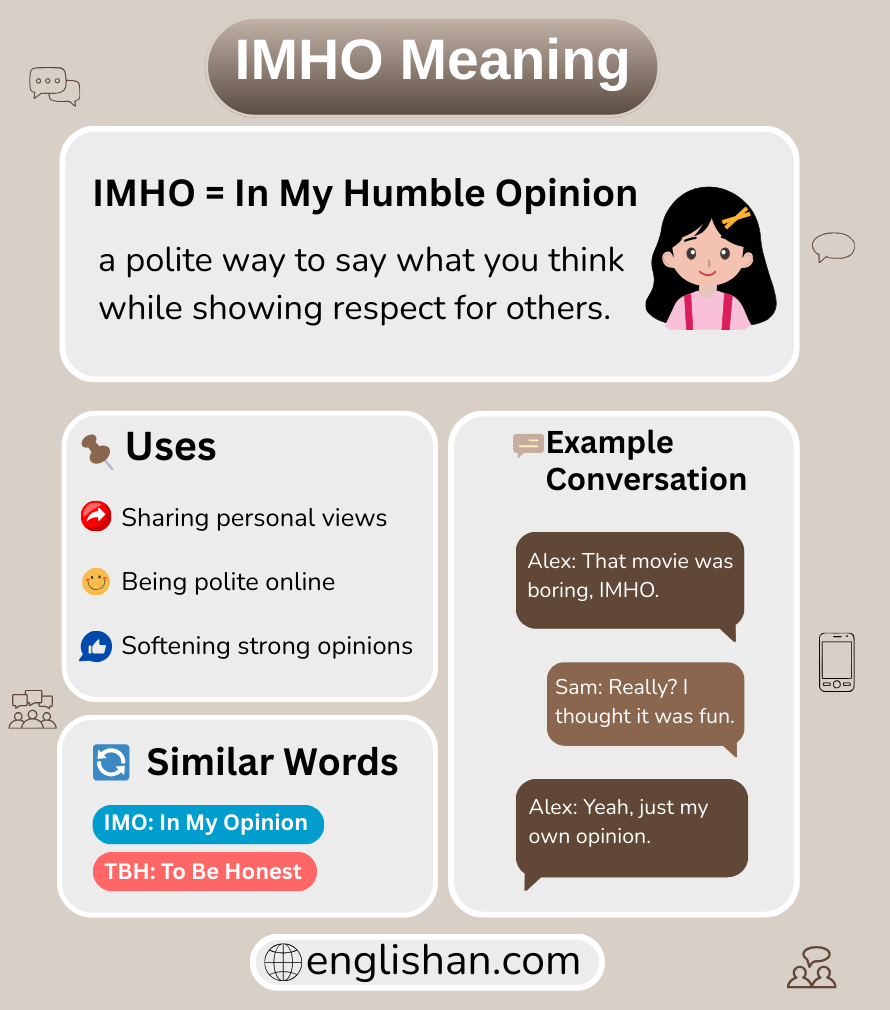
What Does IMHO Stand For?
The acronym most commonly represents the phrase In My Humble Opinion. The word “Humble” differentiates it from a standard opinion by adding a layer of politeness. This full form indicates the speaker acknowledges they might be wrong or that others may disagree.
How To Use IMHO
People place this abbreviation in forums or comments when disagreeing with someone to avoid starting a fight. It helps to soften the impact of a critique or a controversial statement. By using it, the writer invites open discussion rather than shutting down the conversation.
IMHO Meaning In Text Messages
In direct messaging, this tag serves as a quick disclaimer that the following text is just a subjective viewpoint. Friends use it when offering advice on sensitive topics like relationships or fashion. It assures the reader that the advice is well-meaning and not a command.
When To Avoid IMHO
Writers should skip this slang in formal business reports or when stating proven facts. Using it in these settings can make the speaker appear unsure or lacking in confidence. It is better to state the facts directly without the qualifier of modesty in professional documents.
IMHO Example Conversations
These dialogues show how friends and colleagues use the term to offer advice without sounding bossy.
Jordan: I am thinking about buying that red jacket we saw yesterday.
Casey: IMHO, the blue one matched your style much better.
Jordan: You might be right, the red was a bit bright.
Casey: It is your choice, but the blue one was classic.
Alex: This report is ready to send to the client, right?
Sam: I read through it, and IMHO the conclusion is a little weak.
Alex: Okay, I will add some more data points to strengthen it.
Sam: That sounds like a good plan.
Taylor: I cannot believe the movie ended like that.
Jamie: It was definitely a shock, but imho it fit the story perfectly.
Taylor: I just wanted a happier ending for the main character.
Jamie: I get that, but the tragedy made it memorable.
Origin Of IMHO
The term emerged during the era of early internet forums and bulletin board systems in the 1980s. Tech-savvy users adopted it to navigate heated text-based debates without causing offense. It has remained a staple of online etiquette for decades due to its utility in tone management.
Common Confusions About IMHO
Some readers mistake the tone of this tag as purely sarcastic or passive-aggressive. While it can be used that way, the primary intent is usually genuine politeness. Misreading the intent of the sender often leads to unnecessary arguments in comment sections.
IMHO Vs IMO
The shorter version, IMO, stands for “In My Opinion” and lacks the specific note of humility. IMO is faster and more direct, while the added “H” in IMHO adds modesty to the statement. Users choose the longer version when they want to be extra careful about feelings.
IMHO Humble Or Honest?
While “Humble” is the original and most common definition, some users interpret the “H” as In My Honest Opinion. This variant changes the tone from modest to frank or even blunt. Context usually reveals whether the speaker is trying to be polite or brutally truthful.
Other Related Slang Words Like IMHO
Digital communication relies on several acronyms to clarify the intent behind a message.
- IMO: The standard form meaning In My Opinion.
- TBH: Stands for To Be Honest, often used before a frank admission.
- JMHO: Adds “Just” to the phrase for extra minimization.
Key Takeaway
We use the slang term IMHO to soften our opinions and show respect for other viewpoints. It stands for In My Humble Opinion and acts as a buffer against conflict in online discussions. While sometimes interpreted as “Honest,” the primary usage remains focused on modesty and politeness. By using this acronym, we contribute to a more civil and open exchange of ideas in digital spaces.
FAQs
No, it is generally considered polite because it frames a statement as a humble opinion rather than a fact. However, using it sarcastically can seem condescending.
Yes, most people write it in all caps, but lowercase “imho” is acceptable in casual texting. Both forms carry the same meaning.
It depends on the company culture. It is fine for casual internal chats but avoid it in formal emails or client presentations.
It traditionally stands for “Humble,” which implies modesty. However, some people use it to mean “Honest” when they want to be blunt or direct.
No, while it is an older term, it is still widely used in forums, Reddit, and text messages. It remains a standard part of internet vocabulary.
You May Also Like