ISTG meaning shows up when someone wants their words taken seriously. In everyday messages, ISTG stands for I swear to God, used to show honesty, frustration, or strong feeling. You will see it in a text message, DM, or group chat when someone insists they are telling the truth or reacting to something shocking or annoying.
In this article, we explain ISTG meaning first, then how people use it in daily conversation. We look at moments of promise, anger, and disbelief, and then move into short examples that show when it sounds like a serious promise and when it is just emotional emphasis.
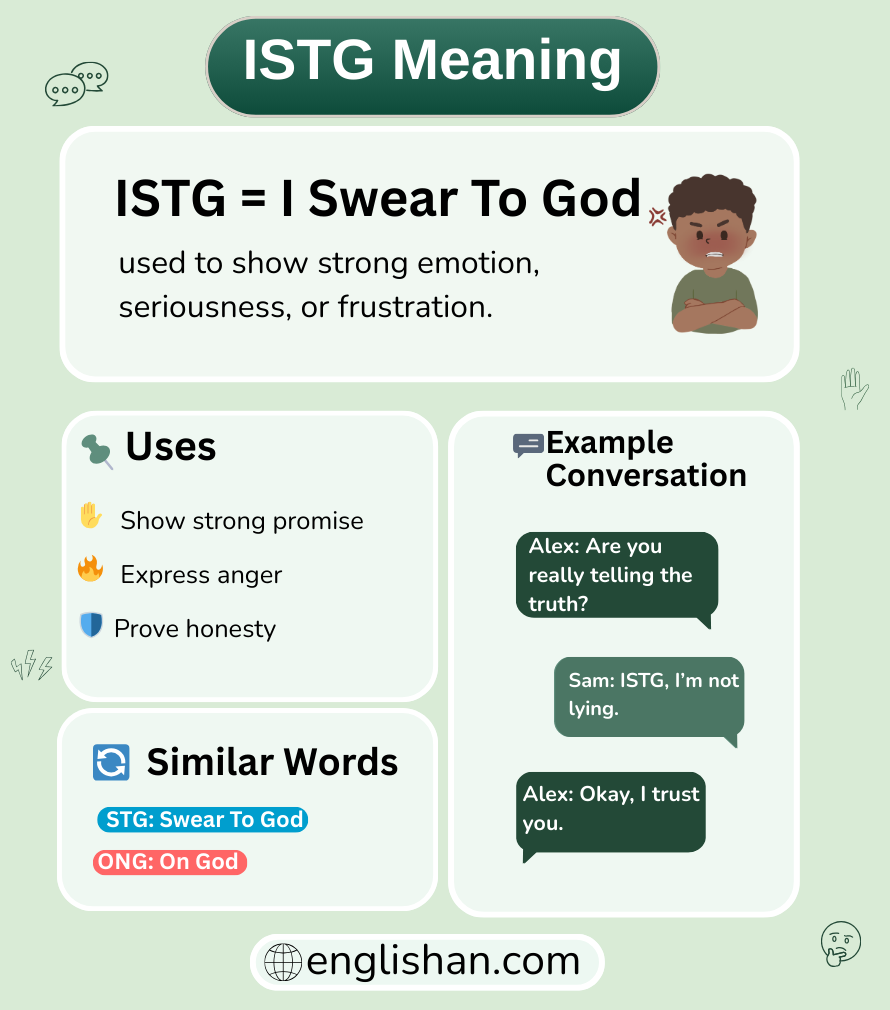
What Does ISTG Mean
The acronym ISTG functions as a powerful declaration of honesty and frustration. It signals that the speaker is being completely truthful about a situation, often because they feel others do not believe them. Writers use it to emphasize their sincerity or to vent annoyance when a situation becomes difficult to handle.
What Does ISTG Stand For?
This four-letter abbreviation stands strictly for the phrase I Swear To God. It grammatically acts as an interjection or an introductory clause at the start of a sentence. While the letters are usually capitalized for impact, they always represent this specific idiom used to assert truthfulness.
How ISTG Is Used In Texts And Social Posts
People type this slang to express annoyance with a persistent problem or to validate a surprising story. It often appears at the beginning of a message to set a serious tone before delivering the main point. You will see it used when someone is fed up with bad luck or trying to prove they are right in an argument.
When People Use ISTG
You should use this term when you feel your honesty is being questioned by friends or strangers. It is also appropriate when you need to vent about a situation that is testing your patience, like slow internet or a rude customer. It acts as a verbal shield against skepticism and a release valve for stress.
ISTG On TikTok
On this video platform, creators use the tag in relatable captions to describe universal struggles or funny mishaps. It often accompanies videos where the user is ranting about a specific pet peeve that the audience will understand. The acronym signals that the creator is not exaggerating the annoyance they feel.
ISTG On Snapchat
Users frequently add this text to photos of daily complaints, such as a pile of homework or a flat tire. It highlights the user’s exasperation with real-time events that are ruining their day. It signals to friends that the user is genuinely done with the situation shown in the snap.
How To Reply To ISTG
If someone sends this to you, the best response is to validate their feelings or acknowledge their truth. If they are venting anger, you should offer sympathy rather than arguing with them. If they are trying to prove a fact, simply agreeing with them usually ends the conflict.
Example Conversations Using ISTG
These dialogues demonstrate how friends use the term to emphasize truth and vent frustration.
Jason: Are you sure you locked the front door?
Mike: Yes, ISTG I turned the key twice.
Jason: Okay, I believe you.
Sarah: Why is this traffic moving so slowly?
Emily: ISTG we are going to be late for the movie.
Sarah: We should have left an hour earlier.
David: I didn’t eat your leftover pizza.
Jessica: You are the only one home.
David: ISTG it wasn’t me, maybe Dad ate it.
Origin Of ISTG
The abbreviation emerged during the early 2000s alongside the rise of SMS text messaging and instant messenger services. It was created to shorten the common expression “I swear to God” to fit within character limits and speed up typing. It has remained a staple of digital vocabulary because it conveys strong emotion with very few keystrokes.
Other Related Slang Words
These acronyms also express honesty or emotional intensity in digital conversations.
- STG: Swear To God. A shorter version of the phrase.
- ONG: On God. Used to swear truth on a higher power.
- OMG: Oh My God. Used to express shock.
Common Confusions
A frequent mix-up occurs with the similar acronym IG (Instagram or I Guess). Readers might misread the letters and think the writer is talking about a social media app instead of making a promise. Context usually clarifies this, as ISTG is almost always used to start a sentence about feelings or facts.
ISTG Vs STG
There is very little difference in meaning, but ISTG is often perceived as more personal. Adding the pronoun “I” makes the statement sound like a direct, individual pledge rather than a general interjection. STG is often more casual and used for simple agreement or verification.
ISTG Vs ONG
While both terms assert truth, ONG (On God) is typically used to express agreement or confirmation of someone else’s statement. ISTG is almost always used to defend one’s own statement or feelings. You say ISTG when you talk about yourself, and ONG when you agree with a friend.
Key Takeaway
We define this acronym as a common text abbreviation standing for “I Swear To God,” used to assert honesty or vent frustration. It serves as a digital promise that the speaker is telling the truth, often used when a story seems unbelievable or annoying. While extremely popular on social media for emphasizing complaints, users should be aware that it can sound aggressive or informal. Remember to use ISTG when you need to convince a friend that you are being serious about a situation.
FAQs
No, but some find “swearing to God” disrespectful in religious contexts.
It is too informal and emotional for professional emails.
Yes, it is usually written as ISTG to show intensity.
No, IG stands for Instagram. ISTG means “I Swear To God.”
It can be. It often implies frustration or anger.
You May Also Like