

MBN pops up under a vacation photo or new job message, and you are unsure how to read it. It usually means must be nice, a short reaction that can carry jealousy or sarcasm. You will see it in a DM, text message, group chat, Instagram comment, TikTok caption, or Snapchat reply.
In this article, we explain MBN meaning first, then how people use it when praising, teasing, or venting. The next examples show when it lands as friendly envy and when it sounds sharp, so you can respond without confusion.
What Does MBN Mean
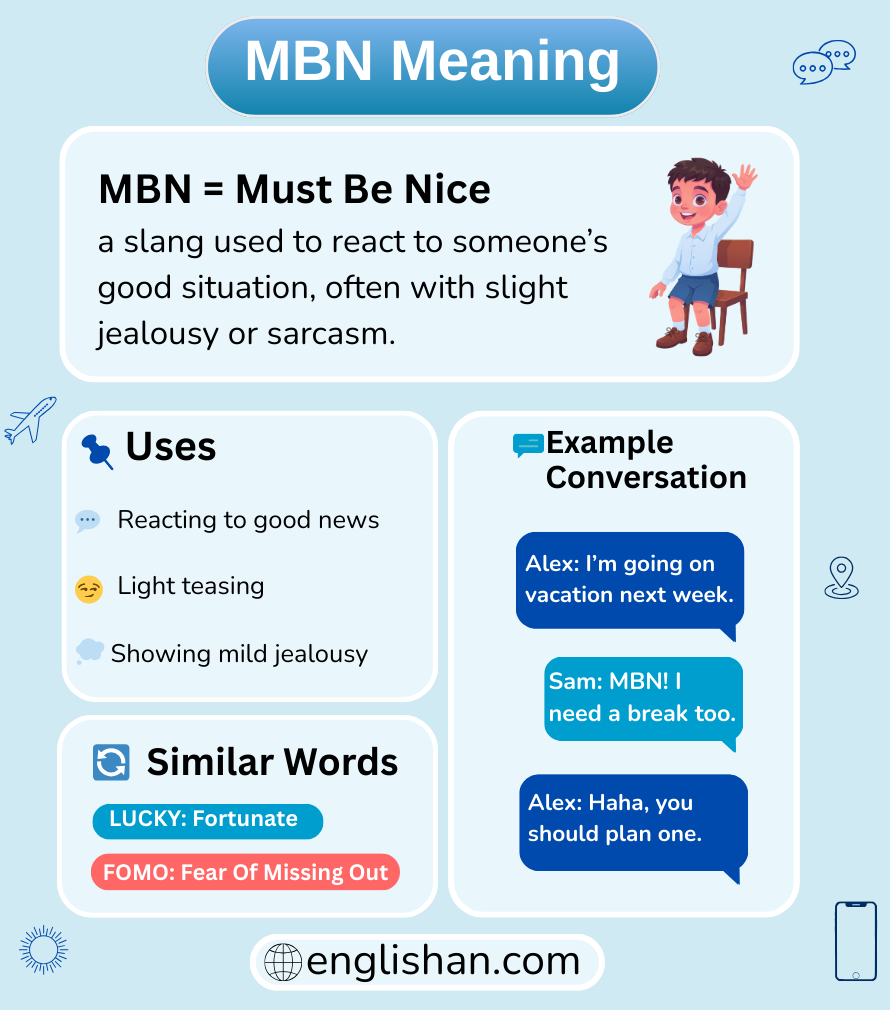
The acronym MBN serves as a reaction of envy or jealousy towards someone else’s good fortune. It acts as a comment on a situation where one person is enjoying a privilege or luxury that the speaker does not have. Writers use it to express that they wish they were in the other person’s shoes.
What Does MBN Stand For?
This three-letter abbreviation stands directly for the phrase Must Be Nice. It grammatically acts as an interjection or a standalone sentence fragment. While the letters are simple, they represent a complex mix of longing, judgment, and social comparison.
How MBN Is Used In Texts And Online Chats
People type this slang to respond to flexes or good news in a group chat. It is a common reply when someone sends a photo of a vacation view or mentions they are leaving work early. You will see it used to poke fun at friends who seem to have endless free time or money.
How MBN Is Used In Comments And Captions
On social media posts showing luxury items or travel, users comment “MBN” to acknowledge the high status of the content. It serves as a way to say “I am jealous” without typing a long sentence. Sometimes, users caption their own photos with it ironically when things are going wrong.
When People Use MBN
You should use this term when you want to playfully tease a friend about their luck. It is appropriate when a friend gets a day off that you do not have. However, avoid using it when someone shares a serious achievement they worked hard for, as it can minimize their effort by calling it “luck.”
How To Reply To MBN
If someone comments this on your post, the best response is usually to laugh it off or be humble. A reply like “I wish!” or “Just got lucky this time” defuses the tension. If the comment feels rude, ignoring it is often the best strategy to avoid an argument about privilege.
Example Conversations Using MBN
These dialogues demonstrate how friends use the term to express jealousy or sarcasm about good news.
Jason: I just found twenty dollars on the sidewalk.
Mike: MBN. I lost my wallet yesterday.
Jason: Sorry, I will buy you lunch with it.
Sarah: My parents are taking me to Hawaii for spring break.
Emily: MBN to be rich. I have to work all week.
Sarah: You can come with us next time!
David: I am so tired of eating steak every night.
Jessica: MBN. I am eating instant noodles again.
David: I didn’t mean to brag.
Origin Of MBN
The phrase “must be nice” has been a standard English idiom for decades, often used in working-class culture to comment on the wealthy. The acronym MBN became popular with the rise of text messaging and Twitter in the early 2010s. It condensed the sentiment of social envy into a quick, three-letter bite that fit perfectly in short-form content.
Other Related Slang Words
These terms also express jealousy or admiration for status.
- Goals: Used to say you want what they have.
- Flex: To show off wealth or status.
- Salt: Slang for being bitter or jealous.
- Jelly: A playful shortening of jealous.
Common Confusions
A frequent mix-up occurs with the medical abbreviation MBN (Medullary Breast Neoplasms) or business terms. In casual conversation, however, it almost always refers to “Must Be Nice.” Readers must look at the context; if the topic is health, do not assume it is slang.
MBN Vs MB
The acronym MB usually stands for My Bad (an apology), while MBN stands for Must Be Nice (an observation). Confusing them changes the meaning entirely from taking responsibility to expressing jealousy. “MB” admits a mistake, whereas “MBN” comments on someone else’s life.
Key Takeaway
We define this acronym as a common text reaction standing for “Must Be Nice,” used to express envy or sarcasm. It serves as a way to comment on someone else’s good luck, wealth, or privilege, often implying that the speaker wishes they had the same advantages. While it can be playful among friends, it frequently carries a passive-aggressive tone that suggests the other person has it too easy. Remember to use MBN sparingly to avoid sounding bitter about your friends’ success.
FAQs
It can be passive-aggressive, so use it carefully.
No, it strictly means Must Be Nice.
Yes, if said with a friendly tone, it acknowledges good luck.
You can write mbn or MBN; both are correct.
No, it is too informal and emotional for work.
You May Also Like