EOD means “end of day.” If you’ve ever wondered about EOD meaning in a work context, it’s used in a work email or Slack message to set a same-day deadline: finish this task, send this file, or reply to this thread before the workday ends. The abbreviation shows up in subject lines, project boards, status updates, and quick chat messages between colleagues who need a polite way to say today, not tomorrow.
What makes EOD tricky is the word day. For some teams, EOD means 5:00 PM in the sender’s time zone. For others, it stretches to midnight. For global remote teams, it can mean three different hours depending on who reads the message first. The abbreviation is short, but the interpretation varies by company, region, and workplace culture.
Outside the office, EOD crosses into casual texting as a borrowed work term. A friend texting “I’ll finish that playlist EOD” is using corporate shorthand as a joke deadline. In military contexts, EOD stands for something entirely different: Explosive Ordnance Disposal, the bomb-squad speciality.
What Does EOD Mean At Work?
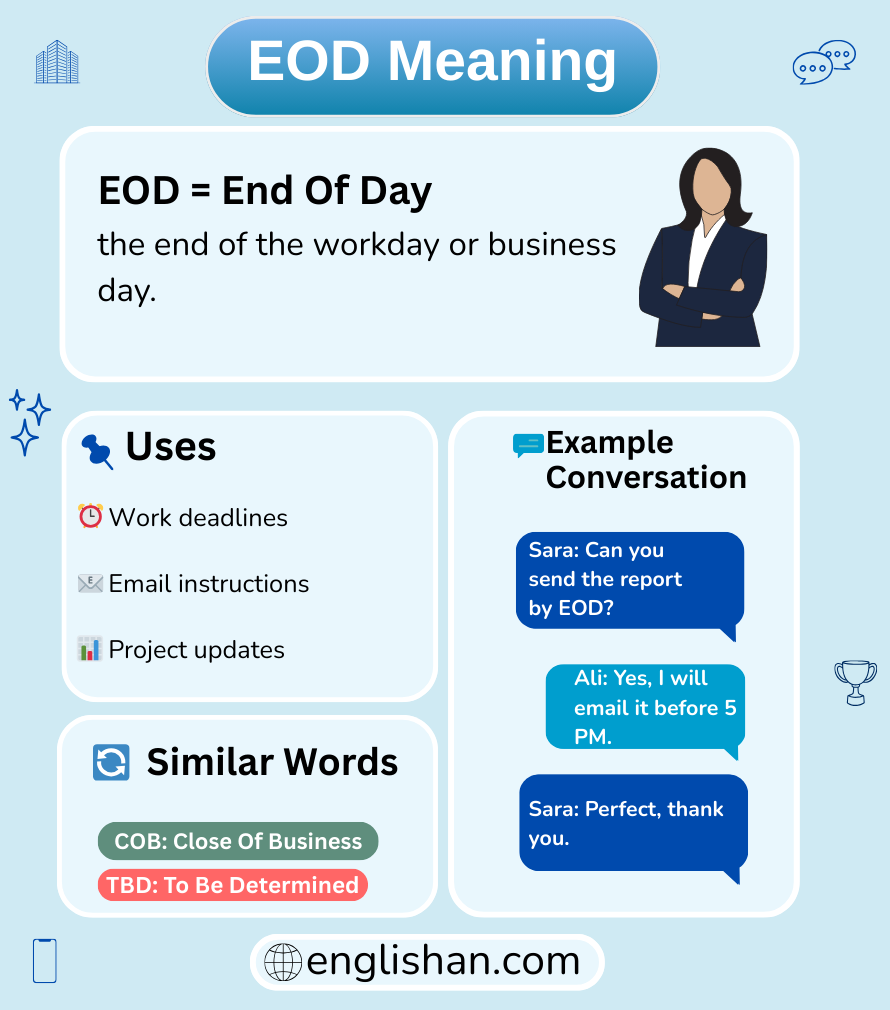
EOD stands for “End of Day” in workplace communication. The full form is sometimes written as “End of the Day” or read as “End of Business Day,” but the standard abbreviation is always EOD. It tells the recipient that a task, deliverable, or reply is expected before the current workday finishes.
The abbreviation works as both a deadline marker and a time reference. As a deadline: “Please send the revised draft by EOD.” As a time reference: “I’ll be in meetings until EOD, then I’m free.”
One detail worth noting early: EOD is professional shorthand, not formal business language. It appears in internal emails, team chats, and project tools. It doesn’t appear in contracts, legal documents, client-facing proposals, or board presentations. In those settings, professionals write “by the close of business on Friday, July 11” or “by 5:00 PM EST.”
What Time Is EOD? The Time-Zone Problem
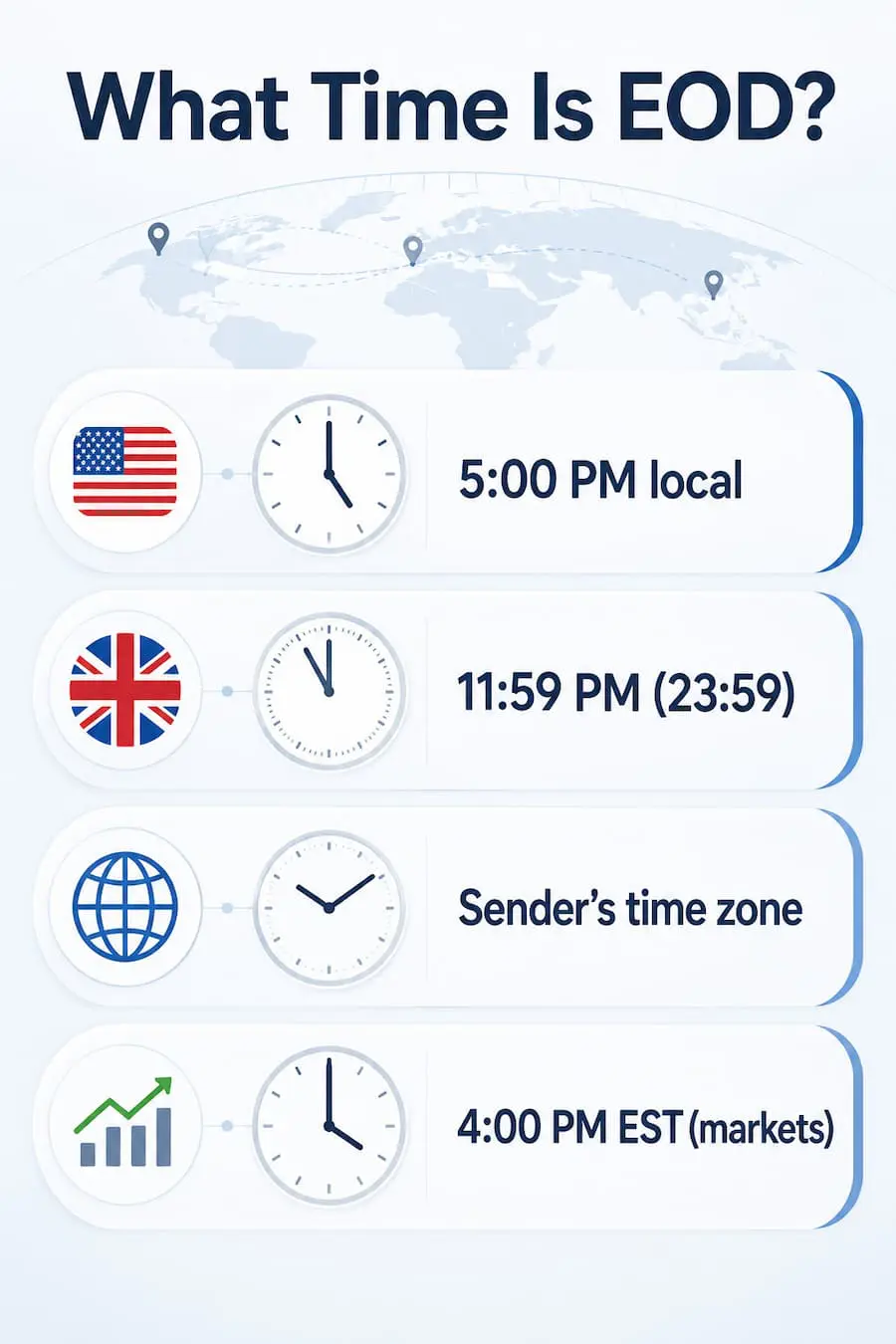
EOD doesn’t name a fixed hour. That’s the source of most confusion around the term.
In the United States, EOD in a business context typically means 5:00 PM in the sender’s local time zone. Most American companies treat EOD and “close of business” as roughly interchangeable, both pointing to the end of the standard 9-to-5 workday.
In the United Kingdom, EOD can stretch later. Wikipedia’s “End of day” entry notes that UK usage often treats EOD as 23:59, the literal end of the calendar day, not the end of business hours. This distinction catches cross-Atlantic teams off guard.
In global remote teams, EOD becomes genuinely ambiguous. A manager in New York writing “send it by EOD” to a developer in Bangalore is setting a deadline five hours behind the developer’s local evening. Without a time-zone tag, the developer has to guess whose end of day applies.
The best practice from Vidyard and Indeed: when EOD crosses time zones, add the specific hour and zone. Write “by EOD (5:00 PM EST)” or “by end of day Friday, 6:00 PM GMT.” The three extra words eliminate every misread.
| EOD interpretation | Where it applies | Typical time |
|---|---|---|
| End of business hours | US corporate default | 5:00 PM sender’s local time |
| End of calendar day | UK convention, some global teams | 23:59 local time |
| End of sender’s workday | Remote and flexible schedules | Varies by individual |
| Market close | Financial trading | 4:00 PM EST (US markets) |
If your team has never discussed what EOD means internally, the safest move is to ask once and settle it. One Slack message saves months of missed deadlines.
How To Use EOD In An Email Or Slack Message
EOD works as a deadline tag attached to a request, a promise, or a status update. The placement depends on the formality of the channel.
In an email subject line: “Q3 forecast, needed by EOD Friday”
In the body of a work email: “Hi Sarah, could you send me the updated deck by EOD today? I need it for tomorrow’s meeting.”
In a Slack or Teams message: “@design can someone review the mockups? Need feedback by eod”
In a project board (Asana, Trello, Jira): Due date label: “EOD July 11”
As a promise rather than a request: “I’ll have the revisions back to you by EOD.”
With a time-zone clarification (best practice): “Please submit final numbers by EOD (5:00 PM EST) so finance can process them overnight.”
“Updated deck attached, sent before EOD as promised.” ✅
“Here’s the deck.” (sent at 11 PM with no prior deadline context) ❌
The first version confirms the deadline was met. The second arrives late without acknowledging the gap. When someone gives you an EOD deadline and you deliver, name it.
EOD Vs COB Vs EOB: What’s The Difference?
Three abbreviations point to the same general concept, the end of the workday, but each one carries a slightly different scope and formality level.
| Term | Full form | What it means | Formality | Time-zone anchor |
|---|---|---|---|---|
| EOD | End of Day | End of the workday, flexible | Semi-formal | Sender’s local time zone |
| COB | Close of Business | End of the standard business day | More formal | Often defaults to 5:00 PM EST (US markets) |
| EOB | End of Business | Same as COB | Formal | Same as COB |
| COP | Close of Play | End of the trading day | UK / financial | London market close |
| EOP | End of Play | Same as COP | UK / informal | Same as COP |
The real difference between EOD and COB: COB originally referred to the close of the New York financial markets at 4:00 PM EST (or 5:00 PM EST for the broader business day). Because of that Wall Street anchor, COB carries an implied EST time zone even when the sender is in a different zone. EOD is looser and defaults to the sender’s own time zone without the financial-markets connotation.
In practice, most American offices treat EOD and COB as interchangeable. The distinction matters most in finance, in legal deadlines, and in cross-time-zone communication where the EST anchor of COB provides a fixed reference point that EOD doesn’t.
COP and EOP are the British equivalents. Close of play borrows from cricket terminology and means the same thing: when work stops for the day. You’ll see COP in UK corporate emails and EOP in UK informal messages.
How To Reply When Your Boss Says EOD
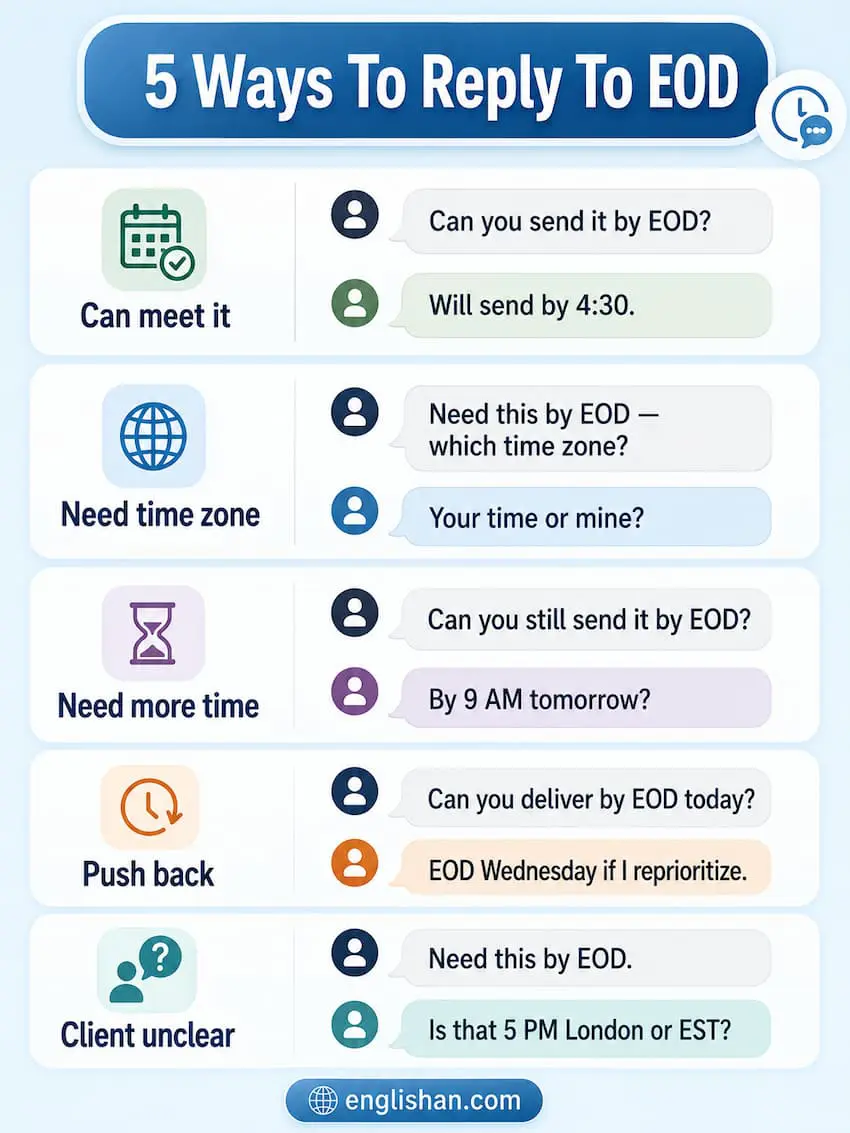
The right response depends on whether you can meet the deadline, need clarification, or need to push back.
1. You can meet it, so confirm cleanly:
Boss: Can you send me the client summary by EOD?
You: On it, will send by 4:30.
Naming a specific time inside the EOD window signals reliability. “By EOD” as a reply is fine, but “by 4:30” is better.
2. You need to clarify the time zone:
Boss: Need the data by EOD Friday.
You: Confirmed. Just to check, EOD your time or mine? I’m three hours behind.
Never guess on time zones. One question prevents a missed deadline.
3. You can’t meet EOD but can deliver early next morning:
Boss: Final version by EOD please.
You: I’m close but won’t have it polished by 5. I can send a clean draft by 9 AM tomorrow if that works?
Offering a specific alternative time is always stronger than a bare “I can’t.”
4. You need to push back on the deadline itself:
Boss: Run the full audit and send by EOD.
You: The full audit takes about six hours and I’m midway through the Henderson deliverable. I can have it by EOD Wednesday if I start tomorrow morning. Want me to reprioritize?
Frame the pushback around workload and offer a concrete counter-deadline.
5. A client says EOD and you’re unsure what time they mean:
Client: We’ll need the proposal by EOD.
You: Absolutely. Just to confirm, is that 5 PM your time in London, or end of day in our office (EST)?
With clients, precision protects the relationship. Asking once is professional. Missing the deadline because you guessed is not.
Real EOD Conversations At Work And In Texts
Five exchanges across different settings.
Deadline request in email (manager to employee):
Lisa: Hi Tom, could you send me the updated numbers by EOD? Finance needs them for the board deck.
Tom: Will do. I’ll have them over by 4 PM.
Status update in Slack (team channel):
@dev-team: Sprint review notes are in the shared doc. Please add your comments by eod so I can compile before standup tomorrow.
Cross-time-zone check (remote team):
Priya: David, the design specs say EOD, is that London EOD or New York EOD?
David: Sorry, should have specified. 5 PM EST, so 10 PM your time. If that’s too late, tomorrow morning works too.
Casual text between friends (borrowed corporate term):
Sam: you finishing that album ranking today?
Mike: yeah I’ll send it eod lol
Sam: bro you’re not my manager 😂
End of Discussion use (online forum):
@user1: The original trilogy is better than the prequels and that’s EOD.
@user2: you say EOD but I have three paragraphs ready
The “End of Discussion” shape is a niche internet use, mostly on Reddit, X, and gaming forums. The speaker declares the argument over. It works as punctuation on an opinion, not as a deadline.
Where EOD Came From
EOD started on trading floors. Financial markets needed a precise term for the moment when trading stopped and accounts reconciled. In the US, that meant 4:00 PM EST for the stock markets, with the broader business day closing at 5:00 PM. End of day named that boundary.
From trading desks, the term moved into general corporate email through the 1990s and early 2000s. As email replaced phone calls for internal communication, professionals needed fast, compact deadline language. EOD, COB, and EOB all spread during this period, with EOD becoming the most common because it was the shortest and the most self-explanatory.
By the 2010s, EOD had crossed into project-management tools (Asana, Trello, Jira) and team-chat platforms (Slack, Microsoft Teams). The abbreviation now appears in status updates, sprint boards, and automated deadline reminders. It has also drifted into casual texting, borrowed as a humorous deadline among friends who spend enough time in corporate environments to find the term funny outside them.
Does EOD Also Mean “End Of Discussion”?
In online forums, Reddit threads, X posts, and gaming chat, some users repurpose EOD to mean “End of Discussion.” This is a rhetorical move, not a deadline. The speaker declares that the argument is over and they won’t respond to further challenges.
“LeBron is the GOAT and that’s EOD.” “We’re not changing the release date. EOD.”
The usage is niche. In any workplace email, Slack message, or project board, EOD means End of Day. The “End of Discussion” reading only surfaces in casual online arguments where the context makes the meaning unmistakable.
Slang.net and ComputerHope both list “End of Discussion” as a secondary meaning, confirming it’s real but rare.
EOD In The Military: Explosive Ordnance Disposal
Outside offices and group chats, EOD carries a completely different meaning. In military contexts, EOD stands for Explosive Ordnance Disposal, the specialized field of locating, identifying, disarming, and disposing of explosive devices including bombs, landmines, IEDs, and unexploded ordnance.
Cambridge Dictionary lists this as its primary definition of EOD, ahead of “End of Day.” Dictionary.com’s usage citations for EOD lean heavily military, referencing bomb squads in Iraq, NATO training exercises, and Army EOD technicians.
The context signal is straightforward: if the conversation involves military operations, conflict zones, law enforcement bomb squads, or defence training, EOD means Explosive Ordnance Disposal. If the conversation involves a deadline, it means End of Day. The two meanings never collide in practice because their settings don’t overlap.
When To Write “End Of Day” Instead Of EOD
EOD is workplace shorthand. It works inside a team that already knows the term. It breaks down in four situations where writing the full phrase (or a specific time) is the stronger choice.
With new clients or external partners: A first email to a client you haven’t worked with should spell out “end of day” or give a specific hour. EOD assumes shared vocabulary that a new relationship hasn’t built yet.
In contracts and legal documents: Deadlines in contracts need specific dates and times, not abbreviations. “By 5:00 PM EST on July 11, 2026” is enforceable. “By EOD” is not.
With colleagues who work in a different language: ESL colleagues in global teams learn abbreviations at different speeds. Writing “by end of day Friday” takes three extra words and removes all ambiguity.
In spoken conversation: Saying ee-oh-dee out loud in a meeting sounds stiff. “By end of day” or “by five o’clock” flows more naturally in speech.
The swap: use EOD in internal emails, Slack, Teams, and project boards where the team already shares the vocabulary. Use the full phrase or a specific time everywhere else.
FAQs
In most US workplaces, EOD means 5:00 PM in the sender’s local time zone. In the UK, EOD can stretch to 23:59 (the literal end of the calendar day). In global remote teams, it defaults to the sender’s time zone unless a specific hour is added. When in doubt, ask.
Nearly. Both refer to the end of the workday. COB (Close of Business) originally anchored to the 5:00 PM EST close of the New York financial markets, so it carries an implied EST time zone. EOD is looser, defaulting to the sender’s own time zone. Most American offices treat them as interchangeable.
Yes, for internal emails and team chats. EOD is standard vocabulary in most offices, especially in tech, finance, marketing, and project management. Avoid it in contracts, legal documents, client-facing proposals, and board presentations, where a specific date and time is expected.
Borrowed corporate shorthand. A friend texting “I’ll finish it eod” is using the abbreviation as a casual (often humorous) way of saying “by tonight.” The tone is self-aware: they know it sounds like a work email, and that’s the joke.
Explosive Ordnance Disposal. In military contexts, EOD refers to the specialized field of disarming and disposing of bombs, IEDs, landmines, and unexploded ordnance. Cambridge Dictionary lists this as its primary definition of EOD.
In online forums and casual chat, some users repurpose EOD to declare an argument closed: “That’s my take, EOD.” This is a niche internet use, mostly on Reddit, X, and gaming forums. In any workplace setting, EOD means End of Day.
Confirm the deadline with a specific time: “On it, will send by 4:30.” If you’re in a different time zone, ask whose EOD applies. If you can’t meet the deadline, offer a concrete alternative: “I can have it by 9 AM tomorrow if that works?”
You May Also Like