Someone ends a text with a short sign off that feels warm and personal. Just a quiet way of showing care without slowing the conversation. To some, it lands as habit. To others, it lands as heart.
Online, ILY stands for I love you. It appears between friends, partners, or family, sometimes light and playful, other times carrying real affection. It can be offered freely, returned warmly, or simply received. Each moment carries its own weight.
This guide explains what ily means and how it shows up in texts, comments, and messages. By the end, you will know when it fits and how to read it with confidence.
What Does ILY Mean?
The acronym ILY is a direct abbreviation for the phrase I love you. It serves as a quick and convenient way to express affection to friends, family, or romantic partners in digital messages. Senders typically use it to end a conversation warmly or to reassure someone of their care.
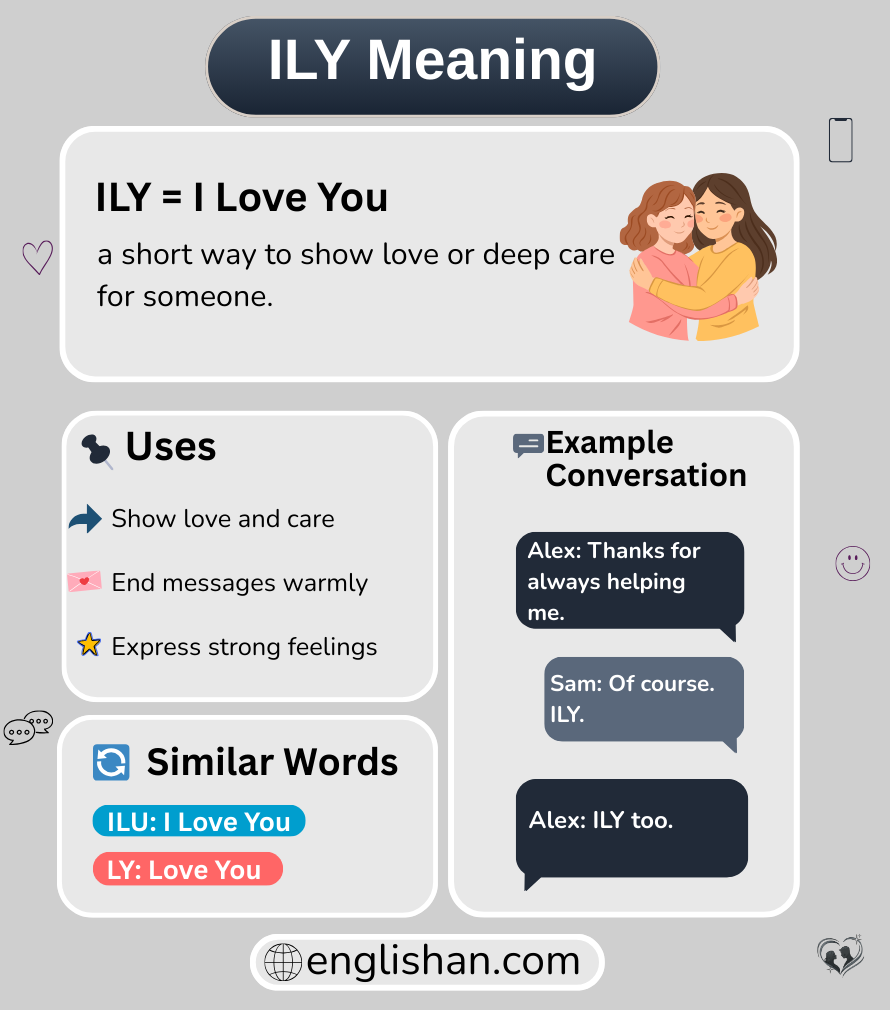
What Does ILY Stand For
This three-letter short form stands strictly for I Love You. While the capitalization can vary between uppercase and lowercase, the meaning remains a declaration of love. It functions grammatically as a complete sentence or a sign-off at the end of a text.
How And Where ILY Is Used
People use this term universally across text messages and social media comments to show support. It appears most often as a closing remark, similar to saying “goodbye,” but with more warmth. You will also see it used casually between close friends to appreciate a favor or a funny joke.
How To Reply To ILY
The most common response is to say ILY too or use the acronym ILYT (I Love You Too). If you are not ready to say it back, you can reply with a heart emoji or a friendly “you’re the best.” It is important to match the tone of the sender to keep the interaction comfortable.
ILY Examples And Conversations
These exchanges demonstrate how family and partners use the term to say goodbye or express gratitude.
Mom: Have a great day at school, honey. Don’t forget your lunch.
Jason: Thanks Mom, I have it. See you later, ILY.
Mom: ILY too, be safe.
Sarah: Thank you so much for listening to me vent about my job.
Emily: Anytime, that is what friends are for. ILY.
Sarah: ILYT, you are a lifesaver.
David: I am heading to sleep now. Goodnight.
Jessica: Goodnight, sweet dreams. ILY.
David: ILY more.
ILY Origin
The abbreviation emerged in the early 2000s alongside the rise of SMS text messaging. Users adopted it to save keystrokes and fit their messages within strict character limits on old phones. It quickly became a standard part of internet vocabulary as a quick way to express affection.
Common ILY Confusions
A frequent misunderstanding is thinking that ILY carries the same serious weight as saying the full phrase “I love you.” Many people view the acronym as more casual and less intense than spelling it out. Partners might feel hurt if they expect a verbal declaration and only receive the abbreviation.
ILY Vs ILU
Both acronyms mean exactly the same thing, but ILY is more common in modern texting. ILU (I Love U) was popular in older internet slang but can look a bit dated today. Most users prefer ILY because it looks cleaner and is more widely recognized.
ILY Vs ILYSM
The addition of “SM” changes the meaning to I Love You So Much. This variation adds emphasis and intensity to the original statement. It is often used when someone does a big favor or when the sender is feeling particularly emotional.
ILYT Meaning
This extension stands for I Love You Too. It is the standard, reciprocal response when someone sends you an ILY message. Using this acronym saves time while still politely returning the affection.
Other Related Slang Words
These terms also help express care and affection in short messages.
- ILYSM: I Love You So Much. Used for extra emphasis.
- LY: Love You. A more casual, shortened version of ILY.
- XOXO: Hugs and Kisses. A classic sign-off for affection.
- BAE: Before Anyone Else. Used to refer to a significant other.
Key Takeaways
We recognize this acronym as the universal digital shorthand for “I Love You,” used to express affection quickly. It functions effectively in both romantic and platonic contexts, often serving as a warm sign-off in text messages. While less formal than the spoken phrase, it remains a powerful tool for maintaining connection. Remember to reserve ILY for friends, family, and partners, avoiding it in professional or unfamiliar relationships.
FAQs
It is generally less serious than saying the full words. Many friends say it casually, so it doesn’t always imply deep romantic love.
Yes, it is very common to say it to close friends. It shows you value their friendship and support.
No, it never means that. It strictly stands for I Love You.
It might mean they are busy or casual. If it bothers you, ask them to say the full phrase sometimes.
You usually read it as the full phrase “I love you.” Some people might say the letters I-L-Y jokingly.
This term is extremely versatile and can be either romantic or friendly depending on the relationship. Between partners, it acts as a sweet reminder of love, while between friends, it signals strong platonic appreciation. The context and the person you are messaging define the nature of the feeling.
You May Also Like