Someone asks a small favor or a simple question, and the reply comes back right away without hesitation. Polite and reassuring, it feels like agreement was expected all along.
In everyday chats, OFC is short for of course. It shows agreement, confirmation, or willingness, often in a friendly or relaxed tone. Depending on context, it can sound warm, casual, or slightly confident, but it rarely adds extra explanation.
This guide explains ofc meaning across texts, comments, and quick replies. By the end, you will know exactly what it signals, how tone changes its impact, and when to use it so agreement feels smooth and appropriate.
What Does OFC Mean?
The acronym OFC means of course in digital communication. It signals strong agreement or confirms that a statement is obviously true without needing full sentences. People use it to answer yes to questions or to show they are on the same page as the sender.
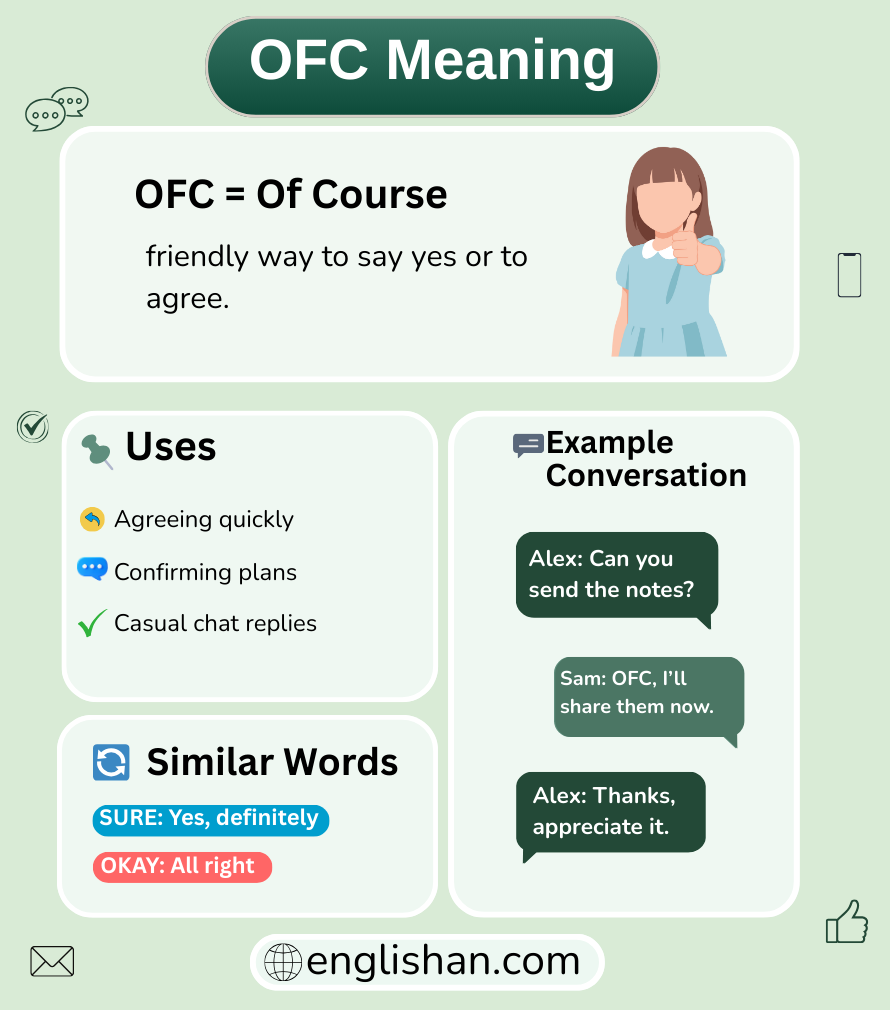
What Does OFC Stand For
This abbreviation strictly stands for Of Course. While it is sometimes capitalized for emphasis, the lowercase version is just as common in casual texts. It functions as a direct shorthand for the standard English phrase used in agreement.
How And Where OFC Is Used
Users type this abbreviation to provide quick confirmation or approval in fast-paced chats. It works well as a standalone reply to a request or as part of a sentence to emphasize certainty. The tone can shift from helpful to sarcastic depending on the context of the conversation.
OFC Examples And Conversations
These dialogues illustrate how friends and family use the term to agree or confirm plans.
Daniel: Are you still coming to the basketball game tonight?
Mike: OFC I am coming. I bought the tickets weeks ago.
Daniel: Just checking because it started raining.
Sarah: Do you think I should wear the blue dress to the party?
Emily: OFC you should. It looks amazing on you.
Sarah: Thanks, I was worried it was too bright.
Mom: Did you remember to feed the dog before you left?
Jason: OFC I did, Mom. I would never forget him.
Mom: Good, just making sure.
OFC Origin
This shorthand originated in early internet chatrooms and instant messaging platforms during the late 1990s and early 2000s. It developed alongside other common acronyms like LOL and BRB to save keystrokes on physical keyboards. The term gained broader popularity with the rise of SMS texting.
OFC Vs Of Course
The full phrase “of course” is formal and carries a sincere tone suitable for professional emails or serious discussions. The acronym is strictly casual and fits better in texts between friends. Writing the full words shows more effort and respect in sensitive situations.
Common OFC Confusions
A frequent mistake is confusing this text abbreviation with the fanfiction term Original Female Character. In creative writing communities, the acronym labels a new character invented by the author, but in general chat, it almost always means of course. Readers must look at the context to decide which definition fits.
Other Related Slang Words
These terms also express agreement or affirmation in digital messages.
- Sure: A standard word often used as a quick, neutral yes.
- Bet: A popular term meaning “yes” or “it’s a plan.”
- Def: Short for definitely, used to show strong certainty.
- K: A very short, sometimes passive-aggressive way to say okay.
Key Takeaways
OFC is a quick way to agree without dragging the conversation out. People use it to confirm plans, acknowledge something obvious, or respond fast when a full sentence feels unnecessary. Depending on tone, it can sound polite, relaxed, or lightly sarcastic. While it has other meanings in niche spaces, online it almost always works as a stand in for of course. It fits casual texts and chats best, where speed and ease matter more than formality.
FAQs
No, you should avoid using it in professional emails. It is too casual for business; use “certainly” or “of course” instead.
No, the standard meaning is harmless agreement. However, some might mistake the ‘F’ for a swear word if they are guessing.
People usually say the full phrase “of course” when reading it aloud. Some might spell out the letters O-F-C in casual speech.
Yes, it can imply a question was stupidly obvious. For example, “OFC the sky is blue” sounds rude and dismissive.
No, these are totally different words. OFF is a standard word, while OFC is an acronym for agreement.
The politeness of this term depends entirely on how it is used. If used to agree enthusiastically, it is friendly and casual. However, if used to dismiss a valid question as stupid or obvious, it can seem sarcastic and disrespectful.
You May Also Like