

Someone asks for your opinion, and you decide not to sugarcoat it. You answer plainly, but you want the other person to know you are being open, not rude.
Online, TBH is used before a statement to signal honesty. It comes from to be honest and often introduces a direct thought, a personal feeling, or a mild truth. People use it in casual chats, comments, and posts when they want to sound open and straightforward without adding tension. Used well, it builds trust. Used carelessly, it can feel like a setup for something harsh.
Here, we will explain tbh meaning and how it is used in everyday online conversations, including tone, common situations, and short examples. You will also see how TBH compares with similar expressions. By the end, you will know what it adds to a message and when it feels natural to use.
What Does TBH Mean?
TBH is an acronym used in digital communication to signal sincerity or a confession. Users include this short code to indicate that the following statement is their true feeling or a candid admission. It prepares the reader for an honest opinion that might be surprising or blunt.
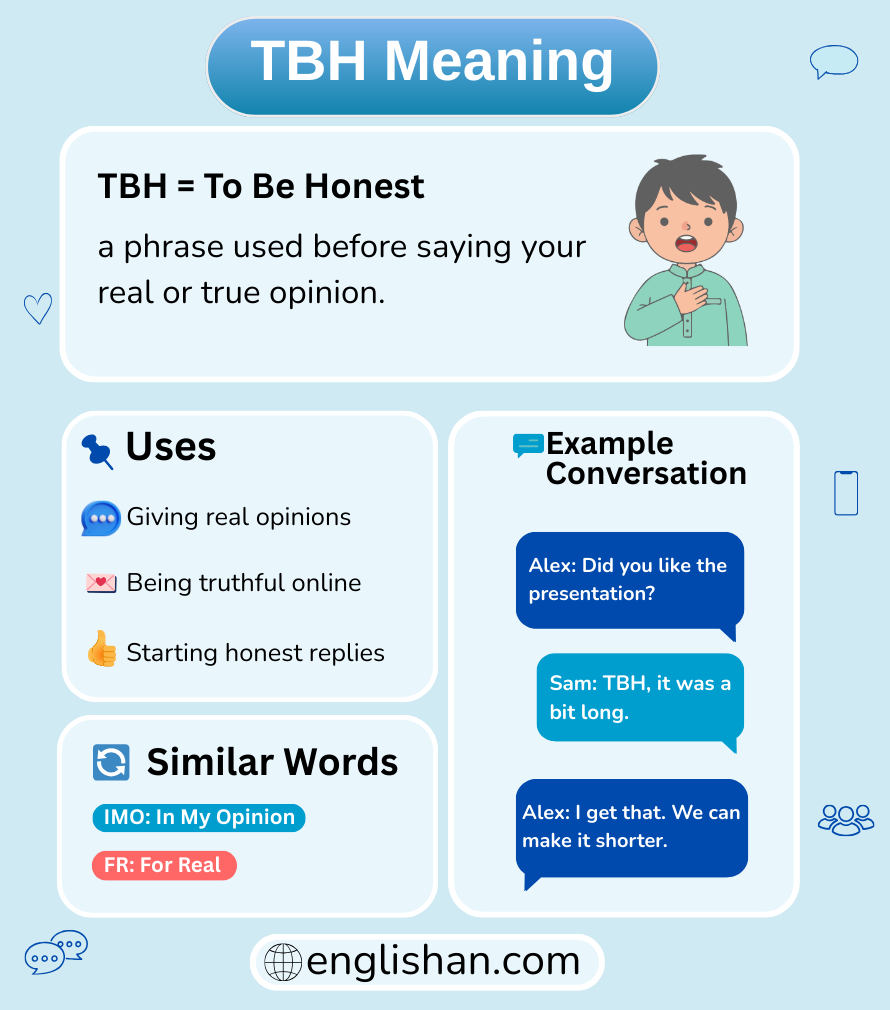
What Does TBH Stand For?
This common abbreviation stands for the phrase To Be Honest. It serves as a direct text replacement for the spoken phrase, allowing users to type faster while maintaining a conversational tone. The three letters function as a sentence starter or closer to emphasize truthfulness.
When To Use TBH
People generally use this term when they want to admit a flaw, give a real compliment, or disagree politely. It fits best in casual threads where the goal is to share feelings or clarify a stance. You might place it at the beginning of a sentence to warn the listener that a real truth is coming.
TBH In Chat
In fast-paced group chats or gaming servers, users type these letters to add emphasis to a quick opinion. It often serves as filler words similar to saying “frankly” or “actually” in speech. Here, it is less about a deep confession and more about stating a preference clearly.
TBH On Social Media
On public feeds, this acronym is frequently used to caption photos or status updates that share a personal view. It helps the post feel less curated and more like a genuine thought from the author. Influencers use it to connect with followers by sounding relatable and down-to-earth.
TBH Origin
The term originated in the early internet chat rooms of the 1990s and early 2000s alongside other common shortcuts. It developed because users needed a quick way to signal sincerity without typing out full phrases during rapid-fire conversations. It has remained a staple of digital vocabulary for decades.
TBH Example Conversations
Here are a few ways friends use this acronym to share honest thoughts.
Jordan: Do you think this shirt looks good on me?
Casey: No, TBH the color clashes with your pants.
Sam: I am really nervous about the presentation tomorrow.
Taylor: You will be fine, TBH you know the material better than anyone.
Alex: Why did you leave the party so early last night? Jamie:
TBH I was just really tired and wanted to sleep.
TBH Vs TBF
While both terms manage expectations, they serve different logical roles. TBH focuses on personal honesty, while TBF (To Be Fair) introduces a counterpoint to balance an argument. TBF is about objective fairness, whereas TBH is about subjective truth.
TBH Vs IMO
These two acronyms are similar but have slight differences in authority. TBH implies you are revealing a hidden truth, while IMO (In My Opinion) simply marks a personal belief. IMO is softer and less assertive than claiming to be “honest.”
TBH Key Takeaways
We have explored how this versatile acronym helps users express sincerity in a digital world. TBH stands for To Be Honest and acts as a verbal signal that the speaker is dropping a filter to say what they really think. Whether used to confess a crush or critique a movie, it bridges the gap between casual chat and real feelings.
TBH FAQs
In texting, TBH stands for To Be Honest and signals a sincere statement.
No, TBH is not a bad word; it is just a phrase to emphasize truth.
This is a social game where someone gives an honest opinion and a number rating of you.
Avoid TBH in work emails; use full phrases like “To be candid” or “Frankly” instead.
This combination means “To Be Honest, I Don’t Know,” admitting a lack of knowledge.
Using this term is not inherently rude, but it depends entirely on the statement that follows. If used to deliver an unsolicited insult, it can come across as blunt or mean-spirited. However, when used to share a vulnerability or a compliment, it is polite and bonding.
You May Also Like