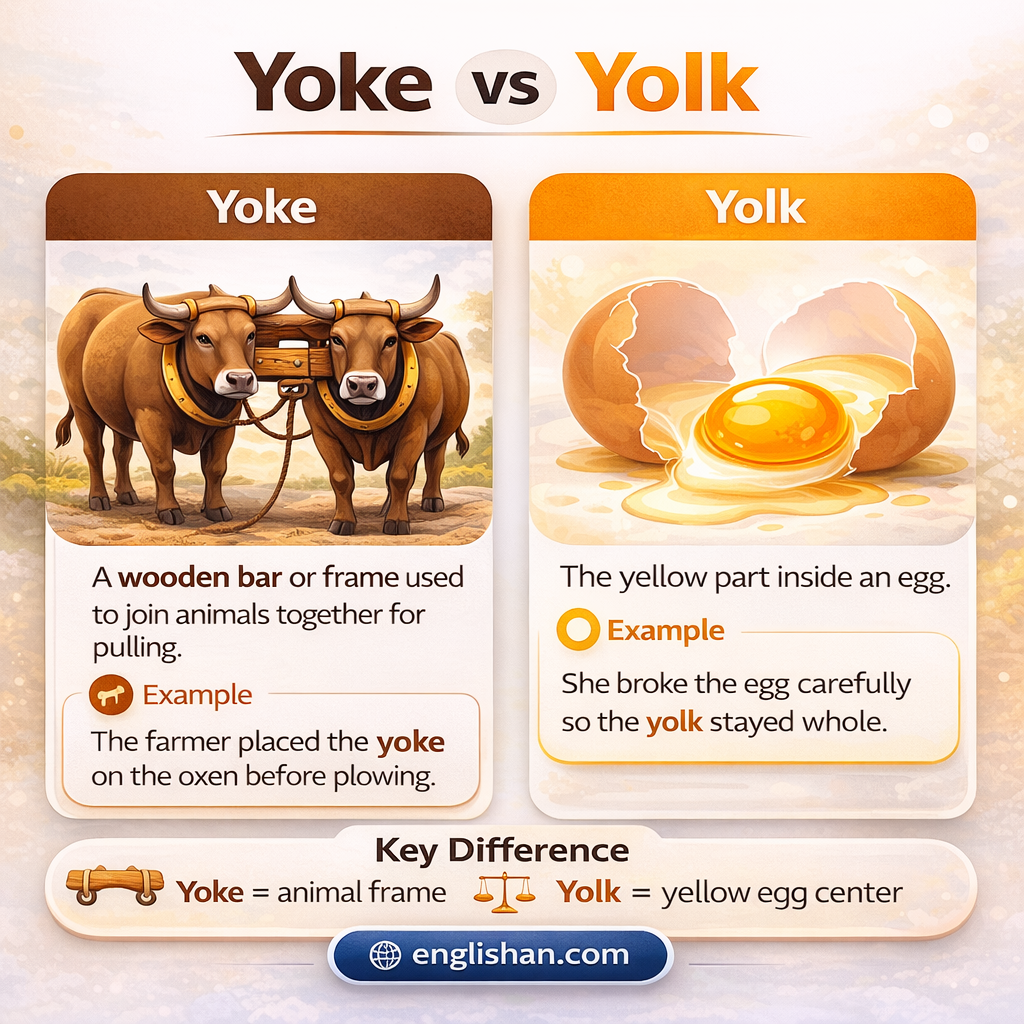
Many people confuse yoke and yolk because they sound exactly alike, but they point to very different things. Yoke refers to a device used to join animals for work and can also suggest burden or control in figurative language. Yolk is the yellow center of an egg.
That difference makes yoke vs yolk much easier once the meanings are separated. One belongs to farming, history, religion, and literary use, while the other belongs to cooking, food, and biology. This article explains what each word means, how each one is used, and how to remember the right spelling.
Yoke vs Yolk: Quick Answer
Here is the quickest way to tell them apart:
| Word | Main Meaning | Part of Speech | Common Context | Example |
|---|---|---|---|---|
| yoke | a joining bar, burden, bond, or act of linking | noun, verb | farming, history, figurative writing | The oxen pulled under a yoke. |
| yolk | the yellow center of an egg | noun | cooking, food, biology | The recipe needs one egg yolk. |
If the sentence is about animals, joining, burden, or control, use yoke.
If it is about eggs, cooking, or nutrition, use yolk.
What Does Yoke Mean?
Yoke can be used as both a noun and a verb.
As a noun, a yoke is traditionally a wooden bar or frame placed across the necks of two animals, usually oxen, so they can pull a plow, cart, or other heavy load together.
Over time, the word also developed figurative meanings. Because of that, yoke can describe a burden, a form of control, or a close bond that joins people, groups, or ideas.
Yoke as a Noun
- The farmer placed a heavy yoke across the oxen’s necks.
- They struggled under the yoke of heavy debt.
- The speech described poverty as a yoke on working families.
Yoke as a Verb
As a verb, to yoke means to join, harness, bind, or connect.
- The farmer yoked the oxen together before sunrise.
- The writer yoked memory and loss together in a single image.
- The project yoked two different teams to the same goal.
In both literal and figurative writing, yoke carries the idea of joining, binding, or burden.
What Does Yolk Mean?
Yolk is a noun in standard modern English.
A yolk is the yellow center of an egg. It contains much of the egg’s fat, nutrients, and flavor, which is why it matters so much in cooking. In biology, the yolk also nourishes a developing embryo in a fertilized egg.
Examples of Yolk
- Separate the yolk from the egg white.
- The sauce becomes richer when you add an extra yolk.
- The baker whisked the yolk into the warm filling.
- In biology class, we learned that the yolk provides nutrients to the embryo.
Parts of Speech and Pronunciation
One of the simplest grammar rules in this pair is this:
- yoke can be a noun or a verb
- yolk is used as a noun
Examples:
- Noun: The oxen moved slowly under the yoke.
- Verb: The farmer yoked the animals together.
- Noun: The chef added one egg yolk to the mixture.
These two words are also pronounced the same in standard English: /joʊk/.
That makes them homophones, which means they sound alike but have different meanings and spellings. When you write them, context matters more than pronunciation.
How to Use Yoke and Yolk Correctly
Use yoke when the sentence is about:
- a wooden bar joining animals
- a burden or oppressive control
- a bond or joining force
- the action of linking or harnessing something
Use yolk when the sentence is about:
- eggs
- cooking
- baking
- nutrition
- biology
A simple test helps here. If the sentence could naturally include words like oxen, burden, control, or join, the spelling is usually yoke. If it could naturally include egg, recipe, baking, or protein, the spelling is usually yolk.
How to Remember Yoke vs Yolk
A quick memory trick can make this pair much easier to remember:
- yolk belongs in the kitchen and inside an egg
- yoke belongs in farming, history, or writing about a burden or bond
Another useful reminder is that egg yolk is a very common phrase. If you are writing about food, the spelling is almost certainly yolk.
Yoke and Yolk in Sentences
Seeing both words side by side helps the difference settle in naturally.
Sentences With Yoke
- The old wooden yoke rested beside the barn door.
- The farmer yoked the oxen before plowing the field.
- She spoke about the yoke of responsibility that came with leadership.
Sentences With Yolk
- The chef separated the yolk from the egg white.
- This cake recipe needs two egg yolks for a richer texture.
- The bright yolk gave the sauce its color and flavor.
Common Mistakes With Yoke and Yolk
Using yoke for the center of an egg
Incorrect:
The recipe calls for one egg yoke.
Better:
The recipe calls for one egg yolk.
Using yolk for an animal harness or burden
Incorrect:
The oxen were joined by a heavy yolk.
Better:
The oxen were joined by a heavy yoke.
Forgetting the figurative meaning of yoke
Some readers recognize yoke only from farming, but the word also appears in writing about power, duty, oppression, and close connection. If the sentence suggests a burden or binding force, yoke may still be the correct word even when no animals are involved.
Summary
Yoke and yolk sound the same, but they belong to very different meanings. Yoke refers to a joining bar, a bond, a burden, or the act of connecting things, and it can work as both a noun and a verb. Yolk refers to the yellow center of an egg and functions as a noun in standard modern usage. Once you connect yoke with joining or burden and yolk with eggs and cooking, the difference becomes much easier to remember.
FAQs
Yoke refers to a wooden bar, a harness, a burden, or the act of joining things together. Yolk is the yellow inner part of an egg.
The correct phrase is egg yolk. Yoke does not refer to any part of an egg.
Yes. Yoke can mean to join, harness, or connect two things, people, or animals together.
In standard modern English, yolk is used as a noun. It names the yellow center of an egg.
Yes. Yoke and yolk are pronounced the same, which is why they are often confused in spelling.
You May Also Like