Englishan-Logo-resized Englishan-Logo-resized
  • Home
  • Grammar
    • Parts of speech
    • Tenses
    • Worksheets
    • Example Sentences
  • Vocabulary
    • Picture Vocabulary
      • Animals
        • Insects
      • Foods
        • Fruits
      • Things
    • Words Lists
      • 5 Letter Words
      • Long Words
    • Vocabulary for Kids
    • Synonyms
    • Antonyms
    • Confused Words
    • Phrasal Verbs
  • English Composition
    • Applications
    • Essay Writing
    • Letters
  • Worksheets
    • Kindergarten Worksheets
  • Contact
Reading: Altogether vs All Together
Share
EnglishanEnglishan
Font ResizerAa
  • Home
  • Grammar
  • Vocabulary
  • English Composition
  • Worksheets
  • Contact
Search
Follow US
  • About
  • Contact
  • Privacy Policy
  • Terms of Service
Copyright © 2026 englishan.com All Rights Reserved.
Englishan > Confused Words > Altogether vs All Together
Confused Words

Altogether vs All Together

Narmeen Khan
By
Narmeen Khan
Last updated: February 15, 2025
4 Min Read
Altogether vs All Together – Key difference explained
Altogether vs All Together – Learn when and how to use each correctly.
SHARE

Many English learners confuse altogether and all together because they sound the same, but they have different meanings and uses. Altogether means “completely” or “entirely,” while all together refers to a group of things or people being in the same place or doing something at the same time. Learning the difference will help you use these words correctly in writing and speech. Improve your vocabulary by exploring more Confused Words.

In This Page
  • Meanings of Altogether and All Together
    • Altogether
    • All Together
  • Differences Between Altogether and All Together
  • Usage of Altogether
  • Usage of All Together
  • Formal and Informal Uses of Altogether and All Together
  • FAQs
    • 1. How do I remember the difference between altogether and all together?
    • 2. Can “altogether” and “all together” be used interchangeably?
    • 3. What is an example sentence using both words?

Meanings of Altogether and All Together

Altogether

Altogether (adverb) means completely, entirely, or in total.

Example Meaning:

  • The cost of the books was altogether $50. (In total)

All Together

All together (phrase) means everyone or everything in the same place or at the same time.

Example Meaning:

  • The family sat all together at the dinner table. (Everyone in the same place)
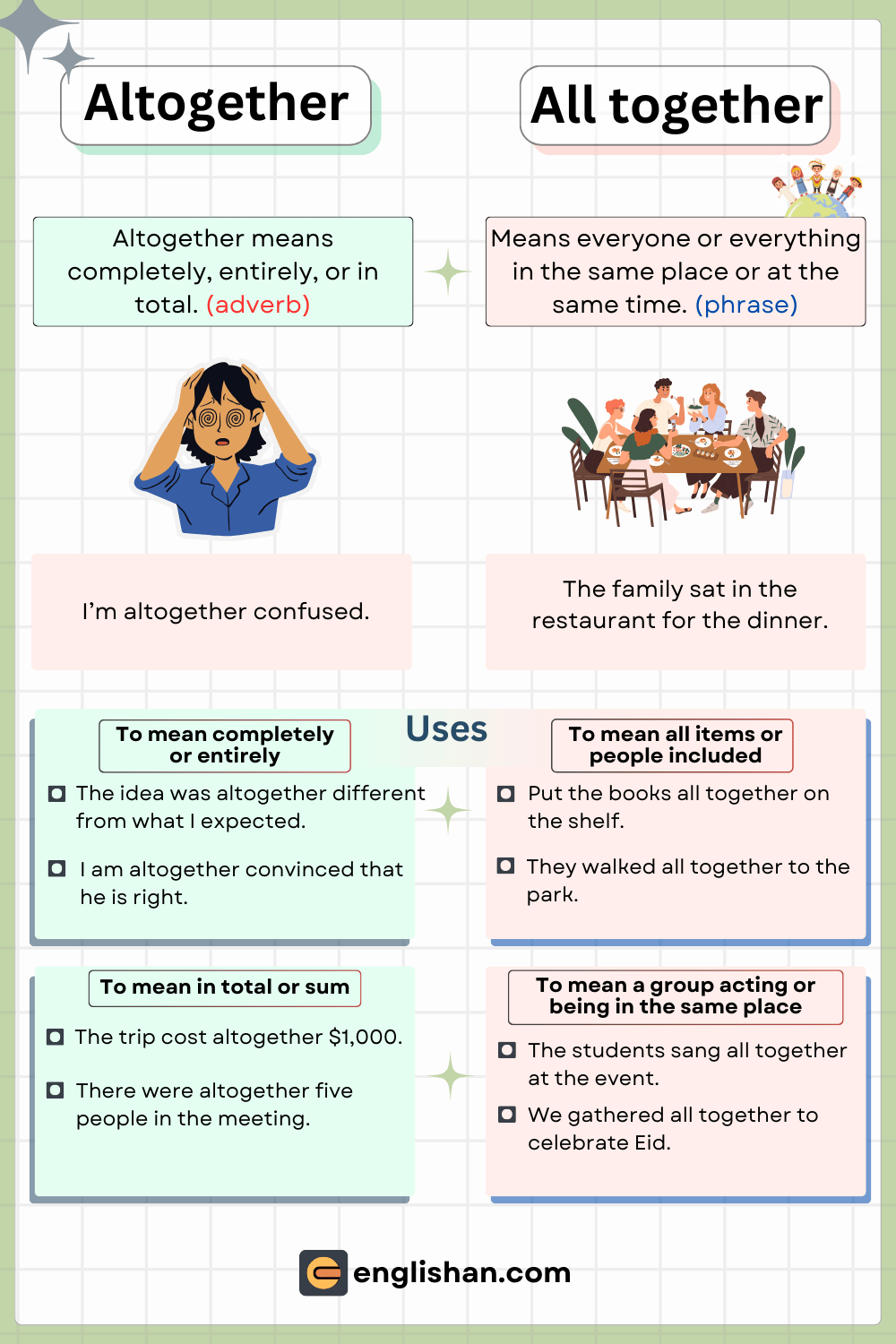
Difference between Altogether and All Together
Difference between Altogether and All Together with easy examples for correct usage.
Advertisement

Differences Between Altogether and All Together

AspectAltogetherAll Together
MeaningCompletely, entirely, or in totalA group doing something together
UsageUsed to describe completenessRefers to collective action or presence
Part of SpeechAdverbPhrase (adverbial)
ExampleThe project is altogether complete.We went to the mosque all together.
Memory TrickThink of “entirely” when you see altogetherThink of “everyone together” when you see all together

Usage of Altogether

1. To mean completely or entirely

  • The idea was altogether different from what I expected.
  • I am altogether convinced that he is right.

2. To mean in total or sum

  • The trip cost altogether $1,000.
  • There were altogether five people in the meeting.

Usage of All Together

1. To mean a group acting or being in the same place

  • The students sang all together at the event.
  • We gathered all together to celebrate Eid.

2. To mean all items or people included

  • Put the books all together on the shelf.
  • They walked all together to the park.

Formal and Informal Uses of Altogether and All Together

UseAltogether ExampleAll Together Example
FormalThe proposal was altogether unacceptable.The guests arrived all together at the wedding.
InformalI am altogether sure about my decision.Let’s go shopping all together this weekend!

FAQs

1. How do I remember the difference between altogether and all together?

Think of altogether as “completely” and all together as “everyone or everything in one place.” If replacing it with “completely” makes sense, use altogether.

2. Can “altogether” and “all together” be used interchangeably?

No. Altogether is an adverb meaning “completely,” while all together refers to a group being together. Using one instead of the other changes the meaning.

3. What is an example sentence using both words?

The family was all together at the park, and altogether, they had a great time.

You May Also Like

  • Sentence Correction Worksheets
  • 500 Formal and Informal Words List PDF
  • Complex Prepositions in English with Examples
  • Formal and Informal English
  • 100 Wedding Anniversary Wishes for Couple with Pictures
Advertisement
Share This Article
Facebook Pinterest Whatsapp Whatsapp LinkedIn Reddit Copy Link
Narmeen Khan
ByNarmeen Khan
Follow:
Narmeen Khan holds a BA (Honours) in English Literature from the Lahore University of Management Sciences (LUMS) and a BS in Media and Communication Studies from COMSATS University. She is also TEFL certified by Arizona State University and has completed training in computer fundamentals to support her tech-related content. With over seven years of experience in digital content creation, she writes educational articles focused on English learning, combining strong research with clear explanations and thoughtfully designed visuals to support learners at all levels.
Previous Article Past vs Passed – Simple difference with examples Past vs Passed
Next Article Types of belts - Leather, casual, dress, and tactical belts with pictures Types of Belts
270KLike
82KPin
- Advertisement -

You Might Also Like

Insure vs Ensure – Key Differences Explained
Confused Words

Insure vs Ensure

12 Min Read
Affective vs Effective – Key differences explained
Confused Words

Affective vs Effective

3 Min Read
Difference between loose and lose with meaning and examples
Confused Words

Loose and Lose

5 Min Read
Complement vs Compliment – Key Differences Explained
Confused Words

Complement vs Compliment

4 Min Read
Englishan-Logo-resized Englishan-Logo-resized

Englishan.com is a blog for better writing, speaking, and study results. We publish grammar and vocabulary posts, plus worksheets, word lists, and example sentences for practice.

Important Pages

  • About
  • Contact
  • Privacy Policy
  • Terms of Service

Get in Touch for Queries

Got any questions - Reach us out at
  • [email protected]
  • +971561449880
  • About
  • Contact
  • Privacy Policy
  • Terms of Service
Welcome Back!

Sign in to your account

Username or Email Address
Password

Lost your password?