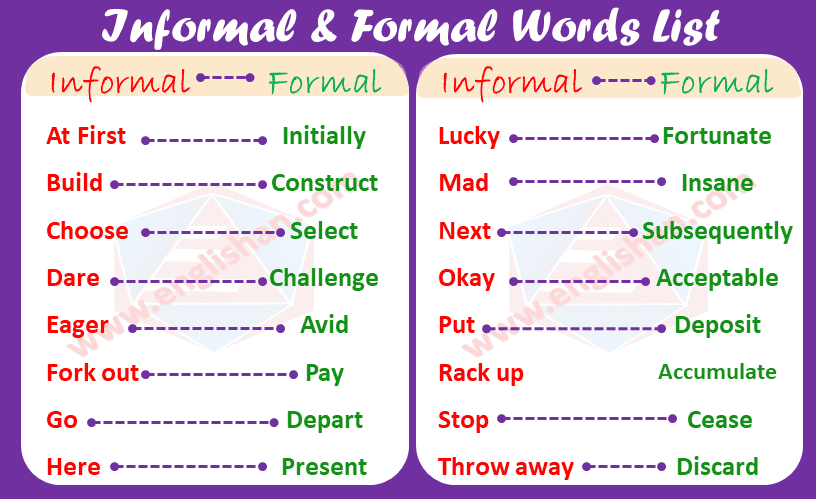
Knowing how to use formal and informal words helps you express the right tone in English. Whether you’re writing a report, answering in class, or sending a message, the choice of words matters. This post helps you learn correct word forms, improve your tone accuracy, and build vocabulary for both serious and relaxed situations. With a full A to Z list and examples, the content supports better understanding of how word tone affects English communication.
A to Z Word List of Formal and Informal English
Understanding how word tone changes from formal to informal improves both your writing and speaking. Below is a grouped list of useful formal and informal word pairs organized from A to Z.
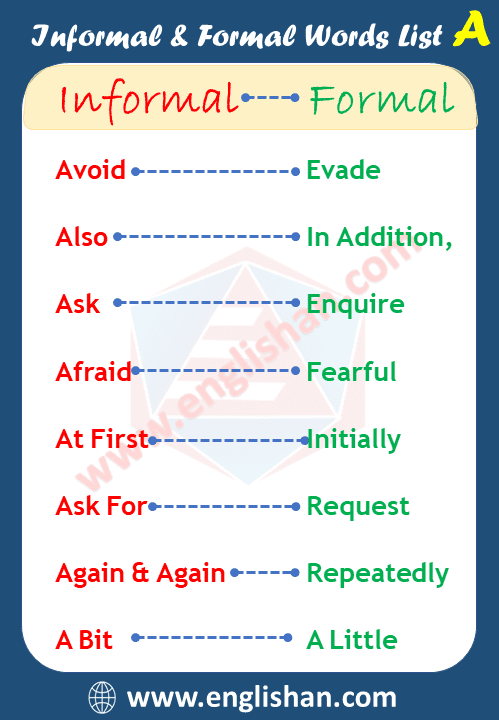
Words Starting with A to C
- Ask → Inquire
- Avoid → Evade
- Begin → Commence
- Buy → Purchase
- Check → Verify
- Choose → Select
- Come → Arrive
- Cut → Reduce
- Admit → Confess
- Agree → Consent
- Angry → Upset
- Answer → Respond
D to F Words
- Deal with → Handle
- Delay → Postpone
- Do → Perform
- End → Conclude
- Find out → Discover
- Fix → Repair
- Free → Release
- Get → Obtain
- Drop → Omit
- Fall apart → Collapse
- Fill in → Complete
- Force → Compel
Words Starting with G to I
- Give → Provide
- Go up → Increase
- Help → Assist
- Hold → Retain
- Hurt → Injure
- Invite → Request
- Inform → Notify
- Improve → Enhance
- Guess → Assume
- Go over → Review
- Get back → Respond
- Insist on → Assert
J to L Words
- Job → Occupation
- Keep → Maintain
- Let → Permit
- Look into → Investigate
- Leave out → Omit
- Live → Reside
- Love → Adore
- Laugh → Giggle
- Jump in → Intervene
- Join in → Participate
- Look for → Seek
- Listen to → Attend to
Words Starting with M to O
- Make up → Fabricate
- Meet → Encounter
- Move → Relocate
- Need → Require
- Put off → Delay
- Pick → Select
- Pay back → Reimburse
- Own → Possess
- Mess up → Mishandle
- Miss → Overlook
- Make sure → Ensure
- Object to → Oppose
P to R Words
- Point out → Indicate
- Put → Place
- Request → Ask for
- Refuse → Decline
- Reply → Respond
- Run → Operate
- Reach → Attain
- Rest → Relax
- Put up with → Tolerate
- Push → Urge
- Remind → Prompt
- Read over → Examine
Words Starting with S to U
- Say sorry → Apologize
- Show → Demonstrate
- Start → Initiate
- Stop → Cease
- Tell → Inform
- Think about → Consider
- Throw away → Discard
- Use → Utilize
- Set up → Establish
- Speed up → Accelerate
- Stand for → Represent
- Try out → Experiment
V to Z Words
- Wait for → Await
- Want → Desire
- Win → Triumph
- Write → Compose
- Work out → Resolve
- Worry → Concern
- Yell → Exclaim
- Zoom in → Magnify
- View → Observe
- Vote for → Elect
- Visit → Call on
- Value → Appreciate
What Are Formal and Informal Words Used For
Formal and informal words serve different roles based on communication type. We use formal vocabulary in school essays, job interviews, or presentations. In contrast, informal language fits casual messages, group chats, and daily conversations. Choosing the right tone builds better connections and credibility.
How Tone Changes with Formal or Informal Word Choice
Tone shifts depending on the words you pick. Let’s see how:
- Say sorry → Apologize
- Put off → Postpone
- Show → Demonstrate
- Start → Initiate
When you switch to a formal term, the sentence sounds more serious or academic. In friendly talk, informal words feel lighter and more personal.
Common Mistakes When Using Formal or Informal Words
Using contractions with formal words: Writing “I’ve commenced the task” mixes styles awkwardly.
Over-replacing simple phrases: “He fabricated a story” may sound unnatural when “made up” works better.
Overcorrecting casual tone: Swapping too many everyday words makes speech stiff and robotic.
Ignoring context: Using “assist” with friends instead of “help” can sound out of place.
Sentence Examples with Word Pairs in Context
Understanding tone becomes easier with sentence-level comparison. Here are more examples:
- Informal: Can you help me with this task?
Formal: Could you assist me with this assignment? - Informal: We’ll put off the trip.
Formal: We’ll postpone the visit. - Informal: I’m gonna find out the answer.
Formal: I will discover the answer. - Informal: She told him the result.
Formal: She informed him of the result. - Informal: He gave me a book.
Formal: He provided me with a book. - Informal: They need more help.
Formal: They require additional assistance.
FAQs
Formal words are used in professional, academic, or serious situations. They are more respectful and polite. Informal words are used in casual conversations with friends, family, or people you know well. They are more relaxed and familiar.
Formal language for work or official settings, and informal language for personal conversations or casual situations.
Here are some easy examples of formal and informal words or phrases:
A. Formal examples:
1. Request (informal: ask)
Formal: I would like to request your assistance.
Informal: Can you ask him to help?
2. Purchase (informal: buy)
Formal: I would like to purchase this item.
Informal: I want to buy this.
3. Assist (informal: help)
Formal: I will assist you with that.
Informal: I can help you with that.
B. Informal examples:
1. Gonna (formal: going to)
Informal: I’m gonna grab lunch.
Formal: I am going to grab lunch.
2. Okay (formal: acceptable)
Informal: Okay, let’s do that.
Formal: That is acceptable.
3. Y’all (formal: you all)
Informal: Y’all ready to go?
Formal: Are you all ready to go?
The main difference between formal and informal letters is the tone and purpose:
In short:
Formal – business or official.
Informal – personal and casual.
GET PDF

You May Also Like