The difference between who’s and whose often confuses English learners because they sound the same but have distinct meanings and uses. Understanding the correct usage of these words will enhance both your writing and speaking skills. To learn more about similar confusing words, visit our Confused Words category.
Meanings of Who’s and Whose
Who’s
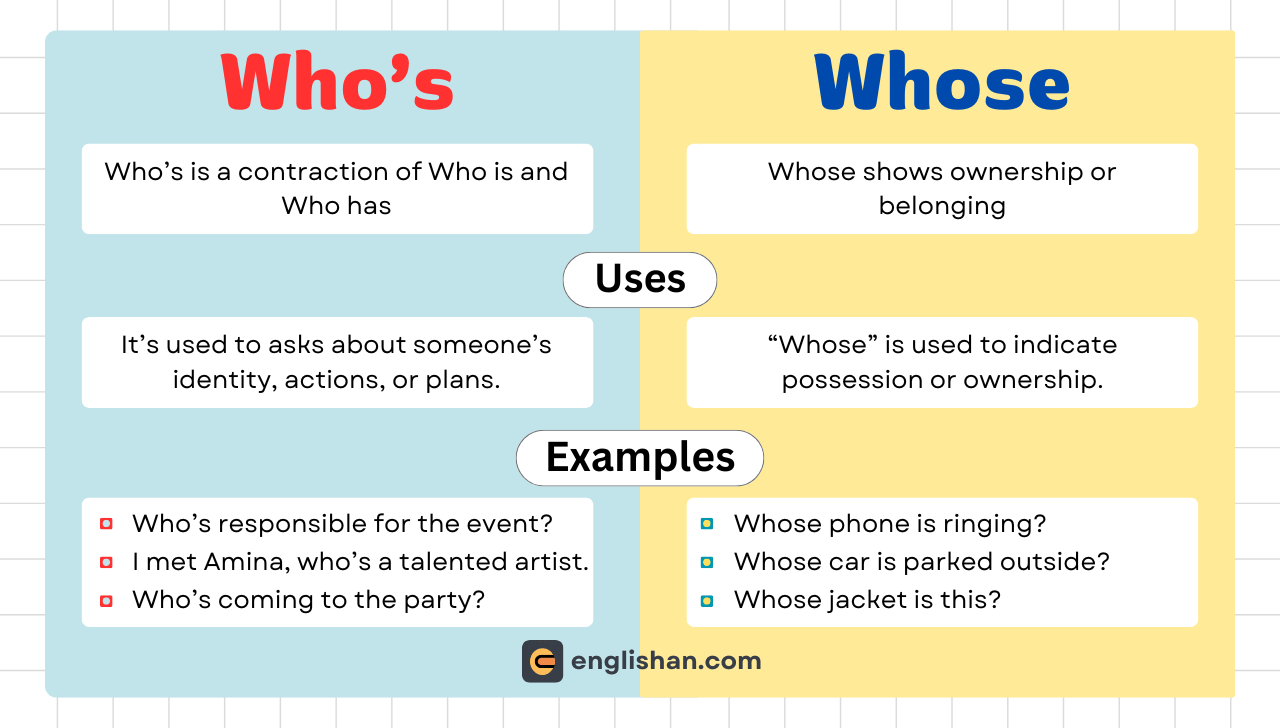
Who’s is a contraction of:
- Who is: Refers to a person’s identity, actions, or plans.
- Who has: Indicates possession or knowledge of something when “has” is part of a verb phrase.
Whose
Whose is a possessive pronoun that shows ownership or relationship:
- Used in questions to ask about possession or ownership.
- Used in statements to describe who something belongs to.
Differences Between Who’s and Whose
| Aspect | Who’s | Whose |
|---|---|---|
| Type | Contraction (who is / who has) | Possessive pronoun |
| Meaning | Refers to identity, actions, or plans | Shows ownership or relationship |
| Usage | In questions/statements about people | In questions/statements about possession |
| Examples | Who’s at the door? ✅ | Whose bag is this? ✅ |
Usage of Who’s
Contraction for “Who is”
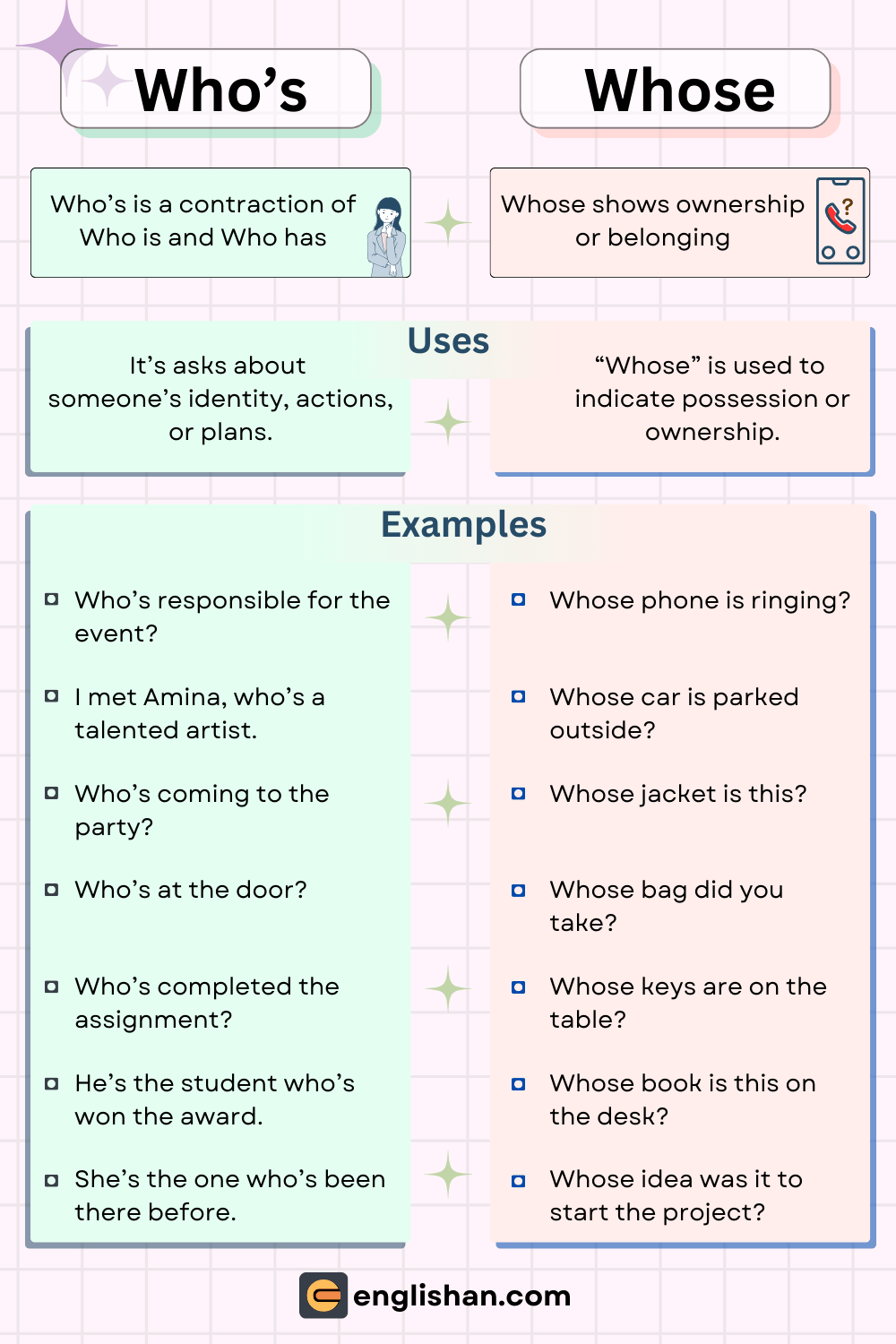
“Who’s” is a contraction of “who is”.
It’s used in questions or statements to inquire about someone’s identity, actions, or plans.
- Example: Who’s responsible for the event? ✅
This means: Who is responsible for the event? - Example: I met Amina, who’s a talented artist. ✅
This means: I met Amina, who is a talented artist.
Contraction for “Who has”
“Who’s” can also be a contraction of “who has”.
It’s used to ask about possession or knowledge of something.
- Example: Who’s completed the assignment? ✅
This means: Who has completed the assignment? - Example: He’s the student who’s won the award. ✅
This means: He is the student who has won the award.
Informal Contexts
“Who’s” is commonly used in informal speech and writing.
- Example: Who’s coming with us? ✅
This means: Who is coming with us?
It’s frequently used in casual conversations, emails, and text messages.
Usage of Whose
Indicates Possession
“Whose” is used to indicate possession or ownership.
It’s used to ask about the owner of an object or to specify possession.
- Example: Whose phone is ringing? ✅
This asks: To whom does the phone belong? - Example: Whose car is parked outside? ✅
This asks: Who owns the car parked outside?
Ownership Inquiry
When you want to know to whom something belongs, you use “whose”.
- Example: Whose jacket is this on the chair? ✅
This means: To whom does this jacket belong that is on the chair?
It helps clarify ownership or possession in a given situation.
Formal and Informal Usage
- Formal:
- Whose responsibility is it to manage this project? ✅
- She’s the manager who’s leading the team. ✅
- Informal:
- Who’s coming to dinner tonight? ✅
- Whose jacket is this on the chair? ✅
FAQs
Think of “who’s” as “who is” or “who has”. If you can replace it with “who is” or “who has” and the sentence still makes sense, it’s correct. “Whose” always shows possession.
Yes, “whose” is the possessive form of “who.” It indicates ownership, similar to possessive pronouns like “his” or “her.”
Summary
Who’s is a contraction of “who is” or “who has,” used to refer to identity, actions, or possession. Whose is a possessive pronoun that indicates ownership or belonging. Knowing how to distinguish between these words helps in writing and speaking accurately.
You May Also Like