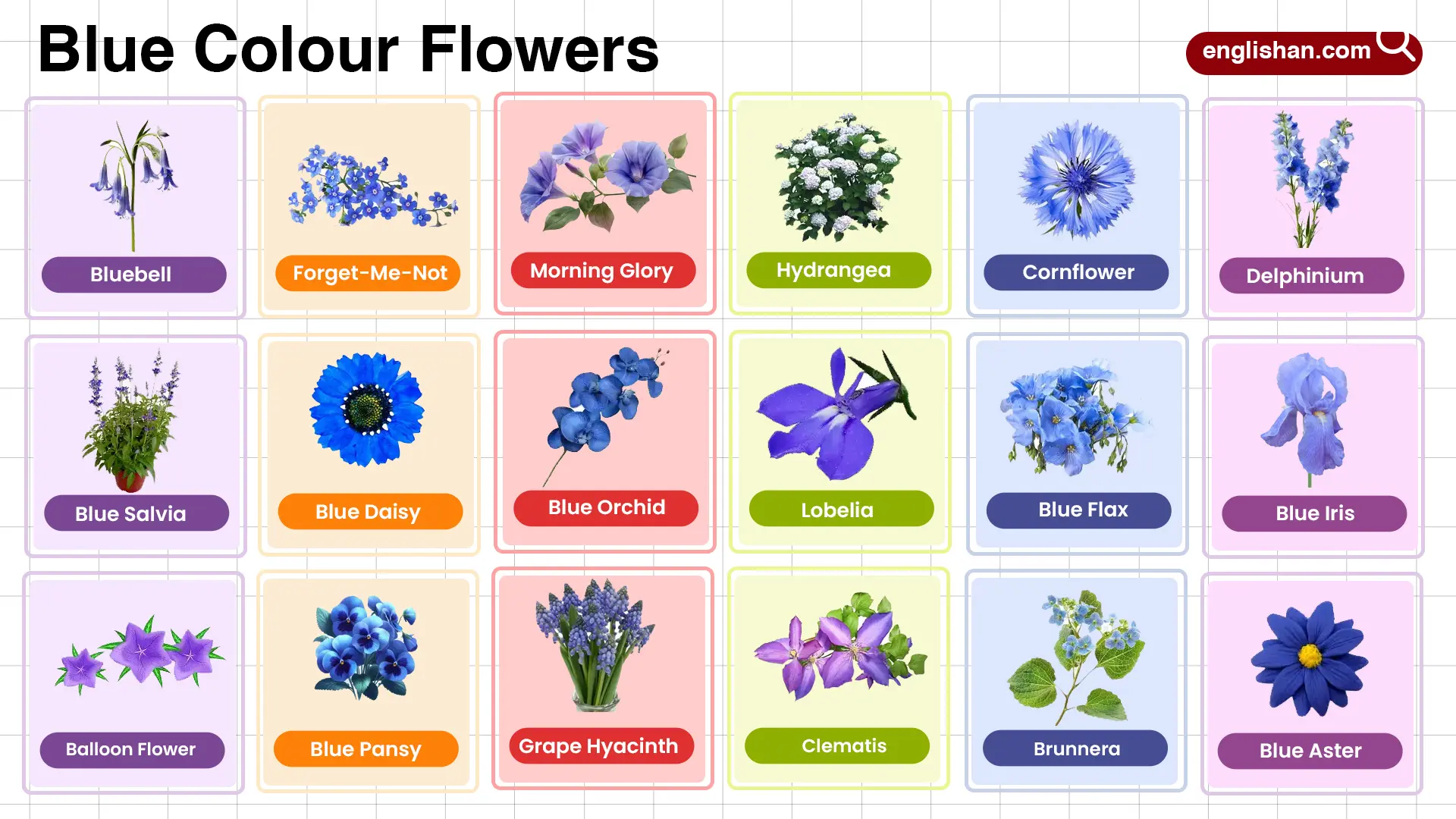
Blue flowers are less common than red, yellow, pink, and white flowers, so even one cool-toned bloom can change the feeling of a border, balcony pot, bouquet, or wildflower field. Common blue flowers names include Bluebell, Forget-me-not, Cornflower, Delphinium, Blue Iris, Hydrangea, Morning Glory, Lobelia, and Grape Hyacinth.
Blue is rarely one flat shade in flowers. Cornflowers carry a rich field-blue tone, Forget-me-nots have tiny sky-blue petals, Delphiniums rise in tall spikes, and Hydrangeas may turn blue in acidic soil. Many flowers sold or described as blue sit closer to violet-blue, lavender-blue, or purple-blue, but they still bring the cool color people want in gardens and flower pictures.
The best way to identify blue flowers is to look at three things together: shade, shape, and growing place. A drooping bell in a woodland path points toward Bluebell, a tight cluster of bead-like spring blooms suggests Grape Hyacinth, and a soft trail of tiny flowers falling from a hanging basket is often Lobelia.
Blue Flowers Names List
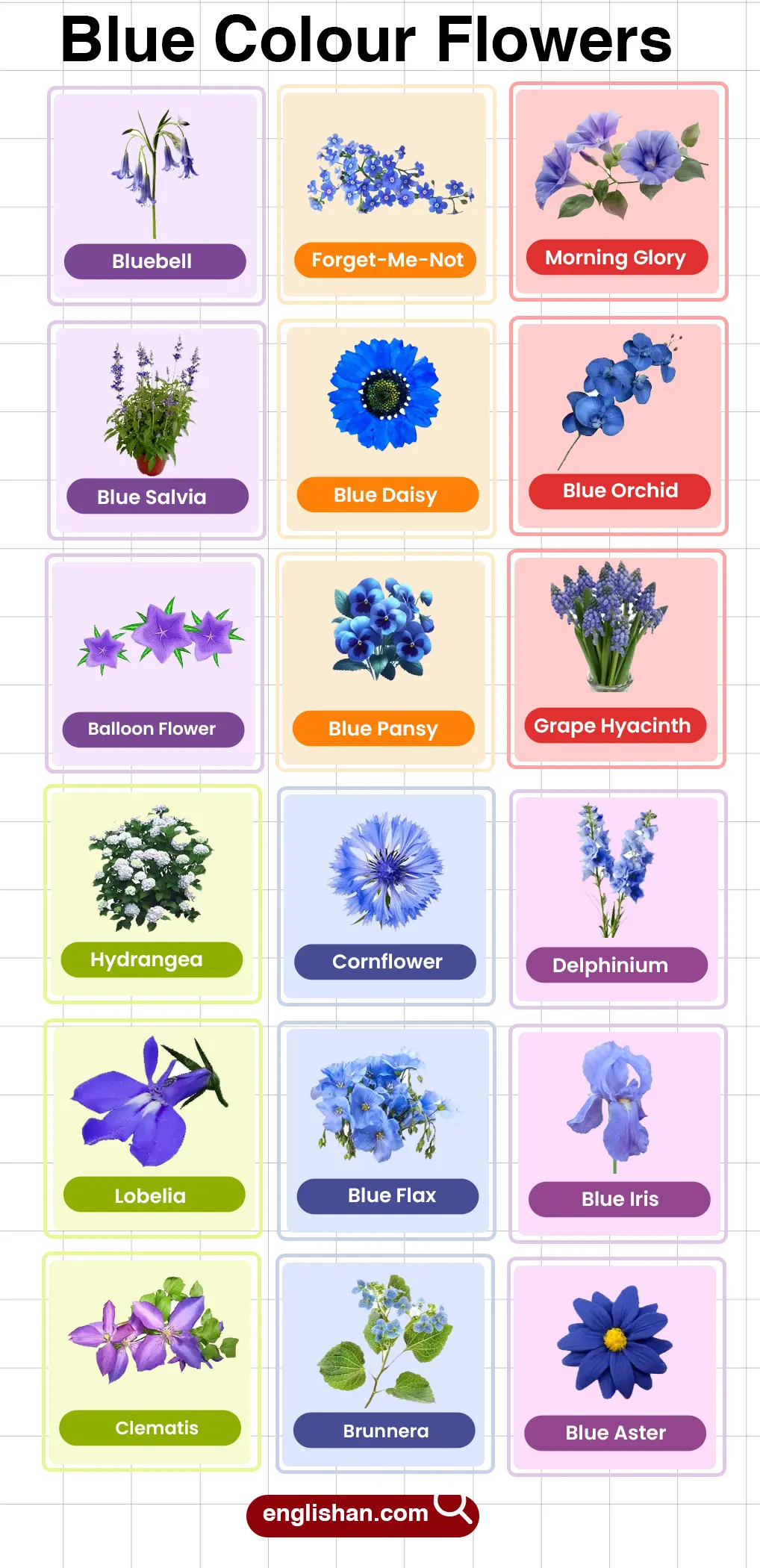
Use this quick list when you need the names first. The detailed sections after the table explain the flower shape, blue shade, common growing place, and visual clues behind the main names.
| Blue Flower | Blue Flower | Blue Flower |
|---|---|---|
| Bluebell | Forget-me-not | Cornflower |
| Delphinium | Hydrangea | Blue Iris |
| Morning Glory | Lobelia | Grape Hyacinth |
| Blue Salvia | Blue Daisy | Blue Orchid |
| Blue Flax | Bachelor’s Button | Balloon Flower |
| Blue Pansy | Clematis | Brunnera |
| Blue Aster | Chicory | Water Forget-me-not |
| Pickerelweed | Borage | Blue Anemone |
| Love in a Mist | Gentian | Virginia Bluebells |
| Speedwell | Scilla | Himalayan Blue Poppy |
Most Common Blue Flowers with Pictures and Meanings
Some blue flowers are easy to spot because of their color; others are better recognized by shape. The flowers below are the names you will meet most often in gardens, fields, woodland paths, pots, borders, and close-up flower photos.
1. Bluebell
Walk through a shaded woodland in spring and the blue ground layer is often made of Bluebells. These small bell shaped flowers bend from thin stems, so the blooms seem to lean gently to one side instead of standing stiffly upright.
The shape matters as much as the color. A Bluebell has a soft, hanging form, while Grape Hyacinth grows in tight upright clusters and Delphinium rises in tall spikes. That drooping bell shape is the quickest clue when you compare blue spring flowers in pictures.
- Shade: soft blue to violet-blue
- Where it grows: woodlands, shaded gardens, spring paths
- Best clue: hanging bell shaped flowers on curved stems
- Example: Bluebells covered the forest path after the first warm days of spring.
2. Forget-me-not
Tiny flowers can still carry a strong identity, and Forget-me-not is a good example. Each small bloom usually has five rounded blue petals around a yellow center, gathered in loose clusters on thin stems.
The flower has a gentle, sentimental feel because of its name, but it is also easy to identify in close-up photos. Look for many small sky-blue blooms growing together rather than one large flower head. In borders and damp garden corners, the flowers can create a soft dotted blue patch.
- Shade: pale blue to sky blue
- Where it grows: moist garden soil, borders, wildflower areas
- Best clue: tiny blue petals with a yellow center
- Example: Forget-me-nots grew beside the fence in small blue clusters.
3. Cornflower
Few flowers carry blue as strongly as Cornflower. The petals have a fringed edge and a vivid field-blue shade that feels brighter than many violet-blue garden blooms.
The name comes from its old link with grain fields, where it once grew among cereal crops. You may also see the same flower called Bachelor’s Button, especially on seed packets. If you want a bold natural blue flower for a picture chart, Cornflower deserves a front row place.
- Shade: deep blue
- Where it grows: fields, wildflower beds, cottage gardens
- Best clue: fringed petals in a strong field-blue color
- Example: Cornflowers added rich blue color beside the white daisies.
4. Delphinium
Height is the first thing you notice with Delphinium. Rather than forming one round bloom, it sends up tall columns packed with blue, pale blue, or purple-blue flowers.
These spikes make Delphinium valuable in garden borders, especially behind shorter plants. From a distance, the flowers read as upright blue lines. That makes them very different from trailing Lobelia, low Grape Hyacinth, or rounded Hydrangea heads.
- Shade: pale blue, rich blue, violet-blue
- Where it grows: garden borders, cottage gardens, flower beds
- Best clue: tall vertical flower spikes
- Example: Delphiniums rose behind the garden border like blue towers.
5. Hydrangea
A blue Hydrangea does not look like a single flower at first glance. It forms a large rounded head made from many small blooms, giving the plant a full, cloud-like shape in summer gardens.
The color can shift depending on the variety and soil. Some Hydrangeas turn blue in acidic soil, while others lean purple, pink, white, or green. When the color turns powder blue, the large flower heads become one of the most recognizable blue garden sights.
- Shade: powder blue, soft blue, blue-purple
- Where it grows: shrubs, shaded gardens, porch areas
- Best clue: large rounded flower heads made of many small blooms
- Example: Blue Hydrangeas filled the corner near the front steps.
6. Blue Iris
The beauty of Blue Iris is in the folds. Its petals curve, open, and overlap in a sculpted shape, often mixing blue with violet, white, or yellow markings.
The plant also has upright sword like leaves, so it is recognizable even before flowering. Near ponds or borders, Blue Iris brings a formal look that feels more architectural than tiny wildflowers such as Chicory or Forget-me-not.
- Shade: blue to violet-blue
- Where it grows: pond edges, borders, moist garden soil
- Best clue: folded petals with tall sword like leaves
- Example: Blue Iris flowers opened beside the pond after the rain.
7. Morning Glory
A blue Morning Glory opens like a small funnel or trumpet, often with a lighter center that draws the eye inward. Many varieties open early in the day and begin to close later, which is exactly why the name fits the flower.
This is a climbing flower, not a border clump. It can cover fences, railings, trellises, and balcony supports with green vines and open blue blooms. The flower feels fresh and bright when it catches morning light.
- Shade: sky blue, pale blue, blue-purple
- Where it grows: vines, fences, trellises, balcony supports
- Best clue: funnel shaped flowers on climbing vines
- Example: Morning Glory flowers opened along the garden gate before noon.
8. Lobelia
For pots and hanging baskets, Lobelia gives blue in a completely different way. Its flowers are small, but they grow close together, often trailing over the edges of containers in a soft blue spill.
Lobelia does not rely on one large showy bloom. Its strength is repetition: many tiny flowers, close leaves, and a low or trailing habit. Planted beside white, yellow, or pink flowers, the blue color becomes stronger.
- Shade: deep blue, violet-blue, pale blue
- Where it grows: hanging baskets, pots, borders, garden edges
- Best clue: many tiny flowers trailing from pots or baskets
- Example: Lobelia spilled over the basket in a wave of small blue flowers.
9. Grape Hyacinth
Spring beds often hide little surprises, and Grape Hyacinth is one of the easiest to name. Its short spikes are covered in tiny round blooms that look like clusters of small blue grapes.
This flower stays close to the ground, so it works differently from Delphinium or Salvia. It often grows near Tulips and Daffodils, adding deep blue patches between taller spring flowers.
- Shade: deep blue to purple-blue
- Where it grows: spring borders, lawns, bulb gardens
- Best clue: tight clusters shaped like tiny blue grapes
- Example: Grape Hyacinths formed tiny blue clusters along the path.
10. Blue Salvia
In a sunny bed, Blue Salvia brings upright color without taking on the towering height of Delphinium. Its flower spikes rise above narrow leaves, often in shades that sit between blue and purple.
Pollinators visit it often, so the plant adds movement as well as color. It works best where you want a vertical flower shape but not a heavy, rounded bloom.
- Shade: blue-purple, deep blue, violet-blue
- Where it grows: sunny beds, borders, pollinator gardens
- Best clue: upright flower spikes with narrow leaves
- Example: Blue Salvia added height behind the yellow flowers.
11. Balloon Flower
Before it opens, Balloon Flower looks like a small inflated bud. That rounded bud is the reason for its name, and it is often more memorable than the open flower itself.
Once open, the bloom spreads into a star shape. Blue varieties often lean purple-blue, but the changing form from puffed bud to star flower makes this plant easy to recognize in pots, borders, and cottage gardens.
- Shade: blue, violet-blue, purple-blue
- Where it grows: borders, pots, cottage gardens
- Best clue: rounded buds that open into star shaped flowers
- Example: The Balloon Flower buds opened into blue star shaped blooms.
12. Brunnera
At first glance, Brunnera can look like Forget-me-not, but the leaves tell the real story. Its flowers are small and blue, yet the plant carries larger heart shaped leaves that make it fuller and more noticeable in shade.
Brunnera works beautifully under trees, near shaded paths, or in woodland style beds. It brings a soft spring blue where brighter sun flowers may struggle.
- Shade: pale blue to soft blue
- Where it grows: shade gardens, woodland borders, under trees
- Best clue: tiny blue flowers above large heart shaped leaves
- Example: Brunnera brightened the shaded bed beneath the maple tree.
13. Chicory
Roadside flowers often have a wilder charm, and Chicory fits that mood. Its pale blue petals open in a loose, airy shape, usually on tall stems beside roads, fields, and open grassy places.
The blooms often open earlier in the day, then close or fade later. This makes morning the best time to see their softer blue color against dry grass and rough ground.
- Shade: pale blue
- Where it grows: roadsides, fields, open grassy areas
- Best clue: pale blue flowers on rough roadside stems
- Example: Chicory flowers opened along the roadside in the morning sun.
14. Blue Flax
Lightness defines Blue Flax. Its thin petals and slender stems give the flower an airy form, especially in open sunny spaces where it can move with the wind.
This is not a dense, heavy bloom like Hydrangea or a bold spike like Delphinium. Blue Flax fits meadow style planting, wildflower gardens, and grassy places where the color blends gently instead of shouting.
- Shade: light blue to sky blue
- Where it grows: sunny fields, wildflower gardens, open ground
- Best clue: thin petals on slender stems
- Example: Blue Flax moved lightly above the summer grass.
15. Bachelor’s Button
The name Bachelor’s Button often points to the same flower as Cornflower. Gardeners may use this name on seed packets, while Cornflower is common in field and wildflower descriptions.
Its deep blue petals have a fringed edge, and the rounded flower head stands out among softer blooms. Knowing both names matters because the same flower may be labeled differently in different places.
- Shade: deep blue
- Where it grows: seed mixes, cottage gardens, wildflower beds
- Best clue: Cornflower style bloom with a second common name
- Example: Bachelor’s Buttons grew beside the white and yellow flowers.
Light Blue Flowers
Light blue flowers have sky-blue, powder-blue, or pale blue tones. They suit spring borders, meadow scenes, shaded corners, cottage gardens, and close-up nature photos because the color feels soft rather than heavy.
- Forget-me-not: Tiny blooms with yellow centers make this one of the most familiar light blue flowers. It often grows in clusters, giving borders and damp corners a dotted sky-blue layer.
- Blue Flax: Thin petals and slender stems give this flower a breezy meadow look. It works best in open sunny spaces where grasses and wildflowers mix naturally.
- Chicory: Pale blue petals open beside roadsides, fields, and rough grassy places. The flower is often at its best in the morning.
- Brunnera: Small blue flowers sit above broad heart shaped leaves. It is a strong shade plant and a good comparison flower for Forget-me-not.
- Borage: Star shaped blue flowers rise above rough green leaves. The pointed petals give close-up pictures more detail.
- Virginia Bluebells: Pinkish buds open into soft blue bell shaped flowers in spring. They bring a woodland feel to shaded natural gardens.
- Scilla: Small blue star shaped blooms grow low to the ground in early spring. They often sit near other bulb flowers in lawns and borders.
Deep Blue Flowers
Deep blue flowers have stronger color and stand out against green leaves, white blooms, and pale garden backgrounds. These are the names to know when you want a richer blue tone in pictures or garden descriptions.
- Cornflower: A vivid field-blue flower with fringed petals and a natural wildflower feel.
- Delphinium: Tall spikes packed with blue blooms, often used to add height at the back of borders.
- Blue Iris: Folded petals with blue, violet, white, or yellow markings, often paired with upright sword like leaves.
- Grape Hyacinth: Low spring spikes with tiny round blooms shaped like blue grapes.
- Lobelia: Small flowers packed closely together, especially striking when trailing from baskets.
- Gentian: Intense blue trumpet shaped flowers, often admired for one of the strongest natural blue shades.
- Blue Anemone: Open blue or violet-blue petals around a darker center, softer than Iris but stronger than pale wildflowers.
Purple-Blue Flowers Often Called Blue
Many flowers called blue are actually violet-blue, lavender-blue, or purple-blue. Florists and gardeners still describe them as blue because they bring the same cool tone to arrangements, borders, and flower pictures.
- Hydrangea: Blue shades may shift toward lavender or purple depending on the plant and soil.
- Blue Salvia: Upright spikes often sit between blue and purple, especially in strong sun.
- Clematis: Climbing flowers may bloom in blue-violet shades on walls, fences, and arches.
- Blue Aster: Daisy like flowers often lean pale blue or lavender-blue late in the season.
- Balloon Flower: Rounded buds open into star shaped blooms, often in violet-blue tones.
- Blue Orchid: Many bright blue orchids sold in shops are dyed, while natural blue orchids are uncommon.
- Blue Pansy: Flat petals often mix blue, violet, and darker markings, giving the bloom a face like look.
Blue Flowers for Gardens and Pots
These blue flowers names work well in borders, containers, hanging baskets, shaded corners, and small outdoor spaces. Choose them by shape and placement: tall spikes for back borders, trailing flowers for baskets, compact blooms for pots, and shrubs for garden corners.
Strong Choices for Garden Borders
- Delphinium: tall blue spikes that rise behind shorter flowers
- Blue Salvia: upright stems that attract bees and butterflies
- Blue Aster: soft late season color after many summer blooms fade
- Balloon Flower: rounded buds and star shaped summer flowers
- Clematis: climbing blue or purple-blue blooms for walls, fences, and arches
Good Choices for Pots and Hanging Baskets
- Lobelia: trailing stems with many small blue flowers
- Blue Pansy: compact blooms for cooler weather pots
- Blue Daisy: blue petals with a bright yellow center
- Morning Glory: climbing blooms when the pot has support
- Brunnera: soft blue flowers for shaded containers
Good Choices for Garden Corners
- Hydrangea: large rounded blue flower heads in the right soil
- Forget-me-not: soft spring patches near path edges
- Grape Hyacinth: low spring bulbs for borders and lawns
- Blue Salvia: upright color in sunny spaces
- Clematis: vertical flowers near a wall, trellis, or fence
Wild Blue Flowers
Wild blue flowers names are valuable when you identify flowers in fields, woodland paths, roadsides, meadows, and open grassy areas. These flowers often have looser shapes and more natural growing habits than florist blooms.
- Bluebell: drooping bell shaped flowers in shaded woodland areas
- Cornflower: rich blue field flower with fringed petals
- Chicory: pale blue roadside flower that opens early in the day
- Blue Flax: airy light blue bloom for sunny open ground
- Virginia Bluebells: soft spring bells for woodland edges and shaded paths
- Speedwell: small blue flowers that may grow in grass, meadows, and garden edges
- Gentian: strong blue flowers, often linked with cooler or mountain regions depending on the type
Blue Flowers That Grow Near Water
Some blue flowers grow near ponds, streams, marshes, lakesides, or damp soil. These flowers belong naturally in pictures with reeds, stones, wet ground, and water edges.
Water Forget-me-not
Small blue flowers and damp ground are the two main clues. Water Forget-me-not resembles regular Forget-me-not, but it belongs closer to streams, pond edges, marshes, and wet soil.
Pickerelweed
At pond and lake edges, Pickerelweed grows with upright blue or purple flower spikes. Bees and dragonflies often visit the flowers, so it brings life as well as color to water margins.
Blue Iris
Moist soil suits many Iris types, and Blue Iris looks natural beside ponds. Its upright leaves bring strong lines, while the folded petals add color near the water.
Water Hyacinth
Floating leaves and pale purple-blue flowers make Water Hyacinth visually striking on water surfaces. In some places it spreads quickly, so it is admired for looks but watched carefully in waterways.
Lobelia
Some Lobelia types prefer moist ground, while garden Lobelias are better known from pots and baskets. The name stays common in blue flower lists because the small blooms can carry a rich blue shade.
Rare and Unusual Blue Flowers
Rare blue flowers names often include blooms that are naturally blue, violet-blue, or unusual enough to stand out in flower pictures. Some are rare in gardens, while others need careful wording because shop colors and natural colors are not always the same.
Blue Orchid
A bright Blue Orchid in a shop may not be naturally blue. Many are dyed, while naturally blue orchids are uncommon. The flower still looks striking, but the plant label matters if natural color is important.
Himalayan Blue Poppy
Soft blue petals and a golden center make Himalayan Blue Poppy one of the most admired blue flowers. Its color feels rare because so few flowers carry a true blue look so strongly.
Gentian
The color of Gentian can be intensely blue, especially in close-up photos. Its trumpet shaped blooms make it one of the strongest examples of a deep natural blue flower.
Blue Anemone
Open petals around a darker center give Blue Anemone a gentle spring shape. It often sits between soft blue and violet-blue, depending on the variety and light.
Love in a Mist
Fine thread like leaves surround the pale blue flowers of Love in a Mist. The whole plant has an airy, delicate form that separates it from heavier flowers such as Iris or Hydrangea.
Blue Passion Flower
A layered center, fine threads, and mixed blue, white, and purple tones make Blue Passion Flower one of the most unusual flowers on this list. It has more visual detail than almost any common blue bloom.
Confusing Blue Flower Names
Some blue flowers look similar in pictures, while others share more than one name. These comparisons make the names easier to use correctly.
Bluebell vs Grape Hyacinth
Bluebells hang from curved stems like small bells. Grape Hyacinths grow in tight upright clusters that look like tiny blue grapes.
Forget-me-not vs Brunnera
Forget-me-nots have tiny blue flowers and a delicate wildflower look. Brunnera has similar blue flowers, but the plant has larger heart shaped leaves.
Cornflower vs Bachelor’s Button
Cornflower and Bachelor’s Button often name the same flower. Cornflower fits field and wildflower descriptions, while Bachelor’s Button is common on seed packets.
Blue Iris vs Blue Orchid
Blue Iris has upright leaves and folded petals. Blue Orchid has a more tropical flower shape, and many bright blue shop orchids are dyed.
Lobelia vs Blue Salvia
Lobelia is usually low, trailing, and suited to baskets or pots. Blue Salvia grows in upright spikes and gives garden beds more height.
How to Use Blue Flowers Names in Sentences
Use these examples when writing about gardens, flower pictures, bouquets, or outdoor scenes.
- Bluebells covered the woodland path in spring.
- Forget-me-nots grew beside the fence.
- Cornflowers added deep blue color to the field.
- Blue Hydrangeas bloomed near the porch.
- Lobelia spilled over the hanging basket.
- Delphiniums rose behind the garden border.
- Grape Hyacinths grew near the Daffodils.
- Blue Iris flowers opened beside the pond.
- Morning Glory climbed along the garden gate.
- Chicory flowers opened beside the roadside.
Final Thoughts on Blue Flowers Names
Blue flowers names become easier to remember when each flower has a shape attached to it. Bluebells hang like tiny bells, Grape Hyacinths grow like small blue grapes, Delphiniums rise in tall spikes, and Forget-me-nots form tiny blue clusters.
Start with the most familiar blue flowers, then compare them by shade and growing place. Light blue flowers, deep blue flowers, wild blue flowers, blue garden flowers, and rare blue blooms all have different visual clues that make the names easier to use in real descriptions.
FAQs
The most common blue flowers names include Bluebell, Forget-me-not, Cornflower, Delphinium, Hydrangea, Blue Iris, Lobelia, Morning Glory, Grape Hyacinth, Blue Salvia, Balloon Flower, Brunnera, and Chicory.
Naturally blue flowers include Bluebell, Cornflower, Forget-me-not, Blue Flax, Chicory, Gentian, and some Delphinium varieties. Many flowers sold or described as blue may lean toward violet, lavender, or purple-blue.
Blue flowers are rare because true blue pigment is uncommon in flowers. Some blooms look blue because of pigment balance, petal structure, soil conditions, or the way light reflects from the petals.
Delphinium, Hydrangea, Lobelia, Blue Salvia, Balloon Flower, Blue Pansy, Clematis, Brunnera, Grape Hyacinth, and Forget-me-not are strong blue flowers for gardens. They offer different shapes, from tall spikes to trailing basket flowers.
Lobelia, Blue Pansy, Blue Daisy, Blue Salvia, Morning Glory, Balloon Flower, and Brunnera grow well in pots or containers. Lobelia is especially common in hanging baskets because it trails over the edges.
Water Forget-me-not, Pickerelweed, Blue Iris, Water Hyacinth, and some Lobelia types grow near water, wet soil, pond edges, or marshy areas.
Light blue flowers have pale, sky-blue, or powder-blue tones, such as Forget-me-not, Blue Flax, and Chicory. Deep blue flowers have stronger color, such as Cornflower, Delphinium, Gentian, and Grape Hyacinth.
Hydrangeas are not always blue. Some varieties can turn blue in acidic soil, while others bloom pink, purple, white, or green depending on the type and growing conditions.
Bluebells, Forget-me-nots, Grape Hyacinths, Brunnera, Scilla, Virginia Bluebells, and some Blue Iris varieties bloom in spring. These flowers often grow in woodland paths, lawns, shaded beds, and early garden borders.
Some blue orchids sold in shops are dyed. Naturally blue orchids are uncommon, so check the label before assuming a Blue Orchid has natural blue petals.
You May Also Like
- Flower Names in English
- Flower Scientific Names
- Summer Flowers in English
- Winter Flowers in English
- Yellow Flowers in English
- Pink Flowers in English
- Green Flower Names
- Seasons Names in English