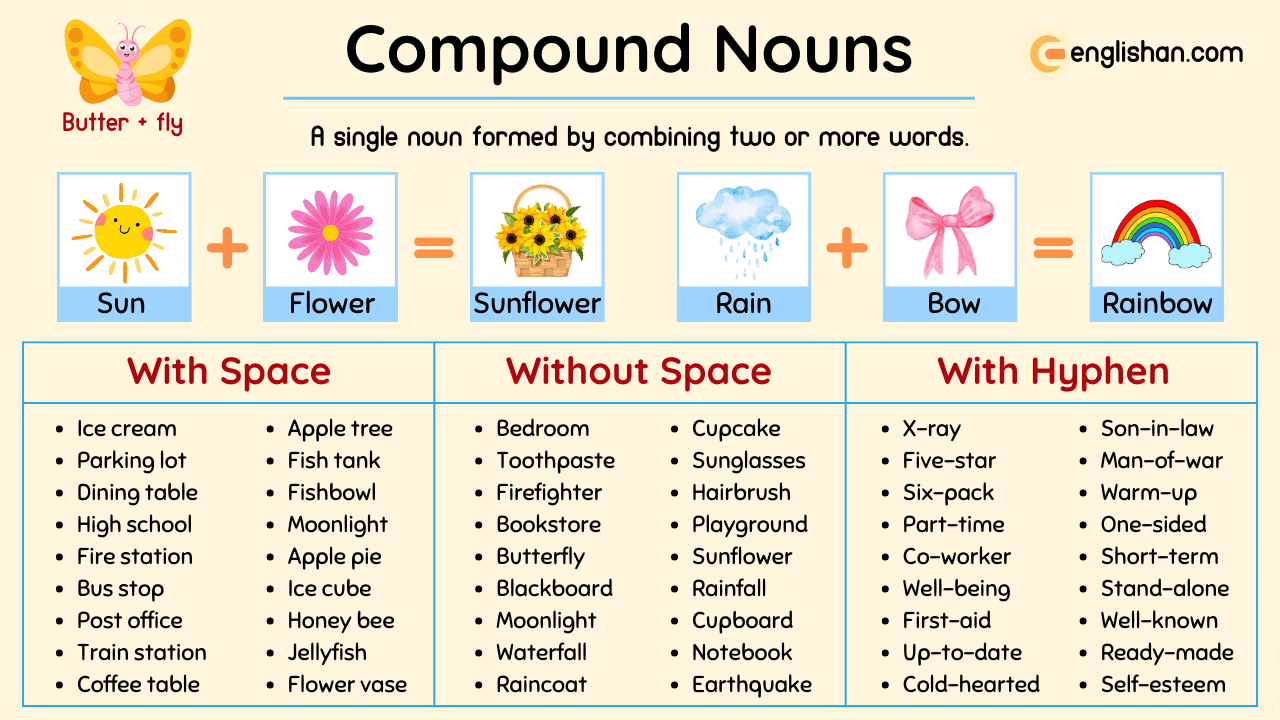
Nouns are naming words that tell us about people, places, things, or ideas. One special kind of noun is a compound noun. It’s made by joining two or more words together to form a single idea. These words can be joined in different ways—sometimes with a hyphen, sometimes written as one word, and sometimes as two separate words. In this post, we’ll learn what compound nouns are, how they are formed, and see lots of useful examples to make the idea clear.
What are Compound Nouns?
A compound noun is a word made by joining two or more words to form a new, single idea. For example, toothbrush joins tooth and brush to mean a tool for cleaning teeth. Compound nouns can be written as one word (bedroom), with a hyphen (mother-in-law), or as separate words (school bus). The meaning of the whole word is usually different from the individual parts.
Examples of compound nouns:
- Bedroom (Bed + Room)
- Toothpaste (Tooth + Paste)
- Firefighter (Fire + Fighter)
- Bookstore (Book + Store)
- Sunflower (Sun + Flower)
Formation of Compound Nouns
Compound nouns can be formed in several ways:
Noun + Noun
This is one of the most common formations for compound nouns, where two nouns are combined to create a new noun representing a specific concept or object.
Examples:
- Bedroom
- Bookcase
- Football
- Raincoat
- Toothbrush
- Sunshine
Adjective + Noun
In this formation, an adjective is combined with a noun to describe a particular type or quality of the noun.
Examples:
- Blackboard
- Redhead
- Greenhouse
- Darkroom
- Coldwater
- Blueberry
Verb + Noun
Compound nouns can also be formed by combining a verb with a noun, often representing a person or object associated with the action.
Examples:
- Swimming pool
- Running shoes
- Washing machine
- Cooking pot
- Swimsuit
- Sleeping bag
Preposition + Noun
Prepositions can be part of compound nouns, indicating location, direction, or relationship.
Examples:
- Underground
- Offspring
- Underworld
- Outlook
- Forehead
- Overpass
Noun + Verb
In some cases, nouns can combine with verbs to form compound nouns, typically representing activities or events.
Examples:
- Breakfast
- Handshake
- Haircut
- Rainfall
- Footprint
- Playground
Adverb + Adjective
Though less common, compound nouns can also be formed by combining an adverb with an adjective to describe a specific quality or characteristic.
Examples:
- Afterwards
- Nearby
- Outside
- Inside
- Upstairs
Compound Nouns Formed by Noun + Preposition
This formation combines a noun with a preposition to indicate a specific location or relationship.
Examples:
- Backyard
- Bedroom
- Sidewalk
- Waterfall
- Highway
Gerund + Noun
Gerunds (verbs ending in “-ing” used as nouns) can combine with other nouns to create compound nouns, often representing activities or concepts.
Examples:
- Shopping cart
- Swimming pool
- Reading glasses
- Writing desk
- Running shoes
- Walking stick
Noun + Adjective
Sometimes, a noun is combined with an adjective to describe a particular type or quality of the noun.
Examples:
- Airplane
- Sunshine
- Earthquake
- Rainforest
- Firefly
Verb + Particle
Compound nouns can also be formed by combining a verb with a particle (often a preposition or adverb) to represent an action or event.
Examples:
- Breakthrough
- Runaway
- Takeoff
- Handout
- Checkout
Adjective + Verb
This formation combines an adjective with a verb to create compound nouns describing actions or characteristics.
Examples:
- Breakdown
- Outcry
- Uprising
- Outburst
- Outfield
Noun + Preposition + Noun
Sometimes, a compound noun consists of a noun followed by a preposition and then another noun.
Examples:
- Daughter-in-law
- Commander-in-chief
- Father-in-law
- Man-of-war
- Maid-of-honor
Types of Compound Nouns
Compound nouns can be grouped into different types based on how they are written:
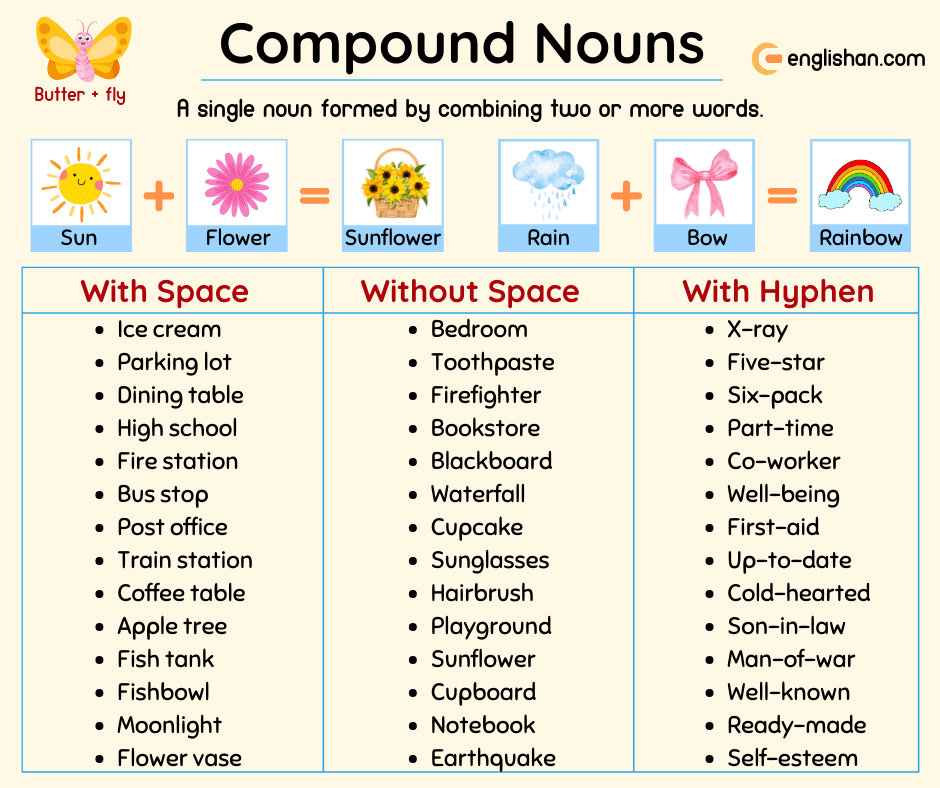
- Closed Compound Nouns: Written as one word with no space. Example: football, blueberry.
- Hyphenated Compound Nouns: Joined by a hyphen. Example: mother-in-law, six-pack.
- Open Compound Nouns: Written as separate words. Example: ice cream, post office.
- Proper Compound Nouns: Specific names of people, places, or events. Example: New York, United States, World War II.
Compound Nouns List
- Bedroom
- Toothpaste
- Firefighter
- Bookstore
- Butterfly
- Goldfish
- Blackboard
- Moonlight
- Waterfall
- Raincoat
- Cupcake
- Sunglasses
- Hairbrush
- Schoolteacher
- Playground
- Sunflower
- Rainfall
- Doorbell
- Cupboard
- Teaspoon
- Headphones
- Moonlight
- Cupboard
- Notebook
- Snowflake
- Riverbank
- Snowman
- Raindrop
- Earthquake
- Newspaper
- Seashore
- Toothbrush
- Sidewalk
- Pancake
- Rainforest
- Sunshine
- Grasshopper
- Mailbox
- Footprint
- Daylight
- Wheelchair
- Headlight
- Sunglasses
- Eggplant
- Dragonfly
- Cupboard
- Snowball
- Buttercup
- Firefly
- Rainstorm
- Ice cream
- Parking lot
- Dining table
- Swimming pool
- High school
- Tooth fairy
- Paper airplane
- Fire station
- Tennis court
- Coffee shop
- Bus stop
- Fruit basket
- Police station
- Lemonade stand
- Soccer field
- Ice cream parlor
- Birdhouse
- Basketball court
- Pizza delivery
- Post office
- Train station
- Grocery store
- Flower shop
- Gas station
- Coffee table
- Football field
- Ice cream truck
- Treehouse
- Lemonade stand
- Flower garden
- Tennis racket
- Apple tree
- Fish tank
- Coffee mug
- Fishbowl
- Moonlight
- Grasshopper
- Watermelon
- Apple pie
- Ice cube
- Peanut butter
- Honey bee
- Jellyfish
- Baseball field
- Butter knife
- Ice cream cone
- Lemon tree
- Flower vase
- Birdhouse
- Fire truck
FAQs About Compound Nouns
Compound nouns can be formed by combining two or more words, and they fall into three main categories:
1. Open compounds (words spaced apart, like “ice cream”)
2. Hyphenated compounds (words joined by a hyphen, like “mother-in-law”)
3. Closed compounds (words written without spaces or hyphens, like “bedroom”)
Common compound nouns include:
1. Breakfast
2. Toothpaste
3. Raincoat
4. Classroom
5. Bookshelf
6. Crosswalk
7. Sunflower
8. Ice-cream
There are three main types of compound nouns:
1. Closed or solid (e.g., bedroom, toothpaste)
2. Hyphenated (e.g., sister-in-law, well-being)
3. Open or spaced (e.g., coffee shop, swimming pool)
Read More