
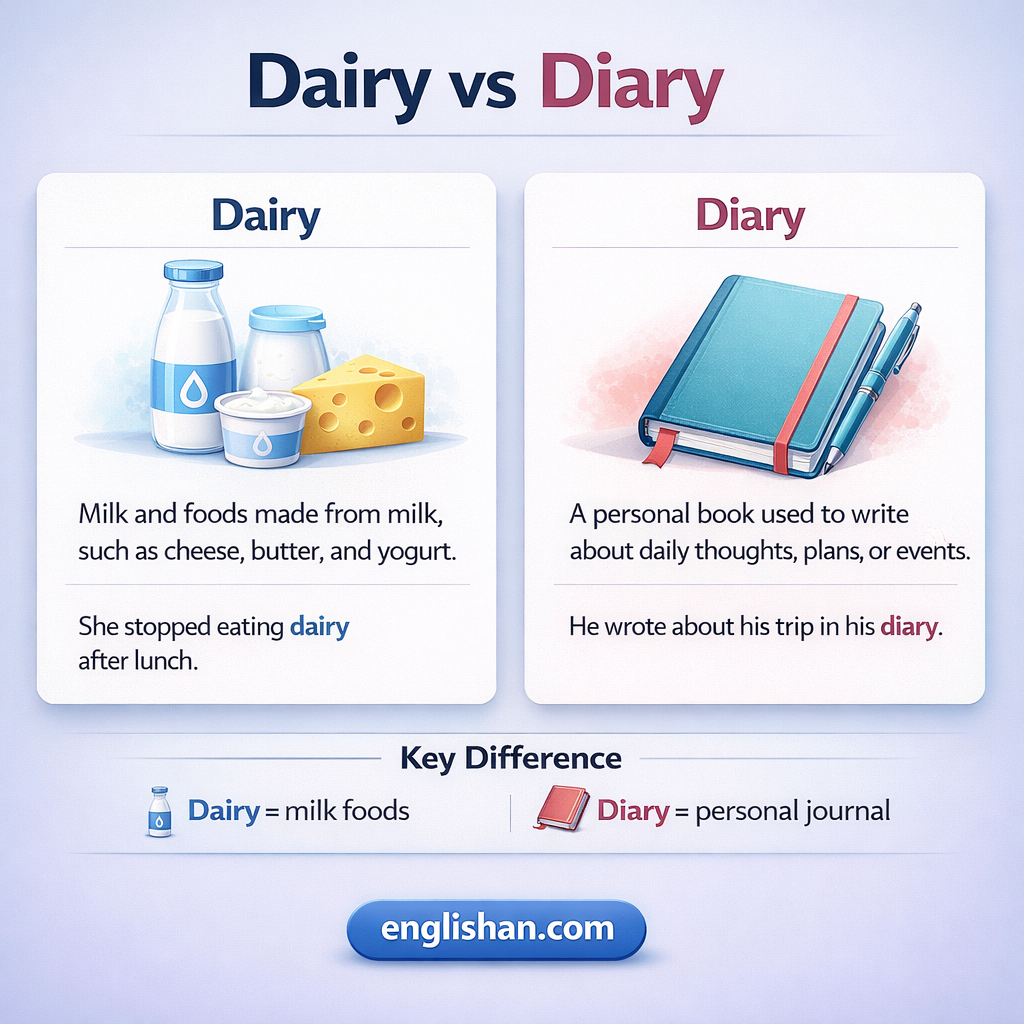
Dairy and diary are easy to confuse in writing because the spellings are close, but the meanings are completely different. Dairy relates to milk, cheese, butter, and milk production, while diary means a personal written record of daily thoughts, events, or experiences.
That difference becomes much easier once you connect each word to its usual setting. In dairy vs diary, one belongs in kitchens, grocery stores, and farm talk, while the other belongs in notebooks, journals, and personal writing. This article explains what each word means, how each one is used, and how to remember the right spelling.
Dairy vs Diary: Quick Answer
Here is the quickest way to tell them apart:
| Word | Main Meaning | Part of Speech | Common Context | Example |
|---|---|---|---|---|
| dairy | milk products or milk production | noun | food, farms, grocery stores | dairy products |
| diary | a personal daily record | noun | journals, writing, reflection | write in a diary |
If the sentence is about milk, cheese, butter, yogurt, or farming, use dairy.
If it is about writing down daily thoughts or events, use diary.
What Does Dairy Mean?
Dairy is usually a noun. It refers to milk-related food, milk production, or businesses connected with milk processing and sale.
That is why people often use dairy in phrases such as:
- dairy products
- dairy farm
- dairy industry
- dairy section
- dairy-free
Common dairy foods include:
- milk
- cheese
- butter
- yogurt
- cream
Examples of “Dairy”
- She avoids dairy because she is lactose intolerant.
- They run a dairy farm outside the city.
- You can find milk, cheese, and yogurt in the dairy section of the store.
- The region is known for its dairy farms and cheese production.
What Does Diary Mean?
Diary is a noun. It means a notebook, book, or private record where someone writes about daily life, thoughts, feelings, or experiences.
People may keep a diary for many reasons, such as:
- personal reflection
- travel notes
- dream tracking
- food tracking
- reading notes
- memory keeping
A diary does not have to be on paper. It can also be digital.
Common phrases include:
- personal diary
- travel diary
- dream diary
- food diary
- reading diary
- online diary
Examples of “Diary”
- She writes in her diary every evening.
- His travel diary was full of sketches and notes.
- The doctor asked her to keep a food diary for two weeks.
- Her diary entry that night filled four pages.
Dairy vs Diary: Parts of Speech
Both words are most often used as nouns, but they behave a little differently in everyday writing.
Dairy
Dairy is a noun, and it also appears very often before another noun, as in:
- dairy farm
- dairy products
- dairy company
- dairy industry
Examples:
- Too much dairy upsets his stomach.
- They own a dairy farm.
Diary
Diary is also a noun. It usually refers to a personal written record.
Examples:
- She keeps a diary by her bed.
- He started a diary during his first year abroad.
For everyday writing, the working rule is straightforward: dairy is the milk word, and diary is the writing word.
How Are Dairy and Diary Pronounced?
These words are not pronounced the same in standard English, and that difference can help.
- dairy begins with a sound like dare
- diary begins with a sound like die
Pronunciation:
- dairy: /ˈdeəri/
- diary: /ˈdaɪəri/
Saying the words aloud can help when you are deciding which spelling fits.
Key Difference Between Dairy and Diary
The difference is easy once you connect each word to its usual setting.
- dairy belongs to milk, food, farms, and grocery stores
- diary belongs to writing, journaling, memory, and personal reflection
One word belongs in the fridge section. The other belongs in a notebook.
How to Remember Dairy vs Diary
A quick memory link makes this pair easier to keep straight.
- diary connects naturally to daily writing
- dairy connects to milk and farm products
You can also remember it like this:
- If the sentence belongs in the kitchen or store, the word is probably dairy.
- If the sentence belongs in a notebook or journal, the word is probably diary.
Dairy and Diary in Sentences
Seeing the two words near each other helps the contrast stick.
Sentences With Dairy
- The café now has more dairy-free options.
- The family has worked in the dairy industry for years.
- We picked up milk and cheese from the dairy section.
Sentences With Diary
- She recorded the whole trip in her diary.
- His diary entry for that day was only two lines long.
- The old diary recorded details the family had forgotten.
Common Mistakes With Dairy and Diary
Using Dairy for a Personal Journal
Incorrect:
She writes in her dairy every night.
Better:
She writes in her diary every night.
Using Diary for Milk Products
Incorrect:
I do not eat diary products.
Better:
I do not eat dairy products.
Forgetting the Daily Link in Diary
The spelling is close, which is why people mix them up. A quick check usually solves it:
- If the idea is about daily writing, choose diary.
- If the idea is about milk, choose dairy.
Summary
Dairy and diary may look similar, but they point to very different meanings. Dairy is the word for milk, milk products, and milk production. Diary is the word for a personal written record of daily life, thoughts, or experiences. Once you connect diary to daily writing and dairy to milk and farming, the difference becomes much easier to remember.
FAQs
Dairy is connected with milk, cheese, butter, yogurt, and milk production. Diary means a personal notebook or written record of daily thoughts, events, or experiences.
The correct phrase is dairy products because the word refers to milk-based foods such as cheese, butter, cream, and yogurt.
The correct phrase is write in a diary because a diary is a personal book or journal used for daily writing.
No, they are not pronounced the same. Dairy begins with a sound like dair, while diary begins with a sound like die and has an extra syllable.
A good way to remember them is this: diary is linked with daily writing, while dairy is the word linked with milk and foods made from milk.
You May Also Like