When writing about Ahmed Faraz, it’s important to understand how his poetry touched hearts with themes of love, truth, and justice. This essay on Ahmed Faraz explains his early life, famous works, writing style, and his impact on Urdu literature. It’s written in 250 words to help students with homework or exams. You can download this Ahmed Faraz essay as a free PDF or image to study or print.
10 Lines Ahmed Faraz Essay for Class 2 to Class 5
- Ahmed Faraz was a famous Urdu poet from Pakistan.
- He was born on January 12, 1931.
- His real name was Syed Ahmed Shah.
- He is known for writing beautiful poems and ghazals.
- His poetry talks about love, peace, and freedom.
- Students and adults enjoy reading his poems.
- He won many awards for his poetry.
- Ahmed Faraz wrote in a simple and powerful way.
- He is loved for his deep and meaningful words.
- People remember him as one of Pakistan’s best poets.

250 Words Essay on Ahmed Faraz for Middle School
Ahmed Faraz was one of the most respected and popular Urdu poets of Pakistan. He was born on January 12, 1931, in Kohat. His real name was Syed Ahmed Shah, but he chose “Ahmed Faraz” as his pen name. He is known for writing deep and beautiful poetry that touches the hearts of many readers.
Faraz’s poetry was often about love, truth, justice, and freedom. His words were simple yet powerful, making it easy for people of all ages to understand and enjoy his poems. He had a unique way of expressing emotions that made his poetry timeless. Students still learn his ghazals and poems in school.
He received several national and international awards for his work, including the Sitara-i-Imtiaz and Hilal-i-Imtiaz. These awards show how much his poetry was valued in Pakistan and beyond. Despite facing political pressure at times, Ahmed Faraz remained honest and bold in his writing.
Ahmed Faraz also worked with Radio Pakistan and other literary organizations to promote Urdu language and literature. His poems continue to be read, sung, and shared today.
In conclusion, Ahmed Faraz is remembered as a great voice in Urdu poetry. His meaningful words and emotional strength make his work important for every generation.
500 Words Ahmed Faraz Essay for Upper Primary and Lower Secondary
Early Life and Education
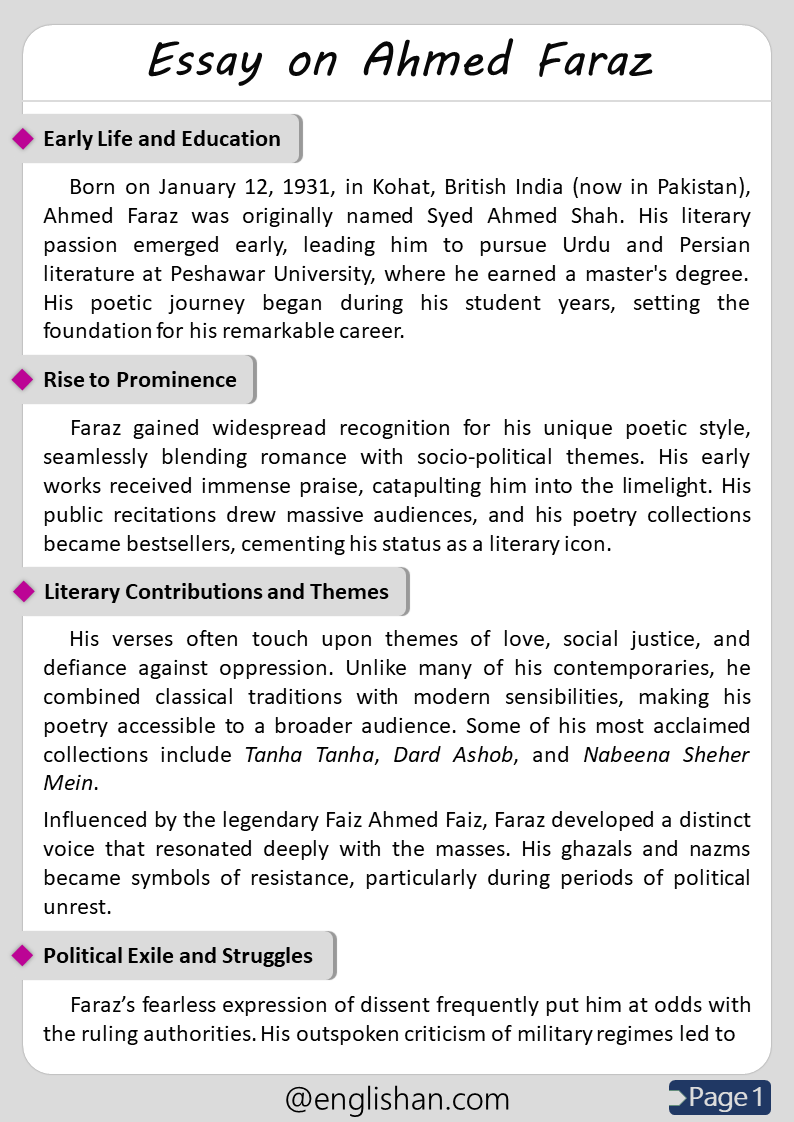
Born on January 12, 1931, in Kohat, British India (now in Pakistan), Ahmed Faraz was originally named Syed Ahmed Shah. His literary passion emerged early, leading him to pursue Urdu and Persian literature at Peshawar University, where he earned a master’s degree. His poetic journey began during his student years, setting the foundation for his remarkable career.
Rise to Prominence
Faraz gained widespread recognition for his unique poetic style, seamlessly blending romance with socio-political themes. His early works received immense praise, catapulting him into the limelight. His public recitations drew massive audiences, and his poetry collections became bestsellers, cementing his status as a literary icon.
Literary Contributions and Themes
His verses often touch upon themes of love, social justice, and defiance against oppression. Unlike many of his contemporaries, he combined classical traditions with modern sensibilities, making his poetry accessible to a broader audience. Some of his most acclaimed collections include Tanha Tanha, Dard Ashob, and Nabeena Sheher Mein.
Influenced by the legendary Faiz Ahmed Faiz, Faraz developed a distinct voice that resonated deeply with the masses. His ghazals and nazms became symbols of resistance, particularly during periods of political unrest.
Political Exile and Struggles
Faraz’s fearless expression of dissent frequently put him at odds with the ruling authorities. His outspoken criticism of military regimes led to his exile during General Zia-ul-Haq’s era. However, this period of forced separation from his homeland only reinforced his commitment to speaking against tyranny and injustice. His resistance poetry remains relevant in contemporary discussions on freedom and human rights.
Notable Works and Literary Influence
Ahmed Faraz’s poetry collections have left a lasting imprint on Urdu literature. His celebrated works, such as Khuwab Gul, Sab Awazain Meri Hain, and Jan-e-Jan, showcase his poetic brilliance, blending romanticism with socio-political critique. His ghazals continue to be widely read, recited, and adapted into musical compositions.
Ahmed Faraz’s Unique Writing Style
His ability to convey complex emotions in an accessible manner made his verses relatable to people from all walks of life. His poetry, whether expressing love, longing, or defiance, continues to inspire emerging poets.
Influence on Modern Poetry and Popular Media
Faraz’s impact extends beyond literature, influencing modern poetry, music, and media. Many contemporary poets and lyricists draw inspiration from his work, reflecting his enduring relevance.
Cultural and Academic Recognition
Faraz’s poetry is widely studied in academic institutions, with his works included in the curricula of various universities. His literary contributions are analyzed in scholarly research and literary forums, reinforcing his significance in Urdu literature.
Public Reception and Global Influence
Poetry has been translated into multiple languages, reaching audiences beyond Urdu-speaking communities. His themes of love, resistance, and human dignity resonate universally, establishing him as a globally recognized literary figure.
Recognition and Legacy
Ahmed Faraz received numerous prestigious awards, including the Sitara-i-Imtiaz and Hilal-i-Imtiaz, for his contributions to literature. His poetry remains an integral part of Urdu literary heritage, cherished by readers and poets alike. His ability to articulate emotions with effortless elegance ensures that his works continue to inspire future generations.
Even after his passing on August 25, 2008, his legacy endures through the continued admiration of his poetry in literary circles, academia, and cultural celebrations worldwide.
Conclusion Ahmed Faraz Essay
Ahmed Faraz’s contributions to Urdu poetry are unparalleled. His fearless expressions of love and resistance established him as an influential literary figure. His poetry remains a timeless beacon of hope and inspiration, securing his place among the greatest poets in Urdu literature.
Difficult Words Used in 500 Ahmed Faraz Essay
| Word | Meaning |
|---|---|
| Exile | Forced absence from one’s country |
| Oppression | Unjust treatment or control |
| Tyranny | Cruel and unfair government rule |
| Defiance | Open resistance to authority |
| Resonance | Deep emotional or intellectual impact |
Ahmed Faraz Essay PDF
You May Also Like