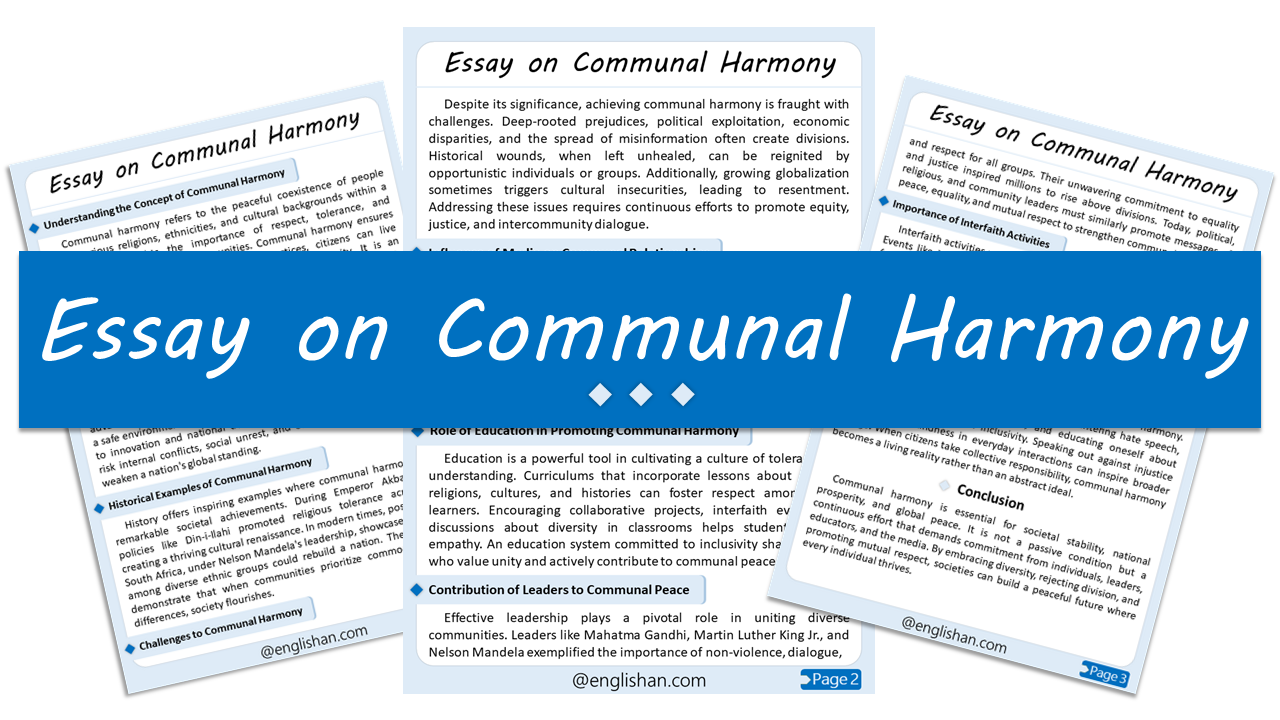
When writing about communal harmony, it’s important to understand how people of different religions, cultures, and languages live together peacefully. This essay on communal harmony explains its meaning, importance, causes of conflict, and how we can promote unity in daily life. It’s written in 500 words to help students with schoolwork, projects, or exams. You can download this communal harmony essay as a free PDF or image to study or print.
10 Lines Communal Harmony Essay for Class 2 to Class 5
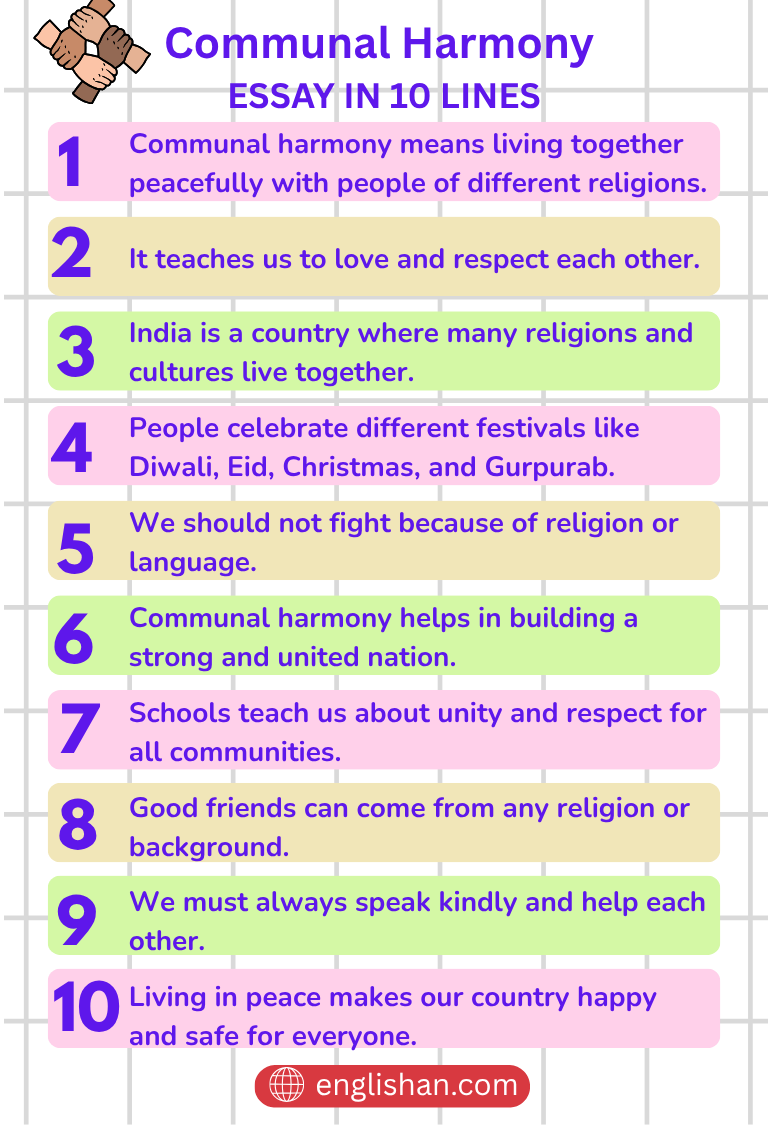
- Communal harmony means living together peacefully with people of different religions.
- It teaches us to love and respect each other.
- India is a country where many religions and cultures live together.
- People celebrate different festivals like Diwali, Eid, Christmas, and Gurpurab.
- We should not fight because of religion or language.
- Communal harmony helps in building a strong and united nation.
- Schools teach us about unity and respect for all communities.
- Good friends can come from any religion or background.
- We must always speak kindly and help each other.
- Living in peace makes our country happy and safe for everyone.
250 Words Essay on Communal Harmony for Middle School
Communal Harmony means peaceful and respectful living among people of different religions, cultures, and traditions. It is very important in a country like India, where many communities live together. People follow different religions such as Hinduism, Islam, Christianity, Sikhism, and others. Despite their differences, they must live with mutual respect, tolerance, and kindness.
Communal harmony creates a peaceful society where everyone can grow and live happily. When people of all religions celebrate festivals together and help one another, it shows unity in diversity. This spirit brings joy and removes hate. It also helps in the development of the country because people work together with love and trust.
However, sometimes people fight because of religious differences. This causes problems in society and stops progress. That is why we should never support violence, hate, or discrimination. We must always promote peace, understanding, and brotherhood.
Schools, families, and communities should teach children the values of love, unity, and respect for all religions. Celebrating different festivals, learning about various cultures, and speaking kindly to everyone are simple ways to build communal harmony.
In conclusion, communal harmony is the key to a strong and united nation. It teaches us to look beyond religion and treat everyone as equal. If we all live with love and peace, the world will be a better place for everyone.
500 Words Communal Harmony Essay for Upper Primary and Lower Secondary
Understanding the Concept of Communal Harmony
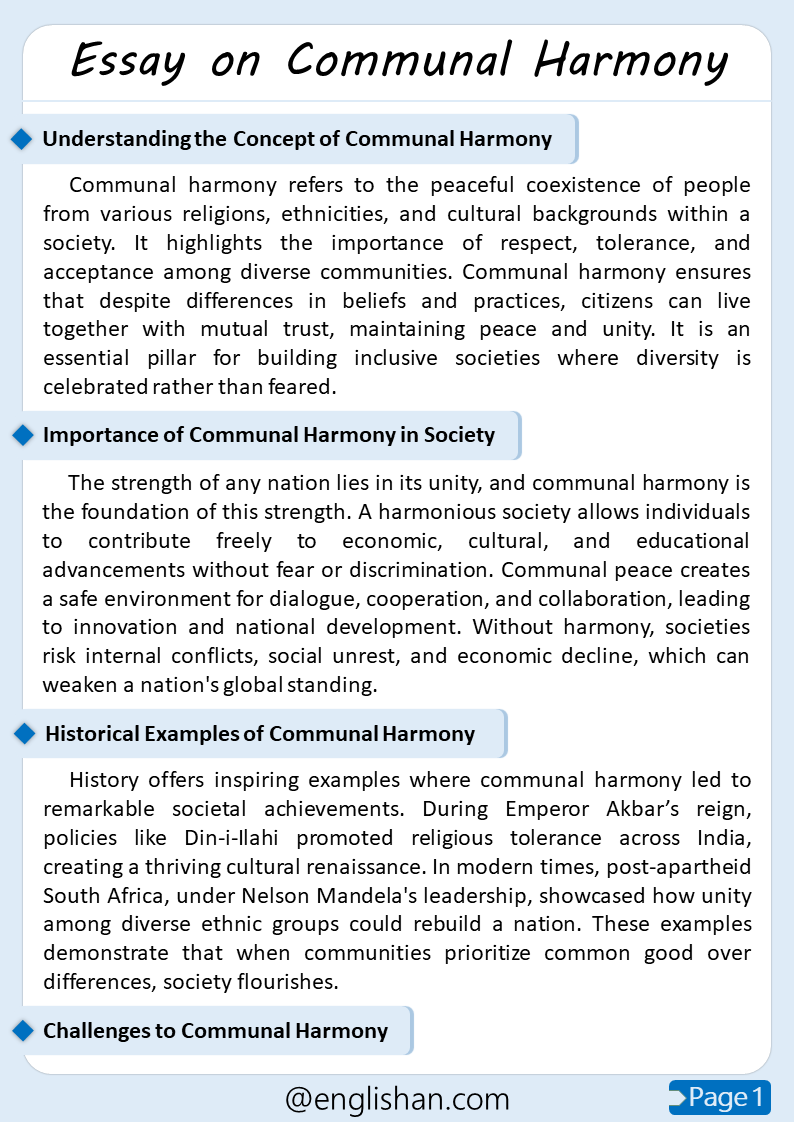
Communal harmony refers to the peaceful coexistence of people from various religions, ethnicities, and cultural backgrounds within a society. It highlights the importance of respect, tolerance, and acceptance among diverse communities. Communal harmony ensures that despite differences in beliefs and practices, citizens can live together with mutual trust, maintaining peace and unity. It is an essential pillar for building inclusive societies where diversity is celebrated rather than feared.
Importance of Communal Harmony in Society
The strength of any nation lies in its unity, and communal harmony is the foundation of this strength. A harmonious society allows individuals to contribute freely to economic, cultural, and educational advancements without fear or discrimination. Communal peace creates a safe environment for dialogue, cooperation, and collaboration, leading to innovation and national development. Without harmony, societies risk internal conflicts, social unrest, and economic decline, which can weaken a nation’s global standing.
Historical Examples of Communal Harmony
History offers inspiring examples where communal harmony led to remarkable societal achievements. During Emperor Akbar’s reign, policies like Din-i-Ilahi promoted religious tolerance across India, creating a thriving cultural renaissance. In modern times, post-apartheid South Africa, under Nelson Mandela’s leadership, showcased how unity among diverse ethnic groups could rebuild a nation. These examples demonstrate that when communities prioritize common good over differences, society flourishes.
Challenges to Communal Harmony
Despite its significance, achieving communal harmony is fraught with challenges. Deep-rooted prejudices, political exploitation, economic disparities, and the spread of misinformation often create divisions. Historical wounds, when left unhealed, can be reignited by opportunistic individuals or groups. Additionally, growing globalization sometimes triggers cultural insecurities, leading to resentment. Addressing these issues requires continuous efforts to promote equity, justice, and intercommunity dialogue.
Influence of Media on Communal Relationships
Media holds tremendous power in shaping public opinion and intercommunity relations. Ethical journalism that portrays positive stories of unity can strengthen bonds between communities. Unfortunately, biased reporting and sensationalism sometimes amplify divisions, spreading fear and mistrust. Social media platforms, while offering opportunities for connection, can also rapidly disseminate hate speech. Therefore, responsible media practices are crucial for maintaining and promoting communal harmony.
Role of Education in Promoting Communal Harmony
Education is a powerful tool in cultivating a culture of tolerance and understanding. Curriculums that incorporate lessons about different religions, cultures, and histories can foster respect among young learners. Encouraging collaborative projects, interfaith events, and discussions about diversity in classrooms helps students develop empathy. An education system committed to inclusivity shapes citizens who value unity and actively contribute to communal peace.
Contribution of Leaders to Communal Peace
Effective leadership plays a pivotal role in uniting diverse communities. Leaders like Mahatma Gandhi, Martin Luther King Jr., and Nelson Mandela exemplified the importance of non-violence, dialogue, and respect for all groups. Their unwavering commitment to equality and justice inspired millions to rise above divisions. Today, political, religious, and community leaders must similarly promote messages of peace, equality, and mutual respect to strengthen communal bonds.
Importance of Interfaith Activities
Interfaith activities serve as important bridges between communities. Events like joint religious celebrations, interfaith prayers, and cultural festivals encourage personal interactions that break down stereotypes. When people participate together, they develop trust, compassion, and shared values. These activities not only deepen understanding but also reduce the likelihood of conflict by building human connections beyond religious and cultural lines.
How Citizens Can Contribute to Communal Harmony
Every individual holds the power to influence societal harmony. Simple acts like respecting others’ traditions, countering hate speech, volunteering for multicultural events, and educating oneself about different communities foster inclusivity. Speaking out against injustice and promoting kindness in everyday interactions can inspire broader change. When citizens take collective responsibility, communal harmony becomes a living reality rather than an abstract ideal.
Conclusion
Communal harmony is essential for societal stability, national prosperity, and global peace. It is not a passive condition but a continuous effort that demands commitment from individuals, leaders, educators, and the media. By embracing diversity, rejecting division, and promoting mutual respect, societies can build a peaceful future where every individual thrives.
Difficult Words Used in 500 Communal Harmony Essay
| Word | Meaning |
|---|---|
| Coexistence | Living together peacefully despite differences |
| Prejudice | An unreasonable dislike or distrust towards people who are different |
| Renaissance | A period of renewed interest and remarkable achievements in culture |
| Sensationalism | Presentation of information in a way that provokes public interest, often exaggerated |
| Inclusivity | The practice of including people from all backgrounds |
| Non-violence | Avoidance of violent actions or behavior |
| Empathy | The ability to understand and share the feelings of others |
| Multicultural | Relating to or consisting of people from different cultures |
| Stereotypes | Oversimplified generalizations about a group of people |
| Prosperity | The state of being successful or thriving |
Communal Harmony Essay PDF
You May Also Like