You may see FFS in a message, comment, social post, or gaming chat and know right away that the tone is frustrated. For ffs meaning in text, the direct expansion is for f*’s sake**, a rude abbreviation people use when they feel annoyed, impatient, or fed up.
That definition is only the starting point. In one message, FFS may sound like tired frustration about a problem. In another, it may sound sharp, sarcastic, or openly rude toward a person. A lot of people pick up the emotion before they know the exact words behind it.
Because the phrase carries implied profanity, it is best treated as informal and potentially offensive. The explanation ahead clears up what it means, how strong it can sound, and when a calmer alternative is the better choice.
What Does FFS Mean in Text?
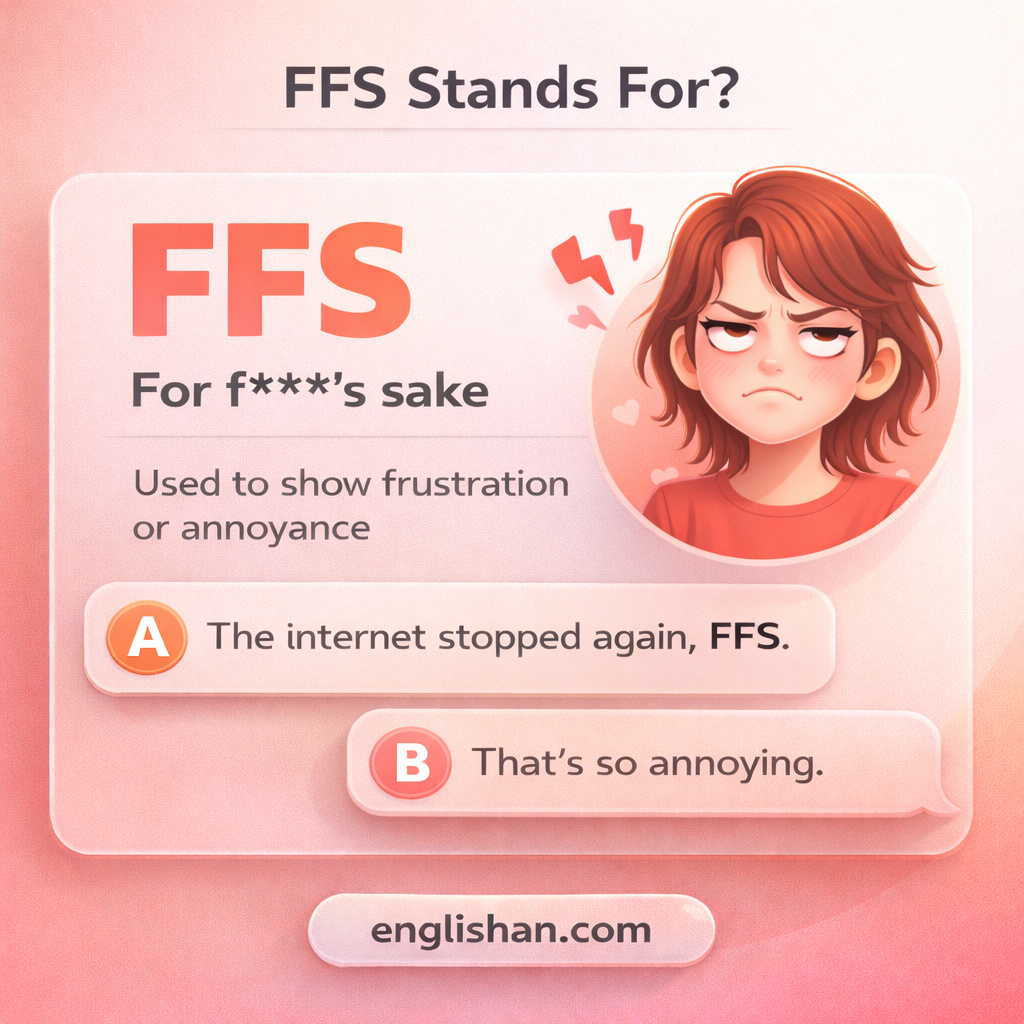
In text messages, FFS means for f**’s sake*.
People use it to show strong irritation, disbelief, impatience, or exasperation. It often appears when something feels repetitive, obvious, annoying, or harder than it should be.
Examples:
- FFS, not again.
- Can this app stop crashing, ffs.
- Oh ffs, seriously?
The phrase is not neutral. Even in shortened form, it carries strong emotion.
FFS Meaning at a Glance
Main meaning
FFS = for f**’s sake*
Common tone
- frustration
- irritation
- impatience
- disbelief
- exasperation
Best setting
Informal chats where strong language is already normal.
Risk to watch
It can sound rude or aggressive, especially when aimed at a person.
What Does FFS Stand For?
FFS stands for for f**’s sake*.
It is a shortened written form of a longer exclamation used to show annoyance or emotional strain. In texting and online chat, the abbreviation saves time but keeps most of the force of the original phrase.
That matters because the letters may look milder than the full wording, but the tone often remains strong.
How Harsh Does FFS Sound?
The tone can range from mild exasperation to open irritation.
At the lighter end, it may sound like frustration at a situation:
- FFS, the Wi-Fi dropped again.
At the harsher end, it may sound more personal:
- FFS, just listen.
That difference matters. A message about a broken app or repeated problem may sound annoyed without sounding hostile. A message directed at a person can feel much sharper.
FFS at a Situation vs FFS at a Person
This is one of the most useful distinctions.
When FFS points at a situation, it usually sounds like venting:
- FFS, the printer jammed again.
- Oh ffs, I forgot my keys.
- ffs this site still will not load.
When FFS points at a person, the tone can become more direct and more negative:
- FFS, stop doing that.
- Can you check the message first, ffs?
- FFS, are you even paying attention?
So if you are deciding whether a message is simply frustrated or actually directed at someone, this is the first thing to notice.
What Changes the Tone of FFS
Small details can change the feel of FFS a lot.
Uppercase vs lowercase
- FFS often looks stronger.
- ffs may feel slightly more casual or tired.
Punctuation
- FFS! feels sharper.
- ffs… can sound drained or defeated.
- oh ffs often sounds like exasperation more than anger.
Emoji
- ffs 😂 can make it sound joking or exaggerated.
- ffs 😑 can sound tired and irritated.
- ffs 😡 pushes it toward open anger.
These details matter because text does not carry voice tone on its own.
FFS vs WTF vs SMH
These expressions can overlap, but they are not the same.
FFS
Best for irritation, exasperation, or being fed up.
WTF
Stronger for shock, anger, or disbelief.
SMH
Usually softer. It often shows disappointment or mild disbelief.
Examples:
- FFS, the site crashed again.
- WTF was that?
- SMH, that was predictable.
If the feeling is tired frustration, FFS usually fits better than WTF. If the tone is more disappointed than explosive, SMH often fits better than either one.
When FFS Is Joking and When It Is Rude
FFS can be joking, but only when the relationship and the topic support that tone.
Among close friends, something like:
- ffs 😂 you really picked that one
may sound playful and exaggerated.
In a tense conversation, the same phrase can sound rude quickly.
A simple rule helps:
- light topic + familiar relationship = more likely joking
- direct criticism + tense situation = more likely rude
That is why FFS works best in spaces where strong casual language is already understood.
What to Say Instead of FFS
Sometimes you want the same idea without the profanity.
Milder casual alternatives
- seriously
- come on
- not again
- you’ve got to be kidding me
- this is so annoying
Polite alternatives
- this is frustrating
- that is really not ideal
- what is going on here?
- this is getting difficult
Professional alternatives
- there seems to be a problem
- this is causing an issue
- can we sort this out?
- something has gone wrong here
These alternatives are useful when you want to show frustration without sounding harsh.
How to Reply to FFS
The best reply depends on what the sender is reacting to.
If they are frustrated at the situation
- yeah, that is really annoying
- I know, it keeps happening
- let’s fix it
- that would frustrate me too
If they are directing it at you
- okay, let’s slow down
- I get that you’re annoyed
- no need to snap, we can sort it out
- tell me what went wrong
If they are joking
- fair enough
- honestly, same
- you are not wrong
- that one deserved a reaction
A useful reply lowers confusion instead of adding more tension.
FFS Examples in Real Messages
Here are a few realistic examples.
Broken tech
- FFS, the internet dropped again right before the upload finished.
Repeated mistake
- We already fixed this once, ffs.
Tired frustration
- oh ffs, I left my notebook at home again.
Gaming chat
- ffs stop running in alone.
Joking exaggeration
- ffs 😂 that was the worst timing possible.
Sharper tone
- Can you answer the question, ffs?
These examples all use the same abbreviation, but the force changes with target, formatting, and context.
When Not to Use FFS
Even in casual writing, FFS does not fit every setting.
Avoid it when:
- you are writing to a teacher, client, manager, or stranger
- the conversation is already tense
- the other person may take it as a personal attack
- the message needs calm rather than heat
- professionalism matters
In those situations, a calmer alternative usually works better.
Key Takeaway
For ffs meaning in text, the direct meaning is for f**’s sake*, a rude abbreviation people use when they feel annoyed, impatient, exasperated, or fed up.
The important part is tone. FFS may point at a problem, a mistake, or a person, and that changes how harsh it feels. Once you notice the target, the formatting, and the message around it, the tone usually becomes much easier to judge.
FAQs
FFS means for f**’s sake* in text. It is used to show frustration, irritation, impatience, or disbelief.
It can be. Because it carries implied profanity, it may sound rude, especially when aimed at a person.
Not always. Sometimes it sounds tired, sarcastic, or joking, especially among close friends, but it is never fully neutral.
Yes, especially with friends or in light frustration, but tone and context still matter.
Usually not in direct communication. On an educational page, it can be explained, but in formal messages it is better to choose more neutral wording.
You May Also Like