

A figure of speech often uses a negative to express a positive, creating understated emphasis in writing or speech. Litotes allows statements to feel subtle, polite, or ironic in sentences.
Practicing litotes sentences helps learners improve English grammar and style. Using these examples allows natural application in writing and speech.
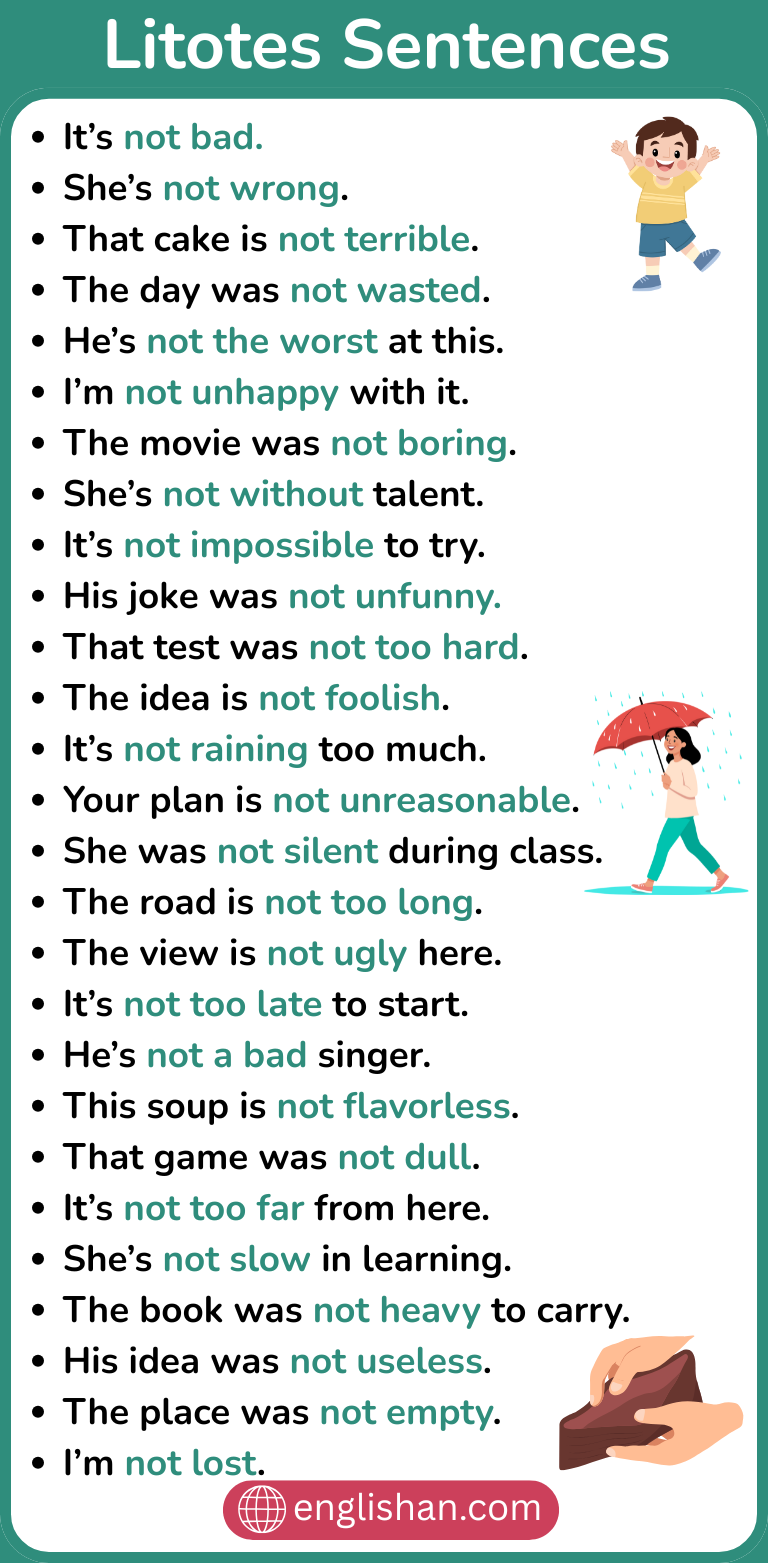
What is Litotes?
Litotes is a figure of speech that expresses an idea by using understatement with a negative to emphasize a positive meaning. It often uses phrases like “not bad” to mean “good” or “not unkind” to suggest kindness.
Litotes Examples In English Sentences
Litotes in English sentences uses a negative to affirm a positive idea indirectly. Below is a list of sentences using litotes to show how these expressions appear naturally in English.
- That movie was not bad at all.
- She’s not unfamiliar with the process.
- The test was no small challenge for him.
- He’s not the worst player on the team.
- This weather is not unpleasant today.
- Your cooking is not too shabby.
- I’m not unaware of the situation.
- The project is no minor task.
- She’s not lacking in courage.
- He’s not without a sense of humor.
- The view here is not disappointing.
- It’s not impossible to solve this.
- She was not unhappy with the results.
- He’s not a bad singer.
- This soup is not flavorless.
- I’m not unimpressed by your work.
- The journey was not without difficulties.
- The book was not boring.
- That was not a terrible idea.
- Her speech was not without emotion.
Short Sentences With Litotes
Short sentences using litotes keep the structure simple and easy to spot in spoken and written English. Below is a list of short sentences using litotes.
- It’s not bad.
- She’s not wrong.
- He’s no fool.
- I’m not tired.
- The food’s not terrible.
- He’s not slow.
- It’s no small thing.
- She’s not weak.
- That’s not useless.
- The plan’s not risky.
- I’m not lost.
- She’s not unhappy.
- The view’s not awful.
- It’s not heavy.
- He’s not clueless.
- That’s not impossible.
- She’s not without hope.
- It’s not dull.
- He’s not shy.
- That’s not boring.
Positive Sentences With Litotes
Litotes can be used in positive sentences to affirm a good idea in a softer way. Below is a list of positive sentences using litotes.
- Your efforts are not unnoticed.
- That solution is not unhelpful.
- She’s not unfamiliar with hard work.
- The team’s success is not surprising.
- His talent is not insignificant.
- The event was not poorly organized.
- This dish is not lacking in flavor.
- Her kindness is not unnoticed.
- The design is not without beauty.
- His answer was not wrong.
- The child’s drawing is not bad.
- Her idea was not useless.
- The support was not unappreciated.
- His effort was not in vain.
- The result is not disappointing.
- That joke was not unfunny.
- Her advice was not unwelcome.
- The game was not unexciting.
- Your gift was not unappreciated.
- The weather is not unpleasant.
Negative Sentences With Litotes
Litotes also appear in negative sentences, using double negatives for indirect emphasis. Below is a list of negative sentences using litotes.
- It’s not uncommon to feel nervous.
- She’s not unaware of the risks.
- The meeting was not without issues.
- His attitude is not without flaws.
- The task is not without difficulty.
- They’re not without options.
- The plan is not without faults.
- The room was not without noise.
- Her speech was not without pauses.
- His story was not without mistakes.
- The weather was not without rain.
- The trip was not without delays.
- The event was not without confusion.
- The game was not without tension.
- His answer was not without hesitation.
- The discussion was not without arguments.
- Their plan was not without risks.
- The process was not without challenges.
- The painting was not without errors.
- The result was not without flaws.
Question Sentences With Litotes
Questions using litotes help form polite or indirect inquiries. Below is a list of question sentences using litotes.
- Isn’t this not a bad idea?
- Isn’t she not unfamiliar with this topic?
- Would you say that’s not unreasonable?
- Isn’t he not the worst choice?
- Don’t you think this is not unimportant?
- Isn’t that not a terrible plan?
- Isn’t it not impossible to try?
- Isn’t the weather not too bad today?
- Would you say this is not without value?
- Isn’t that design not unattractive?
- Isn’t her approach not without merit?
- Isn’t this option not without benefits?
- Isn’t it not uncommon to feel nervous here?
- Would you call this plan not too risky?
- Isn’t this cake not bad?
- Isn’t her idea not foolish?
- Would you say his answer is not wrong?
- Isn’t that test not too hard?
- Isn’t the view here not disappointing?
- Isn’t the journey not too far?
Litotes Sentences In Poems
Litotes are often used in poems to give subtle emphasis. Below is a list of litotes sentences suitable for poems.
- Her smile was not without light.
- The night was not without stars.
- His courage was not unseen.
- The dawn was not without color.
- Her heart was not empty.
- His voice was not silent.
- The river was not still.
- Her eyes were not without hope.
- The road was not easy.
- His spirit was not broken.
- The sky was not dull.
- The rain was not cold.
- Her song was not quiet.
- The breeze was not harsh.
- His words were not sharp.
- The world was not asleep.
- Her laughter was not absent.
- The path was not hidden.
- His dreams were not small.
- The forest was not silent.
Litotes Sentences In Stories
Litotes in stories can shape the tone of a narrative while describing characters, scenes, or actions. Below is a list of litotes sentences used in stories.
- He was not a coward in the face of danger.
- The castle was not without guards.
- She was not unfriendly to the stranger.
- The journey was not without dangers.
- The treasure was not worthless.
- Her kindness was not unnoticed.
- His anger was not hidden.
- The village was not silent that night.
- The hero’s efforts were not in vain.
- The cave was not empty.
- The storm was not calm.
- Her fear was not invisible.
- His words were not empty promises.
- The fight was not easy.
- The path was not clear.
- His promise was not forgotten.
- The forest was not lifeless.
- Her bravery was not untested.
- The quest was not short.
- The moment was not unimportant.
Litotes Sentences In Conversations
Litotes often appear in conversations to soften statements politely. Below is a list of litotes sentences used in conversations.
- “That’s not bad, really.”
- “I’m not unhappy with this.”
- “She’s not wrong, you know.”
- “The coffee’s not terrible.”
- “You’re not wrong about that.”
- “It’s not the worst idea.”
- “I’m not too tired, actually.”
- “He’s not a bad player.”
- “This isn’t not useful.”
- “It’s not impossible, just tricky.”
- “Your advice was not unhelpful.”
- “That’s not a terrible price.”
- “I’m not against the plan.”
- “The weather’s not awful today.”
- “She’s not without skills.”
- “It’s not a huge problem.”
- “This is not too complicated.”
- “You’re not completely wrong.”
- “The food was not bland.”
- “That’s not something to ignore.”
Litotes Sentences For Essays
Litotes can be used in essays to add subtle emphasis and varied tone. Below is a list of litotes sentences suitable for essays.
- The solution is not without flaws.
- This idea is not insignificant.
- The theory is not without merit.
- The evidence is not unconvincing.
- The argument is not weak.
- The data is not without value.
- The method is not impossible to apply.
- The results are not surprising.
- The process is not easy.
- The outcome is not unexpected.
- The progress is not without challenges.
- The proposal is not unreasonable.
- The approach is not without risks.
- The strategy is not ineffective.
- The interpretation is not illogical.
- The study is not unimportant.
- The change is not drastic.
- The event is not without significance.
- The perspective is not unfounded.
- The explanation is not unclear.
You May Also Like