Some birds, such as ostriches and penguins, cannot fly but thrive in their land environments. These flightless birds are known for their special body shape and unique way of living. From deserts to icy coasts, they’ve adapted to different places without the need to fly.
This post gives you the names of flightless birds in English, paired with pictures for easy recall. You’ll find a full list that helps you recognize and describe each bird more confidently.
What Are Birds that Can’t Fly
Flightless birds are a group of birds that do not have the ability to fly. These birds either lost flight through evolution or never developed strong enough wings. They’re known for strong legs, heavy bodies, or small wings.
- Flightless birds: Birds that have no flying ability at all.
- Ground-dwelling birds: They live mostly on the ground and use walking or running.
- Aquatic flightless birds: These birds swim instead of fly, like the penguin.
List of birds that can’t fly
Some birds are born without the ability to fly, while others lost it over time through evolution. Learning their names supports vocabulary growth and recognition of animal types. These birds are often adapted to life on the ground or in water.
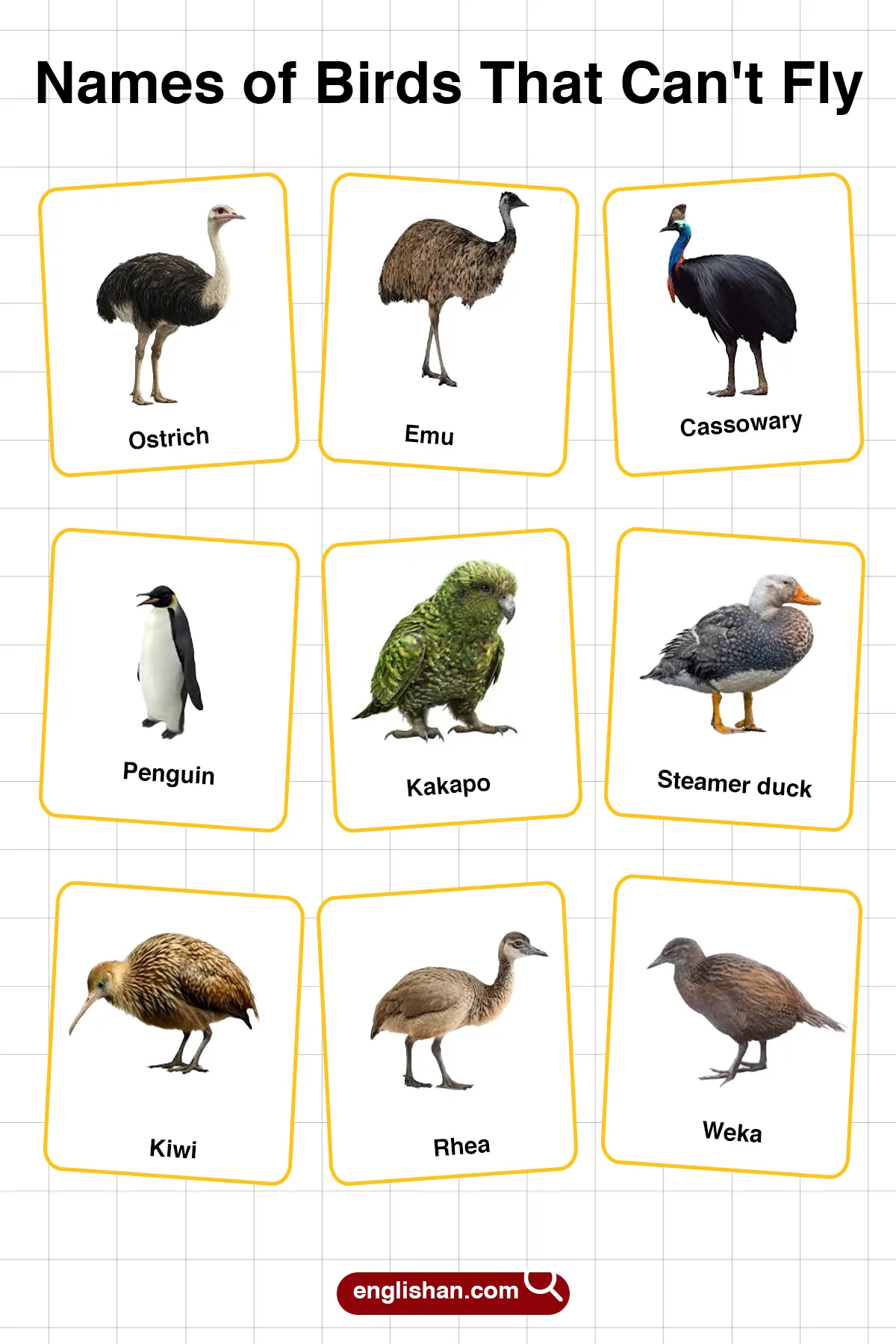
- Ostrich
- Emu
- Cassowary
- Kiwi
- Rhea
- Penguin
- Kakapo
- Steamer duck
- Takahe
- Weka
- Great auk
- Flightless cormorant
- Dodo
- Moa
Birds Evolved to Live Without Flying
Some birds gave up flying as they adapted to their surroundings. These changes helped them survive in places without predators or with more food on the ground.
- Strong legs: Birds like the ostrich evolved strong legs for running.
- Smaller wings: Birds like the kiwi have wings too small for flying.
- Heavier body: A cassowary has a heavy body that prevents flight.
- Safety on islands: Birds like the kakapo evolved without flight on predator-free islands.
Traits of Birds that Don’t Fly
Flightless birds share physical traits that help them live without flying. These include body shape, muscle structure, and behavior.
- Short wings: Their wings are not wide enough to lift them into the air.
- Heavy bodies: Birds like the cassowary are too heavy to fly.
- Strong legs: Strong legs help with walking, running, or swimming.
- Flat breastbone: Without a keeled breastbone, they can’t develop flight muscles.
Large Birds
Big, heavy birds often can’t fly because their wings can’t support their body weight. Many of them rely on speed or strength for protection and survival.
- Ostrich: The ostrich is the largest living bird and uses strong legs to run fast.
- Emu: The emu is native to Australia and can run up to 50 kilometers per hour.
- Cassowary: The cassowary is known for its bright neck and powerful legs.
- Rhea: The rhea is a large South American bird that looks like a smaller ostrich.
Island Birds
Some birds evolved on islands where they didn’t need to fly to escape predators. Over time, they lost their flight ability.
- Kiwi: The kiwi is a small, brown bird from New Zealand with tiny wings.
- Kakapo: The kakapo is a nocturnal parrot that walks and climbs but doesn’t fly.
- Flightless cormorant: Found in the Galápagos, it swims well but cannot fly.
- Weka: The weka is a curious bird from New Zealand that prefers walking.
- Takahe: The takahe is a rare, colorful bird that lives in New Zealand’s grassy areas.
Penguins and Flightless
Penguins are birds, but they cannot fly. Their wings have changed into flippers used for swimming.
- Emperor penguin: The emperor penguin is the tallest and heaviest of all penguins.
- Galápagos penguin: The Galápagos penguin lives near the equator and is excellent at swimming.
- Chinstrap penguin: The chinstrap penguin is named for the black line under its head.
- King penguin: The king penguin looks similar to the emperor but is slightly smaller.
Extinct Flightless Birds
Many flightless birds have gone extinct, often due to human activity. Their names are still studied and remembered.
- Dodo: The dodo lived on Mauritius and became extinct in the 1600s.
- Moa: The moa was a giant bird from New Zealand, now extinct.
- Great auk: The great auk was a northern seabird hunted to extinction.
Support Flightless Birds
The natural homes of flightless birds are often islands, forests, or coasts. These places provide safety and plenty of food.
- Forests: Some birds like the takahe live in mountain forests.
- Grasslands: Rheas and emus live in wide open grasslands.
- Islands: Flightless birds often evolve on predator-free islands.
- Coasts: Penguins live near cold coasts where they can fish and swim.
Identify Birds that Can’t Fly
You can recognize flightless birds by their wings, posture, and the way they move. Most walk or run instead of flying.
- Short wings: Look for small or hidden wings.
- Sturdy legs: Strong legs show they are built for ground movement.
- No take-off: They never flap or glide like flying birds.
- Ground nests: They build nests on the ground, not in trees.
Conclusion
Understanding the names of birds that can’t fly helps improve vocabulary and supports clear communication about animals in English. These birds are useful examples when learning how living things adapt to their environment. Knowing their names also makes it easier to describe bird types in reading and writing tasks. Keep practicing these words to remember their meanings and use them confidently in your language learning.
FAQs About Birds that Can’t Fly
The Inaccessible Island rail is the world’s smallest flightless bird, weighing about 34–40 g and measuring just 13–15 cm long.
Yes the Galápagos or flightless cormorant is the only cormorant species that lost its flying ability. Its wings are about one‑third the size needed to fly.
Yes ratites are a group of flightless birds including ostrich, emu, cassowary, rhea, and kiwi. They all lack a keel on their breastbone, which stops them from flying.
Cassowaries are flightless but have sharp claws and strong legs. They can run fast (up to 30 mph) and have a powerful kick. Some have even injured humans.
Penguins have wings too, but they evolved into powerful flippers. Their wings are too rigid and heavy for flying in air. Instead, penguins use them to swim underwater at high speeds (up to 22 mph).
You May Also Like