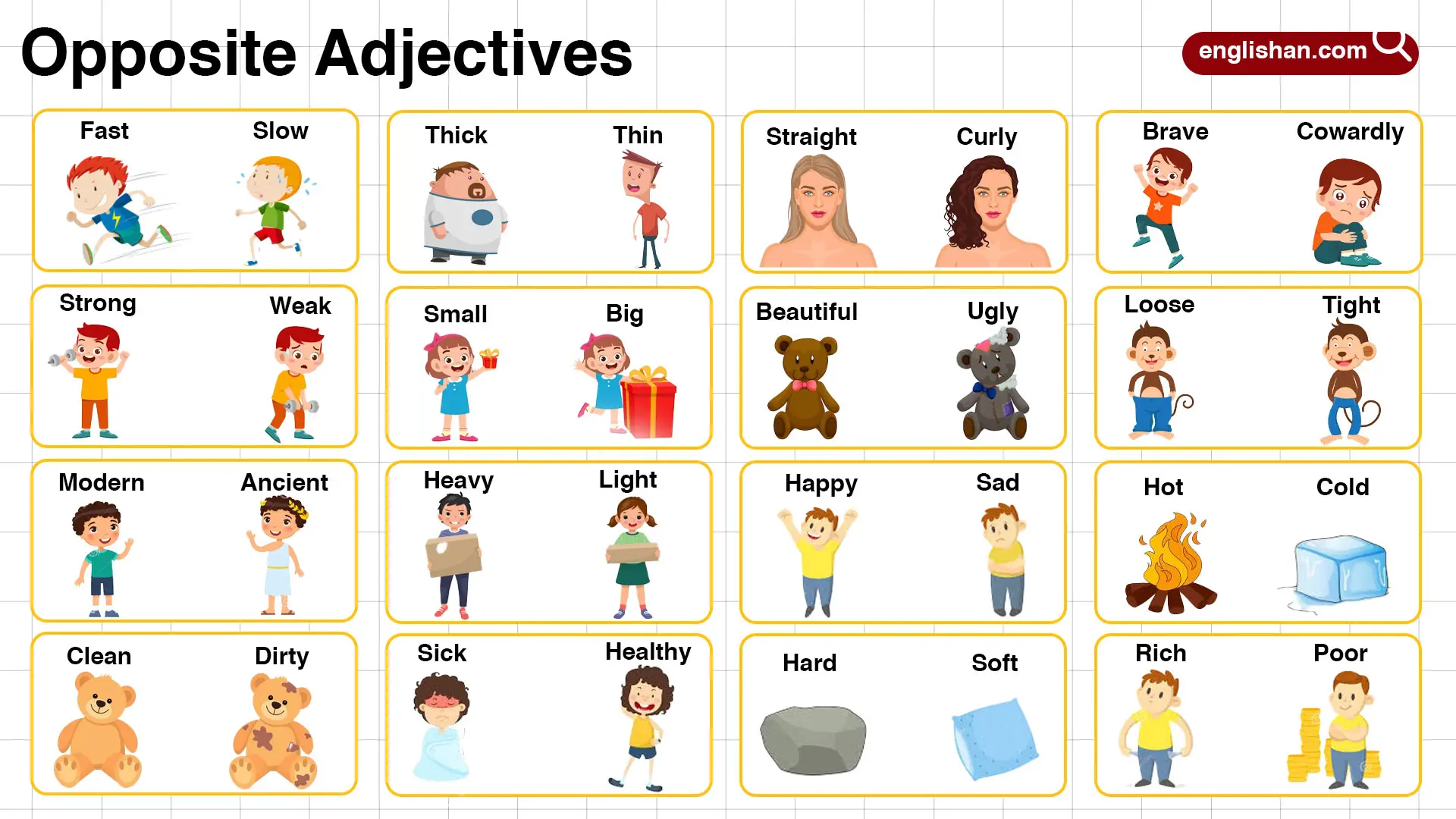
Opposite adjectives are word pairs like big and small or happy and sad that help us show contrast in meaning. These adjectives are useful for describing people, objects, or situations with clear differences. Learning adjective opposites builds vocabulary and helps learners choose the right words when comparing things. In this guide, you’ll learn what opposite adjectives are and how to use them correctly.
What Are Opposite Adjectives?
Opposite adjectives are word pairs that describe completely different or contrasting qualities. For example, big and small show opposite sizes.
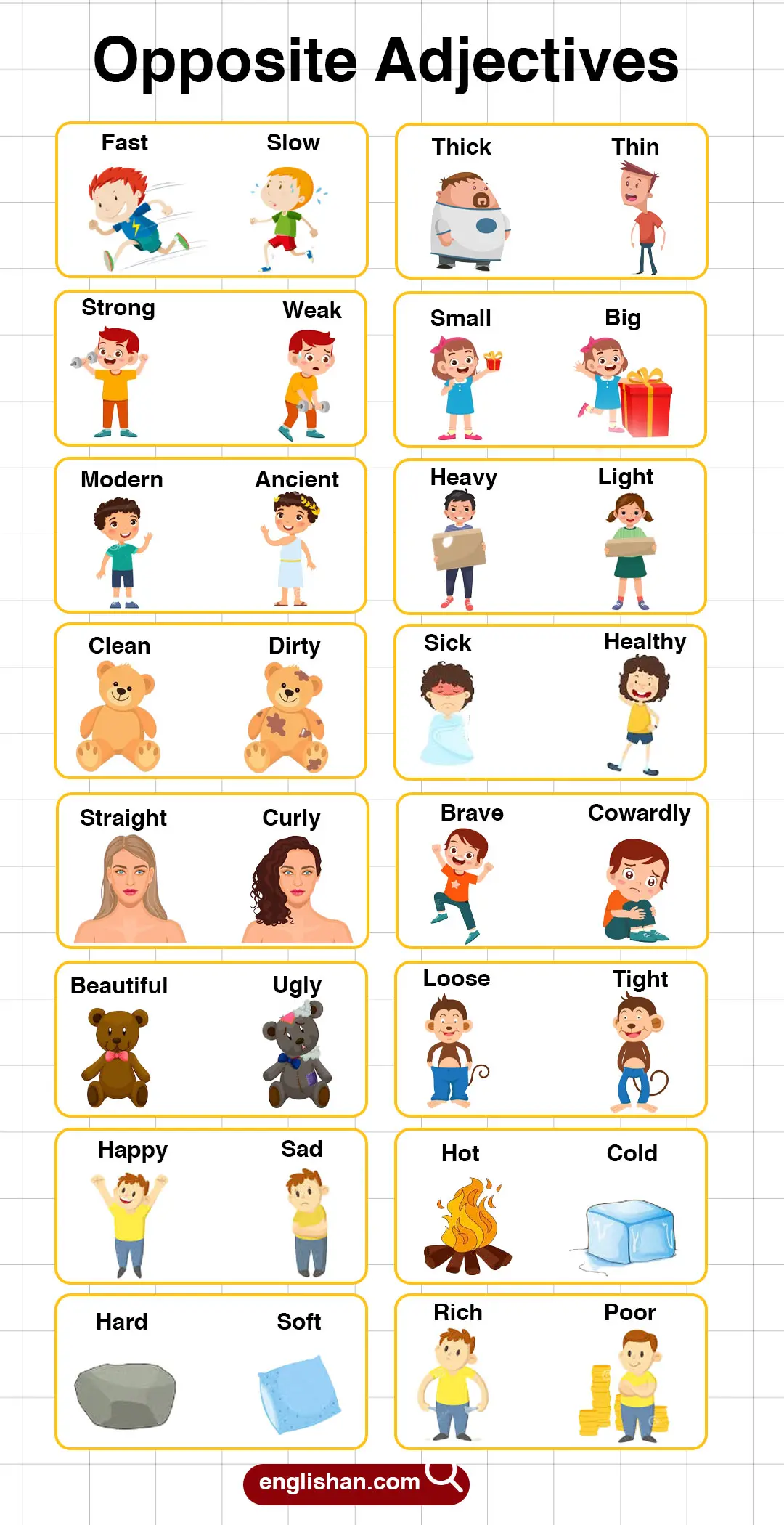
List of Opposite Adjectives with Sentences
| Adjectives | Opposite |
|---|---|
| Slow | Fast |
| Thick | Thin |
| Straight | Curly |
| Light | Heavy |
| Loose | Tight |
| Beautiful | Ugly |
| Big | Small |
| Strong | Weak |
| Brave | Cowardly |
| Modern | Ancient |
| Happy | Sad |
| Hot | Cold |
| Clean | Dirty |
| Healthy | Sick |
| Hard-working | Lazy |
| Optimistic | Pessimistic |
| Friendly | Unfriendly |
| Generous | Selfish |
| Bright | Dim |
| Deep | Shallow |
| Early | Late |
| Expensive | Cheap |
| Full | Empty |
| Hard | Soft |
| Kind | Mean |
| Narrow | Wide |
| Noisy | Quiet |
| Rich | Poor |
| Smart | Foolish |
| Sweet | Bitter |
| Wet | Dry |
| Young | Old |
Personality Opposite Adjectives List with Examples
- Brave vs. Cowardly
– A brave person faces challenges.
– A cowardly person avoids them out of fear.
Example: Zainab is brave for speaking in front of a crowd. - Generous vs. Selfish
– A generous person shares time or things.
– A selfish person only thinks about themselves.
Example: Ali is generous and helps his friends often. - Friendly vs. Unfriendly
– A friendly person is kind and welcoming.
– An unfriendly person is cold or rude.
Example: Our neighbor is friendly and always greets us.
Opposite Adjectives for Appearance (with Examples)
- Beautiful vs. Ugly
– Beautiful means pleasant to look at.
– Ugly means not pleasant or unattractive.
Example: The park is beautiful with flowers, but the alley is ugly and dirty. - Thick vs. Thin
– Thick means wide or full in size.
– Thin means narrow or not thick.
Example: The winter coat is thick and warm, but the scarf is thin and light. - Tall vs. Short
– Tall means greater in height.
– Short means less in height.
Example: Hiba is tall enough to reach the shelf, but her sister is short and uses a stool.
Opposite Adjectives for Actions (with Examples)
- Hard-working vs. Lazy
– A hard-working person puts in consistent effort.
– A lazy person avoids work or effort.
Example: Ahmed is hard-working and stays late to finish his tasks. - Careful vs. Careless
– A careful person pays attention to what they do.
– A careless person acts without thinking or attention.
Example: The careful driver checked all mirrors, but the careless one caused an accident.
Opposite Adjectives for Emotions (with Examples)
- Happy vs. Sad
– Happy means feeling good or joyful.
– Sad means feeling bad or unhappy.
Example: Hassan was happy after passing his exam, but Sarah was sad because she didn’t. - Optimistic vs. Pessimistic
– An optimistic person sees the good in situations.
– A pessimistic person focuses on the negative.
Example: An optimistic person hopes for better days, but a pessimistic one doubts things will improve.
Opposite Adjectives for Places and Objects (with Examples)
- Modern vs. Ancient
– Modern means new or current.
– Ancient means very old or from the past.
Example: The city center is modern, but the outskirts have ancient ruins. - Clean vs. Dirty
– Clean means neat and tidy.
– Dirty means messy or unclean.
Example: The kitchen is clean, but the garage is dirty and cluttered. - Big vs. Small
– Big means large in size.
– Small means little or not large.
Example: The mansion is big and spacious, while the cottage is small but cozy.
Opposite Adjectives for Weather (with Examples)
- Hot vs. Cold
– Hot means high in temperature.
– Cold means low in temperature.
Example: The summer afternoon was hot, but the winter morning was cold and foggy. - Dry vs. Wet
– Dry means no moisture or rain.
– Wet means covered with water or rain.
Example: The desert is dry, but the rainforest is wet and humid. - Bright vs. Dark
– Bright means full of light.
– Dark means little or no light.
Example: The room was bright with sunlight but became dark when the curtains were closed.
Opposite Adjectives for Time and Speed (with Examples)
- Slow vs. Fast
– Slow means something takes more time.
– Fast means something happens quickly.
Example: The old man walked slow, but the young boy ran fast. - Early vs. Late
– Early means before the expected time.
– Late means after the expected time.
Example: We arrived early for the concert, but many people came late.
How to Use Opposite Adjectives in Sentences
When using opposite adjectives, they show differences. For example:
- Correct: Aisha’s dress is long, but Zainab’s dress is short. ✅
- Incorrect: Aisha’s dress is long, and Zainab’s dress is long too. ❌
Tips for using opposite adjectives:
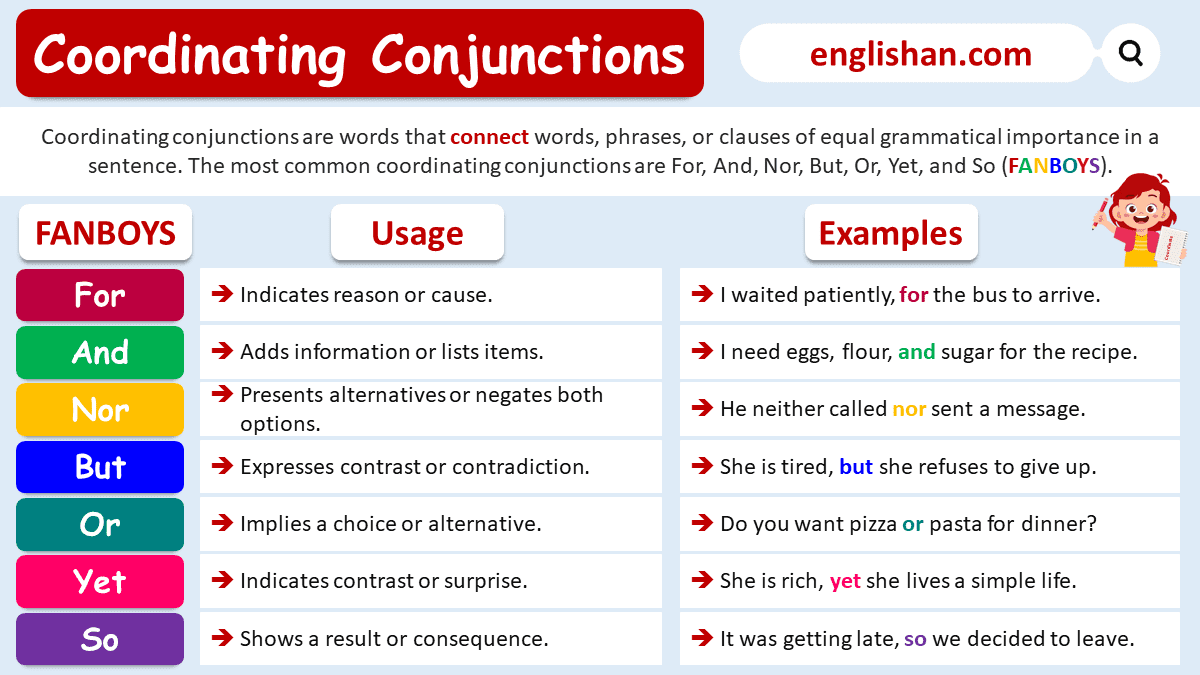
- Use but or while to compare opposites.
- Keep the adjectives near the words they describe.
FAQs on Opposite Adjectives
Q1: What are opposite adjectives?
A1: Opposite adjectives are words that have opposite meanings, like big and small.
Q2: How do I use opposite adjectives in sentences?
A2: You can use them to compare. Example: The blue car is fast, but the red car is slow.
Q3: Why are opposite adjectives important?
A3: They help you explain differences and improve your vocabulary.
You May Also Like