A chandelier might look like a single beautiful piece, but it’s actually made up of many different parts working together. From the ceiling mount that holds it in place to the arms, bulbs, and sparkling crystals, each component has its own role. In this article, we’ll break down the parts of a chandelier in a simple and easy way, along with a labeled diagram to help you clearly understand how everything fits together.
List of Chandelier Parts With Names
- Hook
- Canopy
- Chain
- Rod (Downrod)
- Body Dish
- Column (Central Stem)
- Candle Tube
- Candle Cup
- Bobeche
- Bulb/Lamp
- Prism
- Bottom Bowl
- Arms
- Pendalogue
- Beads / Chains
- Bottom Ball
- Finial
Parts of a Chandelier Diagram With Names
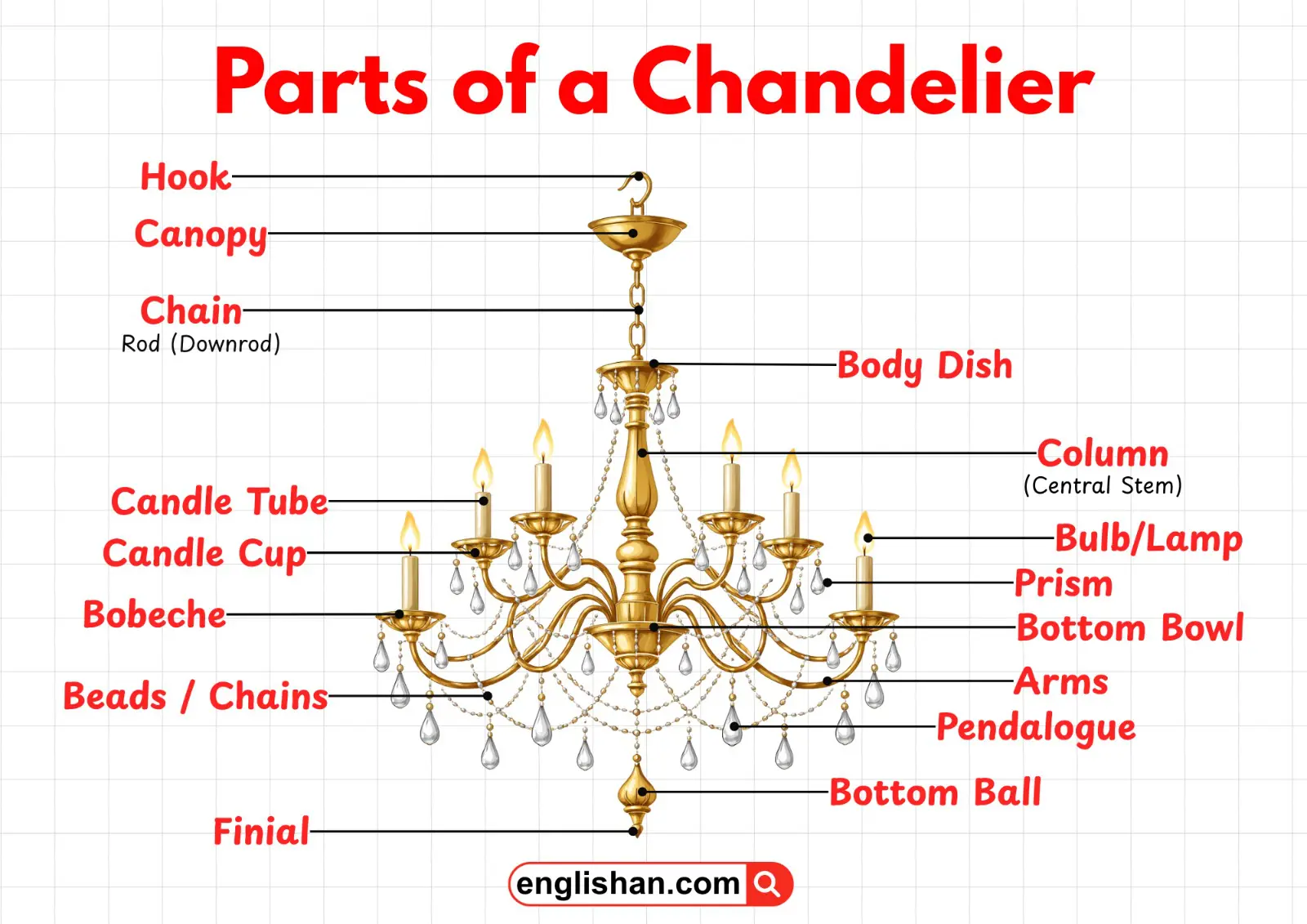
A chandelier is made up of several important parts that work together to create both light and elegance in a space. The mounting components, such as the hook, canopy, and chain, hold the chandelier securely to the ceiling. The central column and arms form the main structure, supporting the lights and giving the chandelier its shape. Lighting elements like the bulb, candle tube, and candle cup provide illumination, while decorative pieces such as prisms, pendalogues, and beads add sparkle and enhance its beauty. Other parts like the finial and bottom bowl complete the overall design and balance. Each component plays a key role in making the chandelier both functional and visually stunning.
Mounting & Support Components
These parts attach the chandelier to the ceiling and provide strong, secure support while also managing height and stability.
Hook
The hook is a heavy-duty metal fixture installed into the ceiling structure, designed to carry the full weight of the chandelier. It acts as the primary anchor point, ensuring safety and preventing the chandelier from falling. A properly installed hook is essential for both stability and long-term durability.
Canopy
The canopy is a dome-shaped cover that sits flush against the ceiling, concealing electrical wiring, mounting brackets, and hardware. Beyond its functional role, it also enhances aesthetics by providing a clean, polished finish where the chandelier meets the ceiling.
Chain
The chain is made of interconnected metal links that suspend the chandelier from the hook. It allows flexibility in adjusting the chandelier’s hanging height and adds a traditional, elegant look. Chains are often designed to match the chandelier’s finish, contributing to the overall style.
Rod (Downrod)
The downrod is a solid, straight metal pipe used as an alternative to a chain. It provides a more rigid and stable support system, minimizing sway. Downrods are commonly used in modern or minimalist chandelier designs where a sleek appearance is preferred.
Main Structure Components
These components form the central body, giving the chandelier its shape, balance, and structural integrity.
Body Dish
The body dish is a decorative, bowl-like component located near the upper section of the chandelier. It acts as a connector between the suspension system and the main body, often serving as a base for attaching crystals or other decorative elements.
Column (Central Stem)
The column, also known as the central stem, is the backbone of the chandelier. It runs vertically from top to bottom, supporting the arms, bowls, and decorative features. This part ensures that all components remain aligned and balanced.
Bottom Bowl
The bottom bowl is a rounded structural piece located toward the lower section of the chandelier. It helps distribute weight evenly and often conceals internal hardware or wiring connections, while also adding to the layered design.
Bottom Ball
The bottom ball is a spherical ornament placed near the end of the chandelier. It provides visual weight and symmetry, making the chandelier appear balanced from top to bottom.
Finial
The finial is the final decorative element at the very bottom tip. It is often intricately designed and serves as a visual “full stop” that completes the chandelier’s overall look with elegance.
Lighting Components
These are the functional parts responsible for holding and supporting the light sources.
Candle Tube
The candle tube is a slim cylindrical cover that surrounds the light socket. It mimics the look of a traditional wax candle, giving classic chandeliers their signature appearance while hiding modern electrical fittings.
Candle Cup
The candle cup sits directly beneath the candle tube and acts as a base. Historically, it was designed to catch dripping wax, but in modern chandeliers, it mainly serves a decorative purpose and supports the lighting structure.
Bulb/Lamp
The bulb or lamp is the actual source of light. It determines the brightness, color temperature, and overall ambiance of the chandelier. Different styles of bulbs (like LED or filament bulbs) can dramatically change the chandelier’s look and feel.
Decorative Components
These elements enhance visual appeal, reflect light, and create the luxurious sparkle associated with chandeliers.
Bobeche
The bobeche is a shallow, dish-like ornament placed around or beneath the candle cup. Traditionally used to catch wax drips, it now often features crystals or glass accents that add elegance and detail.
Prism
Prisms are finely cut crystal pieces designed to refract light into multiple colors. When light passes through them, they create shimmering rainbow effects, adding brilliance and liveliness to the chandelier.
Pendalogue
Pendalogue refers to the hanging crystal ornaments, often shaped like teardrops. These pieces swing slightly and catch light from different angles, enhancing sparkle and movement.
Beads / Chains
Beads or chains are strings of small crystals or decorative elements draped across the chandelier. They add texture, depth, and a sense of richness, making the design more intricate and visually appealing.
Extension & Support Arms
These parts extend outward from the central structure to hold lights and distribute weight evenly.
Arms
The arms are curved or straight extensions that branch out from the central column. Each arm supports a light source (candle tube and bulb) and often includes decorative elements. Their arrangement defines the chandelier’s overall shape and symmetry.
Key Takeaway
As we learned, a chandelier is made up of different parts that work together to provide both support and beauty. The mounting components like the hook, canopy, and chain keep it securely attached, while the central structure such as the column, body dish, and arms give it shape and balance. Lighting parts like the bulb, candle tube, and candle cup provide illumination, and decorative elements like prisms, pendalogues, and beads add sparkle and elegance. Together, all these parts combine to create a functional yet visually stunning lighting fixture.
You May Also Like