A scooty may look simple from the outside, but it’s made up of many important parts that work together to give you a smooth and safe ride. From the handlebar controls to the engine inside, each part has its own role. In this guide, we’ll walk through the main parts of a scooty in a clear and easy way, so you can understand how it works without getting confused.
List of Scooty Parts With Names
- Instrument Panel
- Mirrors
- Headlight
- Signal Lights
- Brakes (Levers)
- Throttle Grip
- Main Switch (Ignition)
- Seat
- Grab Handle
- Fuel Filler Cap
- Body Panels & Frame
- Footboard
- Luggage Hook
- Front Fender
- Mudguard (Rear)
- Tail Light
- Reflector
- Wheels & Tyres
- Exhaust Muffler
- Engine
- Fuel Tank
- Battery
- Starter Motor
- Kick Start Lever
- CVT / Transmission System
- Drive Belt
- Air Filter
- Spark Plug
- Suspension
- Brake System
- Cooling System
- ECU / CDI Unit
- Horn
- Side Stand
- Main Stand
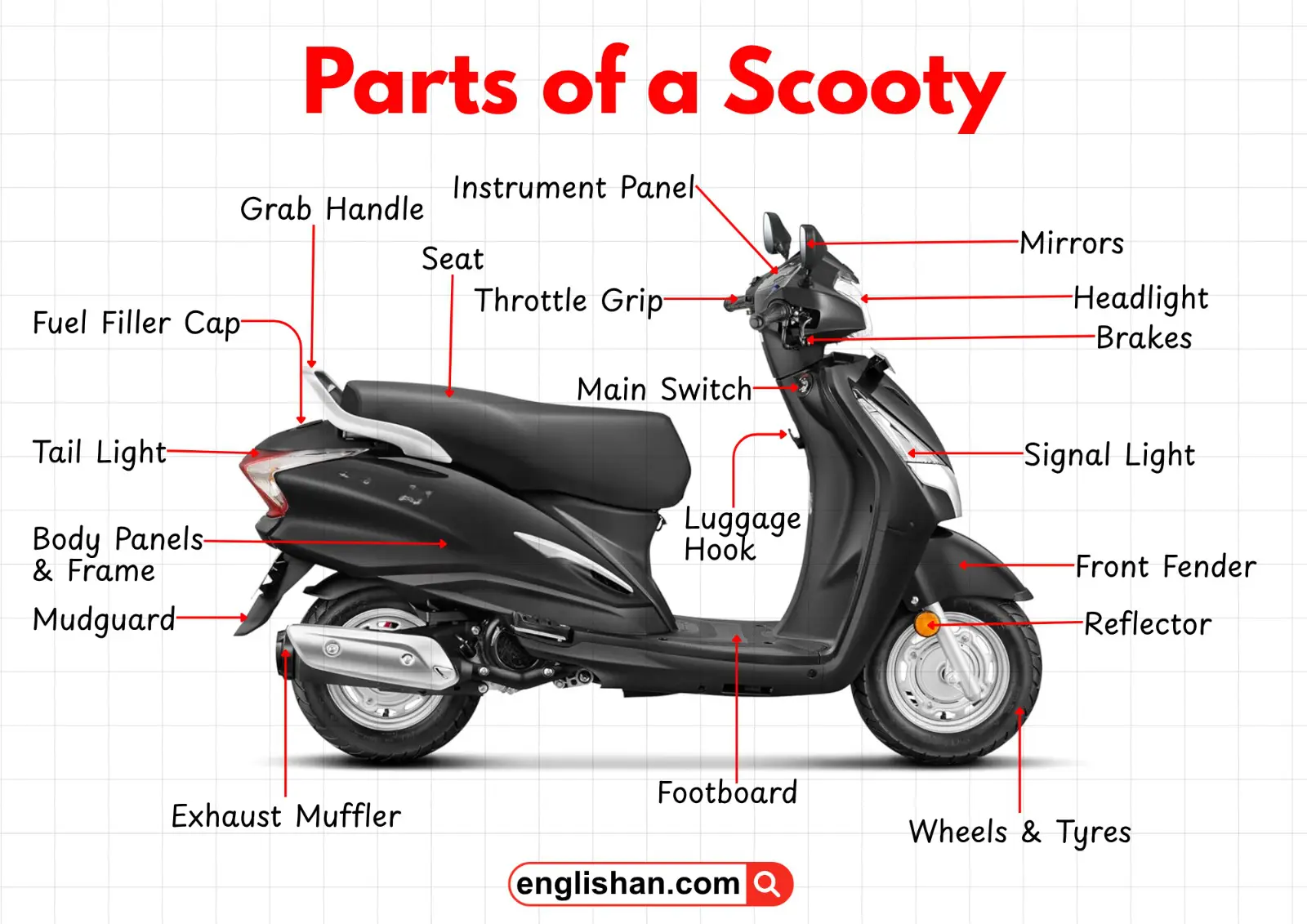
Parts of a Scooty Diagram With Names
A scooty is made up of several parts that work together to provide smooth movement, control, and safety on the road. The frame and body panels form the main structure that supports all the components, while the engine and transmission system generate and transfer power to move the scooty forward. The wheels, tyres, and suspension ensure balance and a comfortable ride on different surfaces. Control parts like the handlebar, brakes, and throttle help the rider manage speed and direction with ease. Lighting components such as the headlight, tail light, and indicators improve visibility and safety, especially in traffic or low-light conditions. Additional parts like the seat, fuel tank, and storage features add comfort and convenience. Each part plays an important role in making a scooty efficient, reliable, and easy to use in everyday life.
Control & Operation Parts
These are the rider-interactive components that govern acceleration, deceleration, steering awareness, and system activation. Precision and responsiveness in these parts directly impact safety and ride quality.
Instrument Panel
The instrument panel functions as the scooty’s real-time feedback system. It continuously displays critical riding data such as speed, fuel level, turn signal status, and warning indicators. Advanced panels may include digital readouts for trip distance, clock, service reminders, and diagnostic alerts. This allows the rider to make informed decisions without distraction.
Throttle Grip
The throttle grip regulates engine output by controlling the air-fuel mixture entering the engine. When rotated, it increases engine RPM, resulting in acceleration. Its design ensures smooth modulation, allowing the rider to precisely control speed in traffic or on open roads.
Brakes (Levers)
Brake levers activate the braking system through mechanical or hydraulic force. Pressing them creates friction within the brake assembly, reducing wheel rotation. Balanced use of both levers ensures controlled deceleration and prevents skidding or instability.
Main Switch (Ignition)
The ignition switch is the central control point for powering the scooty. It activates the electrical system, enabling the engine to start. It also integrates security features like steering lock and may include access controls for storage compartments.
Mirrors
Rear-view mirrors provide situational awareness by reflecting traffic conditions behind the rider. Properly adjusted mirrors minimize blind spots and are essential for safe maneuvering, especially during lane changes or overtaking.
Lighting & Safety Parts
These components enhance visibility, signaling, and road communication, ensuring the rider is both seen and able to see clearly in all conditions.
Headlight
The headlight emits a focused beam of light to illuminate the road ahead. It is engineered with reflectors and lenses to maximize visibility while minimizing glare for oncoming traffic. Dual-beam functionality allows adaptation to different lighting conditions.
Signal Lights
Signal lights communicate the rider’s intended direction. Their blinking mechanism ensures high visibility, allowing other road users to anticipate movements and react accordingly.
Tail Light
The tail light provides constant rear visibility. It intensifies when brakes are applied, serving as a clear visual cue to following vehicles, thereby reducing the risk of rear-end collisions.
Reflector
Reflectors enhance passive safety by reflecting external light sources, such as headlights from other vehicles. This ensures the scooty remains visible even when its own lights are not actively in use.
Horn
The horn emits an audible warning signal to alert pedestrians and vehicles. It is especially critical in dense traffic environments where visual signals alone may be insufficient.
Body & Structural Parts
These parts form the framework and outer shell, ensuring structural integrity, rider protection, and aerodynamic design.
Body Panels & Frame
The frame acts as the load-bearing structure, supporting the engine, wheels, and rider. Body panels are mounted over the frame to protect internal components and provide a streamlined, aesthetic exterior.
Seat
The seat is ergonomically designed to provide comfort during rides. It distributes body weight evenly and often incorporates storage space underneath, making it both functional and practical.
Grab Handle
The grab handle offers support to the passenger, ensuring stability during acceleration and braking. It also assists in maneuvering the scooty during parking or lifting.
Footboard
The footboard provides a stable platform for the rider’s feet, contributing to balance and posture. Its flat design also allows for carrying small items.
Front Fender
The front fender shields the rider and vehicle from debris, mud, and water thrown up by the front tyre, maintaining cleanliness and visibility.
Mudguard (Rear)
The rear mudguard performs a similar protective function for the back wheel, preventing dirt and water from reaching the rider and nearby vehicles.
Utility & Convenience Parts
These parts enhance daily usability and rider convenience, making the scooty more practical for routine tasks.
Fuel Filler Cap
The fuel filler cap securely seals the fuel tank, preventing leakage and contamination. It is designed for easy access while ensuring a tight closure.
Luggage Hook
The luggage hook provides a simple solution for carrying bags. Its strategic placement ensures items remain stable without interfering with riding control.
Wheel & Movement System
These components enable motion, traction, and ride stability, forming the foundation of mobility.
Wheels & Tyres
Wheels support the scooty’s weight, while tyres ensure grip and traction. The tyre composition and tread pattern are crucial for maintaining stability on various road surfaces.
Suspension (Front Fork & Rear Shock Absorber)
The suspension system absorbs shocks from uneven terrain. It maintains tyre contact with the road, improving comfort, handling, and overall ride stability.
Engine & Power System
This system is responsible for generating and sustaining the energy required for movement.
Engine
The engine converts chemical energy from fuel into mechanical energy through combustion. This process drives the scooty forward, making it the core functional unit.
Fuel Tank
The fuel tank stores petrol and ensures a steady supply to the engine. It is designed to handle pressure changes and prevent leakage.
Air Filter
The air filter removes dust and impurities from incoming air. Clean air is essential for efficient combustion and long engine life.
Spark Plug
The spark plug generates an electric spark that ignites the compressed air-fuel mixture. This ignition initiates the power stroke within the engine cycle.
Cooling System (Radiator/Air Cooling)
The cooling system regulates engine temperature by dissipating excess heat. This prevents overheating and ensures consistent performance.
Transmission System
This system ensures smooth transfer of power from the engine to the wheels.
CVT / Transmission System
The CVT automatically adjusts gear ratios based on speed and load. This eliminates the need for manual gear shifting and provides seamless acceleration.
Drive Belt
The drive belt transmits rotational power from the engine to the rear wheel. Its flexibility and durability are essential for efficient power delivery.
Electrical System
These components manage power distribution and electronic control functions.
Battery
The battery stores electrical energy and supplies it to various systems, including lights, ignition, and starting mechanisms.
Starter Motor
The starter motor initiates engine rotation using electrical energy, allowing the engine to start quickly and effortlessly.
ECU / CDI Unit
This unit controls ignition timing and engine parameters. It optimizes performance, fuel efficiency, and reliability.
Braking System (Detailed)
These parts provide controlled stopping power through friction-based mechanisms.
Brake System (Disc/Drum & Caliper)
The braking system converts kinetic energy into heat through friction. Disc brakes use calipers and rotors for strong stopping power, while drum brakes use enclosed shoes for simpler operation.
Support & Stand Parts
These parts ensure stability when the scooty is stationary.
Side Stand
The side stand allows quick and convenient parking by tilting the scooty to one side.
Main Stand
The main stand lifts the scooty upright, providing greater stability and making maintenance tasks easier.
Exhaust System
This system manages emission flow and noise reduction.
Exhaust Muffler
The exhaust muffler channels exhaust gases away from the engine while reducing noise levels. It also helps control emissions, contributing to environmental safety.
Key Takeaway
As we learned, a scooty is a combination of interconnected parts that work together to handle control, power, safety, and comfort. Each component, from the engine to the brakes, plays a specific role, and understanding them in categories makes it easier to see how the scooty functions as a complete and efficient system.
You May Also Like