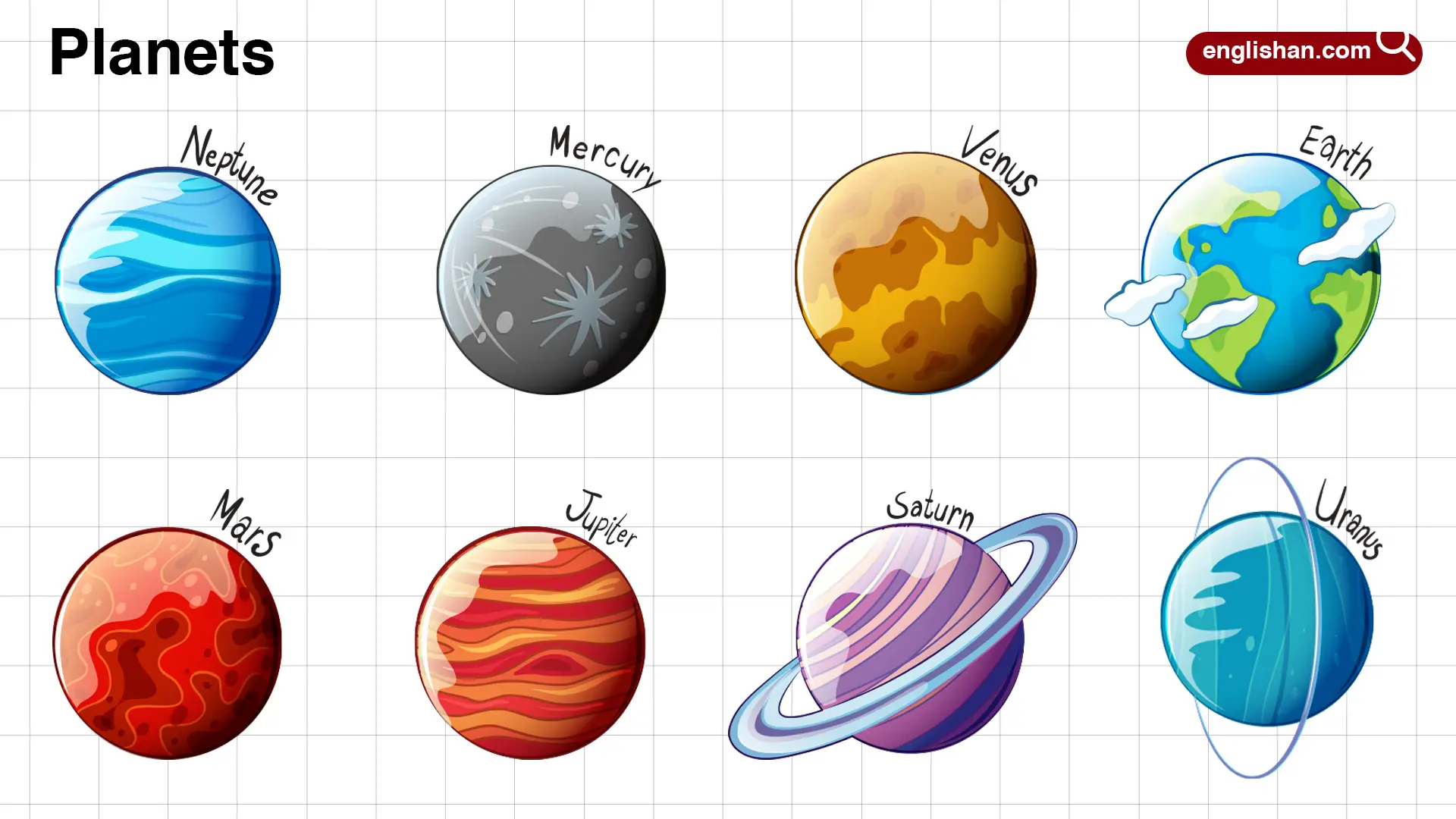
Many large space bodies orbit the Sun in our solar system. These planets names include Mercury, Venus, Earth, and others, each with unique features like size, atmosphere, and distance from the Sun.
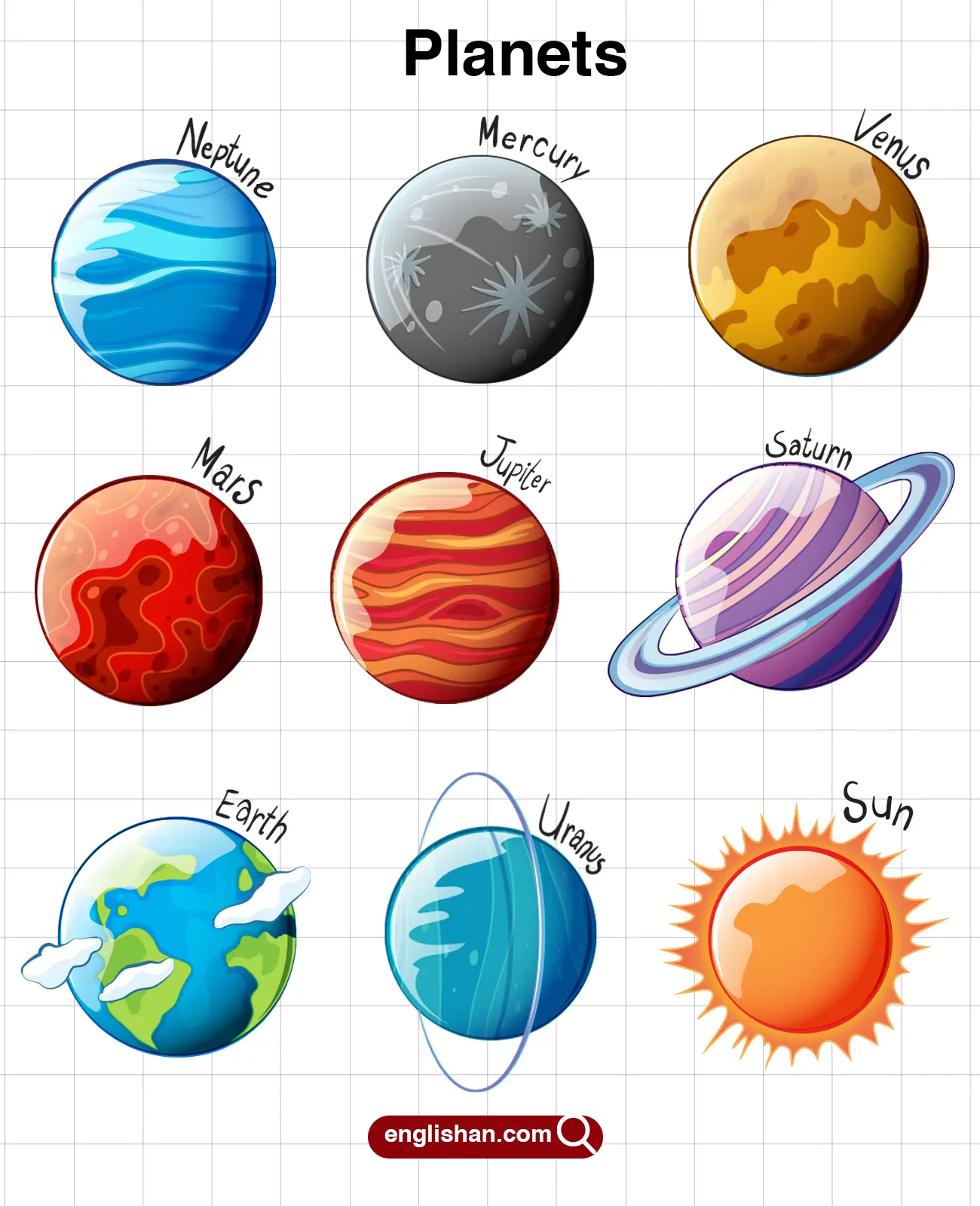
This post lists their planets names with pictures. You’ll learn all planets names in order, grouped to help with vocabulary learning and science understanding.
What Are Planets?
A planet is a large body that moves around a star and has enough gravity to form a round shape. In our solar system, all planets orbit the Sun. Planets are not stars and they do not produce their own light.
List of Planets Names
Planets in our solar system are grouped based on their position from the Sun. Below is the complete list of planets known in our system.
- Mercury
- Venus
- Earth
- Mars
- Jupiter
- Saturn
- Uranus
- Neptune
Types of Planets in the Solar System
Planets in our solar system are grouped based on how far they are from the Sun. The ones closer to the Sun are called inner planets, and the ones farther away are outer planets. Each group has special features that make them different from each other.
List of Inner Planets Names
These are the four planets closest to the Sun. Below is a list of the inner planets.
- Mercury: Mercury is the closest planet to the Sun. It is small, rocky, and has no atmosphere to trap heat.
- Venus: Venus is very hot and covered with thick clouds. It’s about the same size as Earth.
- Earth: Earth is the only planet known to support life. It has water, air, and a variety of living things.
- Mars: Called the Red Planet, Mars has dusty land, thin air, and signs of ancient water on its surface.
They are small, rocky, and have solid surfaces.
Outer Planets Names
These four planets are farther from the Sun. Below is a list of the outer planets.
- Jupiter: Jupiter is the largest planet in the solar system. It has strong storms and dozens of moons.
- Saturn: Known for its beautiful rings, Saturn is made mostly of gas and is the second-largest planet.
- Uranus: Uranus spins on its side and looks blue due to methane gas in its atmosphere.
- Neptune: Neptune is farthest from the Sun. It has strong winds and a dark blue color.
They are larger and made mostly of gases or ice.
Types of Planets by Composition
Planets can also be sorted by what they are made of. Below is a list of planet types based on their physical structure and materials.
Rocky Planets
These planets have solid, rocky surfaces. They are usually smaller and denser.
- Mercury: Dry, rocky surface with many craters from impacts.
- Venus: Thick atmosphere with rocky plains and volcanoes underneath.
- Earth: Rocky crust, oceans, and life-supporting atmosphere.
- Mars: Red dust, rocky valleys, and cold dry air.
Gas-Based Planets
These are large planets with thick atmospheres. They do not have a solid surface you can stand on.
- Jupiter: Largest planet, mostly made of hydrogen and helium gases.
- Saturn: Known for its bright rings and thick gas layers.
- Uranus: Blue color due to methane gas, cold and windy.
- Neptune: Stormy atmosphere, deep blue color, fast winds.
Dwarf Planets
Dwarf planets are smaller than regular planets and cannot clear their orbit paths. Below is a list of known dwarf planets in the solar system.
- Pluto: Once known as the ninth planet, Pluto is now called a dwarf planet because it shares its orbit with others.
- Ceres: Found in the asteroid belt, Ceres is the smallest dwarf planet and the only one located in the inner solar system.
- Eris: Slightly smaller than Pluto, Eris is one of the farthest known dwarf planets and has a very distant orbit.
- Haumea: Known for its long, oval shape, Haumea spins very fast and has two small moons.
- Makemake: This dwarf planet is icy and bright. It was discovered in 2005 and is found in the Kuiper Belt.
These are round, orbit the Sun, but share space with other objects.
List of Exoplanets
Exoplanets are planets that orbit stars outside our solar system. They can be rocky like Earth or huge like Jupiter.
Categories of Exoplanets Names
Exoplanets are classified by size and type. Below are the major types of exoplanets.
- Super-Earths: Bigger than Earth, but smaller than Neptune.
- Hot Jupiters: Large, gas planets that orbit close to their stars.
- Mini-Neptunes: Smaller than Neptune, with thick atmospheres.
- Earth-like Planets: Similar in size and distance from star as Earth.
Conclusion
Learning the names, types, and features of planets helps build useful vocabulary. From inner planets to exoplanets, each term adds to your understanding. Practice using these words in sentences to remember them better and grow your English and science knowledge together.
FAQs About Planets Names
The 8 planets in order from the Sun are Mercury, Venus, Earth, Mars, Jupiter, Saturn, Uranus, and Neptune.
A planet clears its orbit and is round. A dwarf planet is also round but shares its path with other space objects.
Jupiter has the most known moons, with over 90 confirmed natural satellites.
Exoplanets are planets that orbit stars outside our solar system. They are not part of our planetary system.
You May Also Like