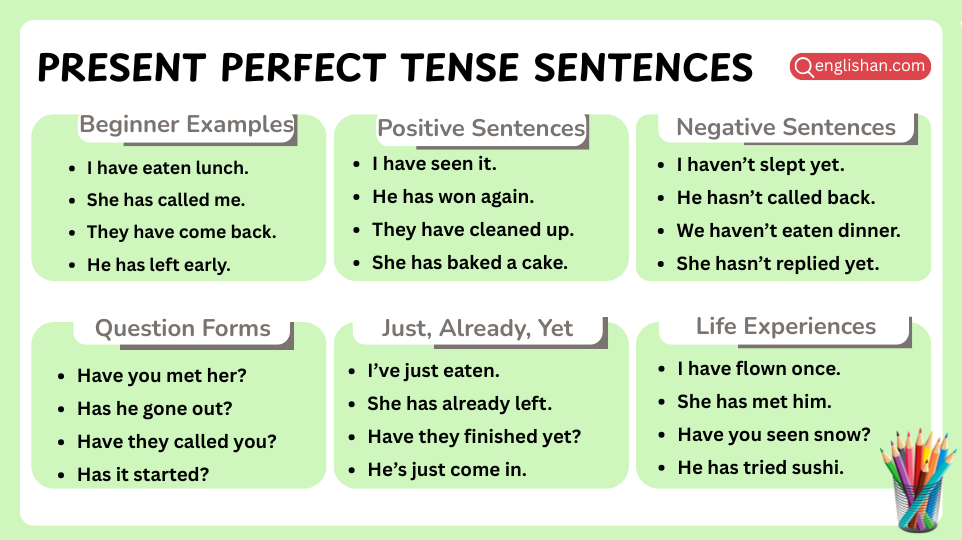
The present perfect tense describes actions that began in the past and still relate to now. It is built with have/has and a past participle, like “I have read that book” or “She has completed her homework.” This link between past and present makes it vital for everyday English.
This post includes 100+ present perfect tense sentences with examples to help you write and speak English more confidently.
Present Perfect Tense Sentences For Beginners
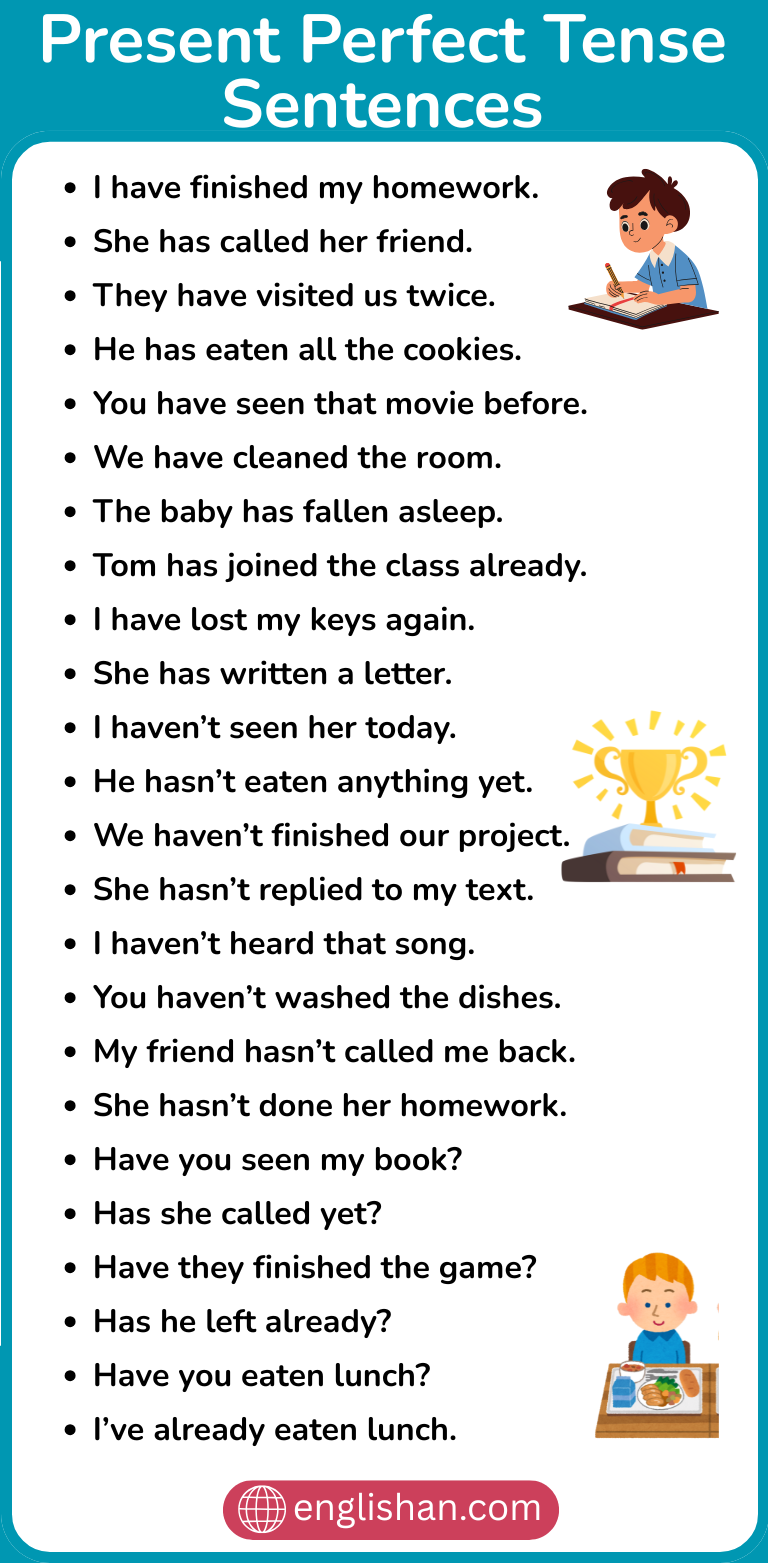
The present perfect tense shows something that happened in the past but still matters now. It uses “have” or “has” with the past participle form of a verb. Below is a list of easy-to-read examples using basic structure and common actions.
- I have finished my homework.
- She has called her friend.
- They have visited us twice.
- He has eaten all the cookies.
- We have cleaned the room.
- You have seen that movie before.
- The baby has fallen asleep.
- My parents have gone to the market.
- She has written a letter.
- I have lost my keys again.
- The students have completed the assignment.
- Tom has joined the class already.
- The dog has barked loudly.
- We have talked about it.
- He has made a mistake.
- They have moved to a new house.
- I have started my new job.
- The teacher has arrived early.
- Sara has drawn a picture.
Positive Examples Using Present Perfect
Positive present perfect sentences confirm that something has happened. These often use has or have with a verb that marks a finished action connected to the present. Below is a list of such statements.
- I have watched that show before.
- He has bought a new phone.
- They have cleaned the garage.
- She has passed the test.
- You have improved a lot.
- We have walked for an hour.
- He has built a birdhouse.
- I have saved some money.
- My brother has repaired the bike.
- The kids have learned a song.
- Emma has painted her room.
- We have planted a tree.
- They have opened the gift.
- I have cooked dinner today.
- The team has scored three goals.
- He has discovered a shortcut.
- You have become very kind.
- She has decorated the hall.
- We have danced all night.
Negative Present Perfect Sentence Examples
Negative sentences in present perfect express that something has not happened. The structure uses hasn’t or haven’t with the verb. Below is a list showing various sentence forms.
- I haven’t seen her today.
- He hasn’t eaten anything yet.
- We haven’t finished our project.
- They haven’t gone to the zoo.
- She hasn’t replied to my text.
- The bus hasn’t arrived yet.
- I haven’t heard that song.
- You haven’t washed the dishes.
- He hasn’t fixed his laptop.
- We haven’t received the package.
- The cat hasn’t moved from the chair.
- They haven’t played the game.
- My friend hasn’t called me back.
- She hasn’t done her homework.
- I haven’t tried that food.
- He hasn’t told the truth.
- We haven’t bought a gift yet.
- The train hasn’t stopped here.
- I haven’t found my wallet.
Interrogative Sentences In Present Perfect Tense
Question forms of present perfect often begin with Have or Has followed by a subject and a verb. Below is a list of sentence questions to help you recognize the structure.
- Have you seen my book?
- Has she called yet?
- Have they finished the game?
- Has he left already?
- Have you eaten lunch?
- Has it rained today?
- Have we met before?
- Has your sister arrived?
- Have I missed anything?
- Has Tom gone home?
- Have the kids cleaned up?
- Have we talked about this?
- Has the movie started?
- Have you done your chores?
- Has she read the book?
- Have I been here before?
- Have you tried the cake?
- Has your mom called back?
- Have they left the party?
Present Perfect Sentences With Already, Just, Yet
Words like already, just, and yet often appear in present perfect sentences. They give clues about when the action happened. Below is a list with all three used naturally.
- I’ve already eaten lunch.
- She has just arrived at school.
- Have they finished yet?
- He’s already done his homework.
- Have you called her yet?
- We’ve just seen the news.
- They’ve already gone to bed.
- I’ve just come back.
- Has she returned yet?
- You’ve already told me that.
- Has the bell rung yet?
- I’ve just cleaned the kitchen.
- We’ve already discussed this.
- Have you finished your task yet?
- He has just spoken to her.
- They’ve already left the house.
- Has the teacher come yet?
- I’ve just made tea.
- She has already read that book.
Life Experience Sentences In Present Perfect
Present perfect is also used to talk about life experiences. These sentences often answer questions like “Have you ever…?” or mention something someone has done in life. Below is a list focused on that usage.
- I have visited Paris once.
- She has never flown in a plane.
- Have you ever eaten sushi?
- We have gone on a boat trip.
- He has tried scuba diving.
- I have met a famous singer.
- They have lived in three countries.
- Have you ever danced on stage?
- He has seen snow before.
- We have never missed a concert.
- She has written a poem.
- Have you ever ridden a camel?
- I have broken my arm.
- They have won a trophy.
- She has been to many cities.
- I have played the guitar in public.
- He has climbed a mountain.
- Have you ever painted a mural?
- They have adopted a puppy.
Present Perfect Sentences Showing Recent Actions
This tense is great for things that just happened or recently completed. Below is a list of natural sentences showing recent actions that still feel relevant now.
- I have just eaten breakfast.
- She has called me a minute ago.
- We have lost the game.
- He has left the building.
- They have reached the station.
- I have dropped my pen.
- She has gone to the store.
- The dog has run away.
- You have spilled the juice.
- We have missed the train.
- I have forgotten my password.
- He has taken the car keys.
- Have you checked your email?
- She has fallen asleep.
- I have started the machine.
- We have called the plumber.
- They have cleaned the room just now.
- He has opened the letter.
- I have told her the news.
Have And Has Examples In Present Perfect
“Have” and “has” are the helping verbs used in the present perfect. Use have with I, you, we, they — and has with he, she, it. Below is a list that mixes both naturally.
- I have finished the book.
- She has cleaned the windows.
- They have made a cake.
- He has sent the email.
- You have broken your phone.
- It has started to rain.
- We have packed our bags.
- My mom has cooked dinner.
- I have found my wallet.
- He has opened the gift.
- You have forgotten your notebook.
- She has closed the shop.
- They have gone outside.
- He has watered the plants.
- We have shared the link.
- I have taken a nap.
- She has written the report.
- They have booked a cab.
- You have checked the results.
You May Also Like