
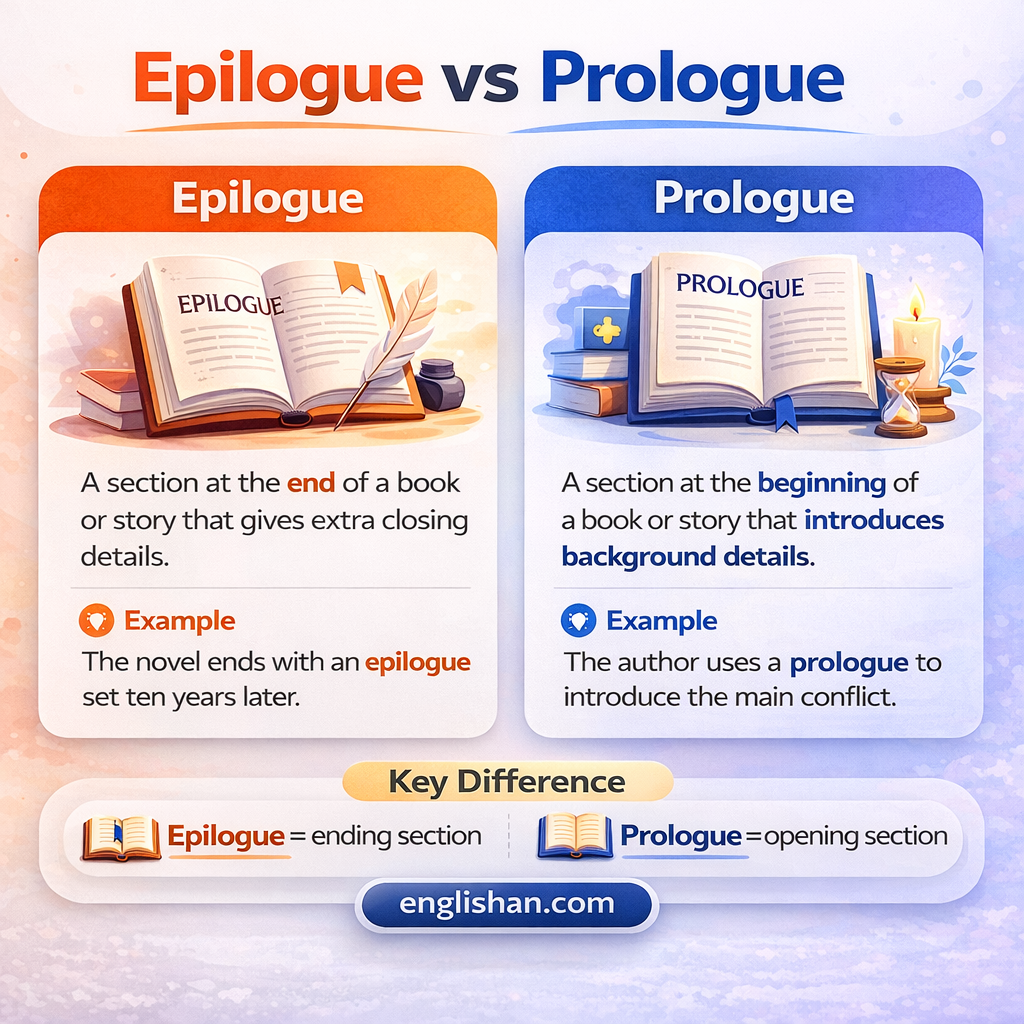
Prologue and epilogue both belong to book structure, but they appear in different places and do different jobs. A prologue comes before the story and helps set things up, while an epilogue comes after the ending and gives a final look at what happens later.
That contrast makes prologue vs epilogue much easier to remember. One opens the story world, and the other looks back after the conflict is done. This article explains what each term means, where each one appears, and how to tell them apart when reading or writing.
Epilogue vs Prologue: Quick Answer
Here is the quickest way to tell them apart:
| Word | Position in a Book | Main Purpose | Example Function |
|---|---|---|---|
| Prologue | before the main story | introduces background, tone, conflict, or an earlier event | reveals a past event before chapter one |
| Epilogue | after the main story | shows what happens later or adds closure | reveals the characters’ lives after the ending |
If a section appears before chapter one, it is usually a prologue. If it appears after the story’s ending, it is usually an epilogue.
What Is a Prologue?
A prologue is an opening section that appears before the main body of a story. It belongs to the book, but it stands apart from the regular chapters because it usually has a special framing role.
Writers often use a prologue to:
- introduce an important event from the past
- reveal background the reader needs early
- create mystery or tension
- set the tone of the story
- show a scene from a different time, place, or point of view
A prologue is not simply chapter one under a different name. It usually feels separate because it frames the story instead of moving directly into the regular flow of the main plot.
Example of a Prologue in Practice
A novel may begin with a murder that takes place twenty years before the main timeline. The main story then opens in the present, where the characters slowly uncover what happened. In that case, the opening scene works as a prologue because it gives the reader one crucial piece of the puzzle before the story properly begins.
What Is an Epilogue?
An epilogue is a closing section that appears after the main story has ended. It gives the reader one final look at what happened after the central conflict was resolved.
Writers often use an epilogue to:
- show what the characters’ lives look like later
- confirm the long-term result of the story
- answer a remaining question
- add emotional closure
- hint at future events
An epilogue does not replace the ending. The main story should already feel complete. The epilogue adds one more layer after that completion.
Example of an Epilogue in Practice
A novel may end with the hero winning the final battle. The epilogue then jumps forward five years and reveals where the main characters are now, which relationships lasted, and how the world changed after the conflict.
Key Difference Between Prologue and Epilogue
The main difference is position and purpose.
A prologue comes before the story and helps prepare the reader for what is coming. An epilogue comes after the story and reflects on what has already happened.
You can think of them this way:
- prologue opens the frame of the story
- epilogue closes the frame of the story
That difference affects how each one feels to the reader. A prologue creates entry context. An epilogue creates aftermath context.
When Writers Use a Prologue or Epilogue
Writers usually include a prologue when the story benefits from one meaningful piece of information before chapter one begins. This often happens when the backstory matters immediately, when an earlier event creates the main conflict, or when the story opens more strongly with tension than with direct exposition.
Writers usually include an epilogue when the main ending resolves the big conflict, but readers still benefit from one more glimpse of the characters or consequences. This often works well when a time jump adds emotional weight, when a final reveal belongs after the ending, or when the story gains something from one reflective closing scene.
A good prologue earns its place. A good epilogue does too. If either one exists only to explain too much or continue after the emotional ending has already landed, it can feel unnecessary.
Can a Book Have Both?
Yes. Some books include both a prologue and an epilogue.
In that structure, the prologue opens the frame of the story, and the epilogue closes it. This often works especially well in stories with long timelines, layered histories, family sagas, mysteries, fantasy series, and historical fiction.
For example, a novel might begin with a prologue set during a war, then tell the main story years later, and end with an epilogue showing how those events shaped the next generation.
Do Books Need a Prologue or an Epilogue?
No. Many strong books use neither.
A story does not become better simply because it includes a prologue or an epilogue. These sections work only when they add something the main chapters cannot do as well.
Some stories begin best by dropping the reader straight into chapter one. Others end with enough force that an epilogue would only weaken the final note.
How These Sections Differ From Similar Book Parts
Prologue vs Introduction vs Preface
These are not the same.
A prologue belongs to the narrative world of the book. An introduction usually explains the subject or purpose more directly. A preface is often the author’s own note about the creation of the book.
That means a prologue is usually more story-driven, while an introduction or preface is more openly explanatory.
Epilogue vs Afterword vs Conclusion
These also differ.
An epilogue returns to the world of the book after the main story ends. An afterword is often a reflective note written by the author or another contributor. A conclusion is more common in nonfiction and brings the main discussion to a close.
So even though they all appear near the end, they do not do the same work.
Prologue and Epilogue in Nonfiction
These terms appear most often in fiction, but they can also appear in nonfiction.
In nonfiction, a prologue may introduce the purpose of the book, set up the subject through a striking opening moment, or frame the discussion with an earlier event. An epilogue may revisit the topic later, reflect on what happened after the main events, or consider the lasting significance of the subject.
For example, a memoir may open with a prologue built around a defining childhood memory and close with an epilogue reflecting on life years after the journey described in the book.
How to Remember Prologue vs Epilogue
A quick memory trick can help:
- prologue comes before the main story
- epilogue comes after the main story ends
An even easier reminder is this:
- prologue opens
- epilogue closes
Once you connect each word to its position in the book, the difference becomes much easier to keep straight.
Prologue and Epilogue in Sentences
Sentences With Prologue
- The novel’s prologue reveals a secret that shapes the entire plot.
- I almost stopped reading, but the prologue made me curious enough to continue.
- Her fantasy novel opens with a prologue set hundreds of years before chapter one.
Sentences With Epilogue
- The epilogue shows where the characters are ten years later.
- I liked the ending, but the epilogue gave the story even more emotional weight.
- His thriller ends with an epilogue that hints at another mystery.
Common Mistakes With Prologue and Epilogue
One common mistake is using these words as if they mean any opening or ending section. That is not always correct. A prologue is not the same as a preface, and an epilogue is not the same as every final note in a book.
Another mistake is assuming that every story benefits from them. Sometimes writers add a prologue to explain too much too early, or an epilogue to continue after the emotional finish has already landed. When these sections work, they feel necessary. When they do not, readers can feel the extra weight.
Summary
A prologue comes before the main story and prepares the reader for what lies ahead. An epilogue comes after the main story and offers a final look at what follows once the major events are over. Both can be useful, but they serve different purposes and appear in different places. Once you connect prologue with opening and epilogue with closing, the distinction becomes much easier to remember and use.
FAQs
A prologue appears before the main story begins, while an epilogue appears after the main story ends.
No. A prologue usually belongs to the narrative world of the story, while an introduction usually explains the subject or purpose more directly.
No. An epilogue usually stays connected to the story world, while an afterword is often a reflective note from the author or another contributor.
Yes. Some books use both to frame the story from beginning to end.
No. Many novels work very well without either one.
You May Also Like