Adverbs of frequency tell us how often something happens. They are used to describe routines, habits, and repeated actions in daily life. Words like always, often, sometimes, and never are common examples. These adverbs usually come before the main verb or after the verb “to be.” In this post, you’ll learn the meaning, placement, and sentence usage of frequency adverbs with clear examples for English learners.
What Is an Adverb of Frequency?
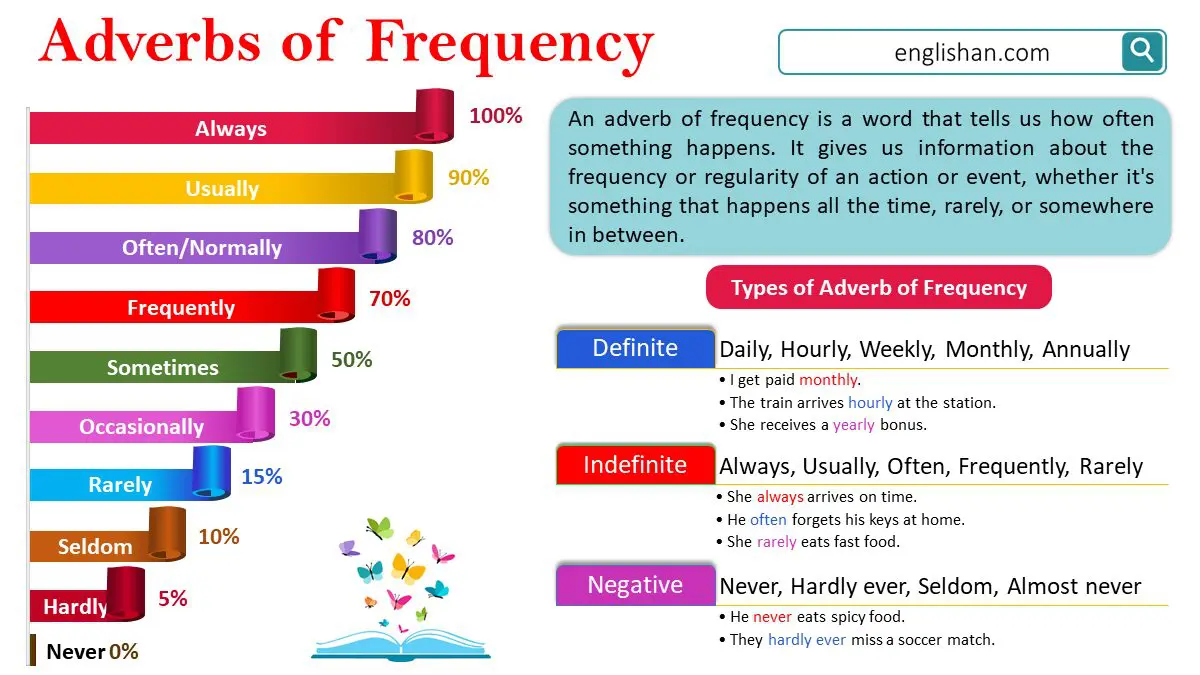
An adverb of frequency is a word that tells how often an action happens. It shows the regularity or repetition of an activity over time — whether it happens always, sometimes, or never.
These adverbs help answer questions like:
- How often does something happen?
- How regularly is the action repeated?
- How frequently does it occur?
Examples:
- How often does she exercise? → She exercises daily.
- How frequently do they visit the park? → They visit rarely.
- How often do you eat pizza? → I eat pizza sometimes.
Types of Adverbs of Frequency
Adverbs of frequency can be categorized into two types:
Definite Frequency Adverbs
These describe actions that occur at a specific, scheduled time.
Examples and Meanings:
- Daily – every day – I go for a walk daily.
- Weekly – every week – We have meetings weekly.
- Monthly – every month – I get paid monthly.
- Hourly – every hour – The clock chimes hourly.
- Quarterly – every 3 months – They review progress quarterly.
- Yearly/Annually – once a year – She receives a yearly bonus.
- Every day/week/month/year – I exercise every day.
- Once/Twice a day/week/month/year – Take this medicine twice a day.
- On Monday/Sunday, etc. – We meet on Fridays.
- Fortnightly – every two weeks – They publish reports fortnightly.
- Perpetually – continuously without stopping – It rained perpetually last week.
Indefinite Frequency Adverbs
These describe how often an action happens without a fixed time.
| Adverb | Estimated Frequency | Example |
|---|---|---|
| Always | 100% | She always arrives on time. |
| Usually | 90% | They usually walk in the evening. |
| Often/Normally | 80% | He often forgets his keys. |
| Frequently | 70% | We frequently travel. |
| Sometimes | 50% | She sometimes forgets to call. |
| Occasionally | 30% | We occasionally go out to eat. |
| Rarely | 15% | He rarely watches TV. |
| Seldom | 10% | She seldom complains. |
| Hardly ever | 5% | They hardly ever arrive early. |
| Never | 0% | He never eats meat. |
Placement of Adverbs of Frequency in English Sentences
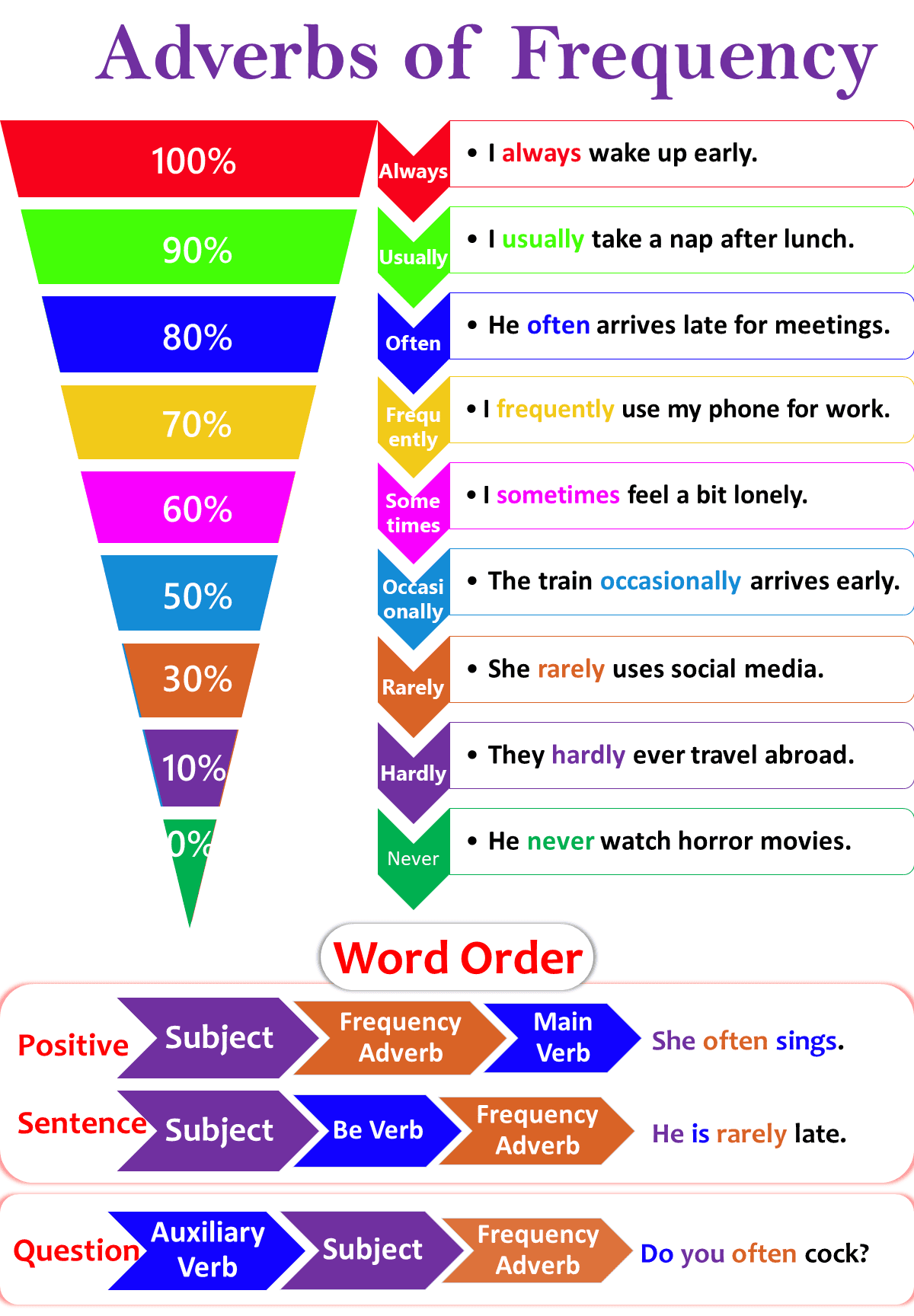
The placement of adverbs of frequency depends on the verb in the sentence. Common adverbs like always, never, and often usually follow these rules:
1. Before the Main Verb (Present Simple)
When the main verb is not “to be”, the adverb usually comes before the verb.
Examples:
- She always arrives on time.
- They never eat meat.
- I usually go to bed at 11 PM.
- He rarely goes to the gym.
- We sometimes go out for dinner.
2. After the Verb “To Be”
If the sentence uses “to be” as the main verb (e.g. is, are, was), the adverb is placed after the verb.
Examples:
- He is often late for work.
- We are always happy to see you.
- It is sometimes difficult to understand.
3. In Negative Sentences
In negative sentences, place the adverb between the negative word (don’t, doesn’t, didn’t) and the main verb — unless the verb is “to be.”
Examples:
- They don’t always listen to my advice.
- I never eat fast food.
- She rarely goes to the gym.
4. At the Beginning or End of the Sentence
Some adverbs of frequency can also appear at the start or end of a sentence, especially for emphasis.
Examples:
- Often, I study late at night.
- I don’t like waking up early, ever.
- Usually, he listens to music while he works.
5. Other Tenses
With tenses like present continuous, present perfect, or future with will, the adverb usually goes between the helping verb and the main verb.
Examples:
- She is always working late.
- He has never been to London.
- I will always remember this day.
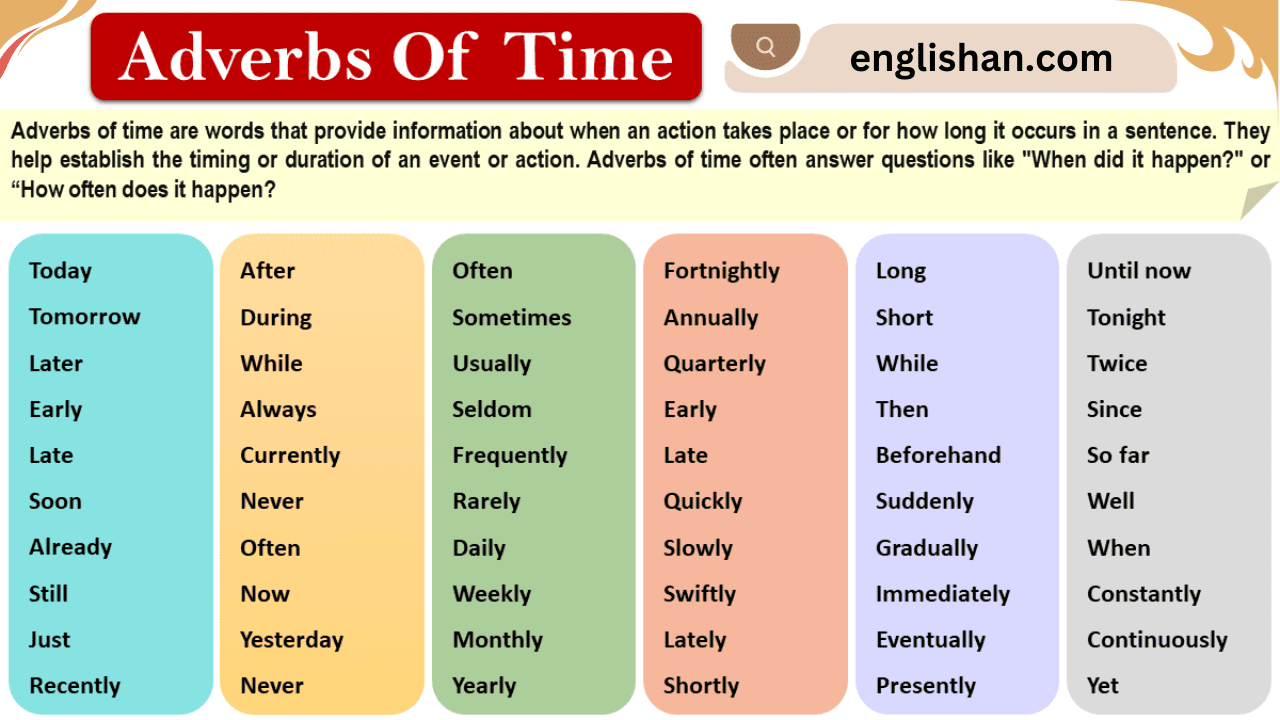
List of Adverbs of Frequency
| Always | daily | Fortnightly | Infrequently | Every winter |
| Usually | Weekly | Perpetually | Not often | Every summer |
| Often | Monthly | Constantly | Rarely | Normally |
| Frequently | Hourly | Regularly | Once in a while | Routinely |
| Sometimes | Quarterly | Instantly | On occasion | Twice |
| Occasionally | Nightly | Every other day | Continuously | On (day name) |
| Rarely | Yearly | At times | Every week | Scarcely ever |
| Seldom | Annually | Very often | Every month | Quite often |
| Hardly ever | Every day | Minimally | Every year | Many times |
| Never | Once | Repeatedly | Not usually | Biweekly |
FAQs:
Adverbs of frequency are words that describe how often something happens. Some examples of adverbs of frequency are always, usually, often, sometimes, rarely, and never.
Adverbs of frequency help to give more information about actions or events in a sentence. They help to convey how often an action happens or doesn’t happen.
Definite frequency adverbs indicate a specific number of times an action is performed, such as twice a week or three times a day. Indefinite frequency adverbs describe frequency in a general sense, such as always, usually, or sometimes.
No, they are only used to modify verbs only. They cannot be used to modify adjectives or other adverbs.
Yes, they can be used together in the same sentence. For example, “I always study on Saturdays, but sometimes I also study on Sundays.” , “I sometimes go to the gym, but I always try to eat healthy.”
Always is an adverb of frequency.
You May Also Like