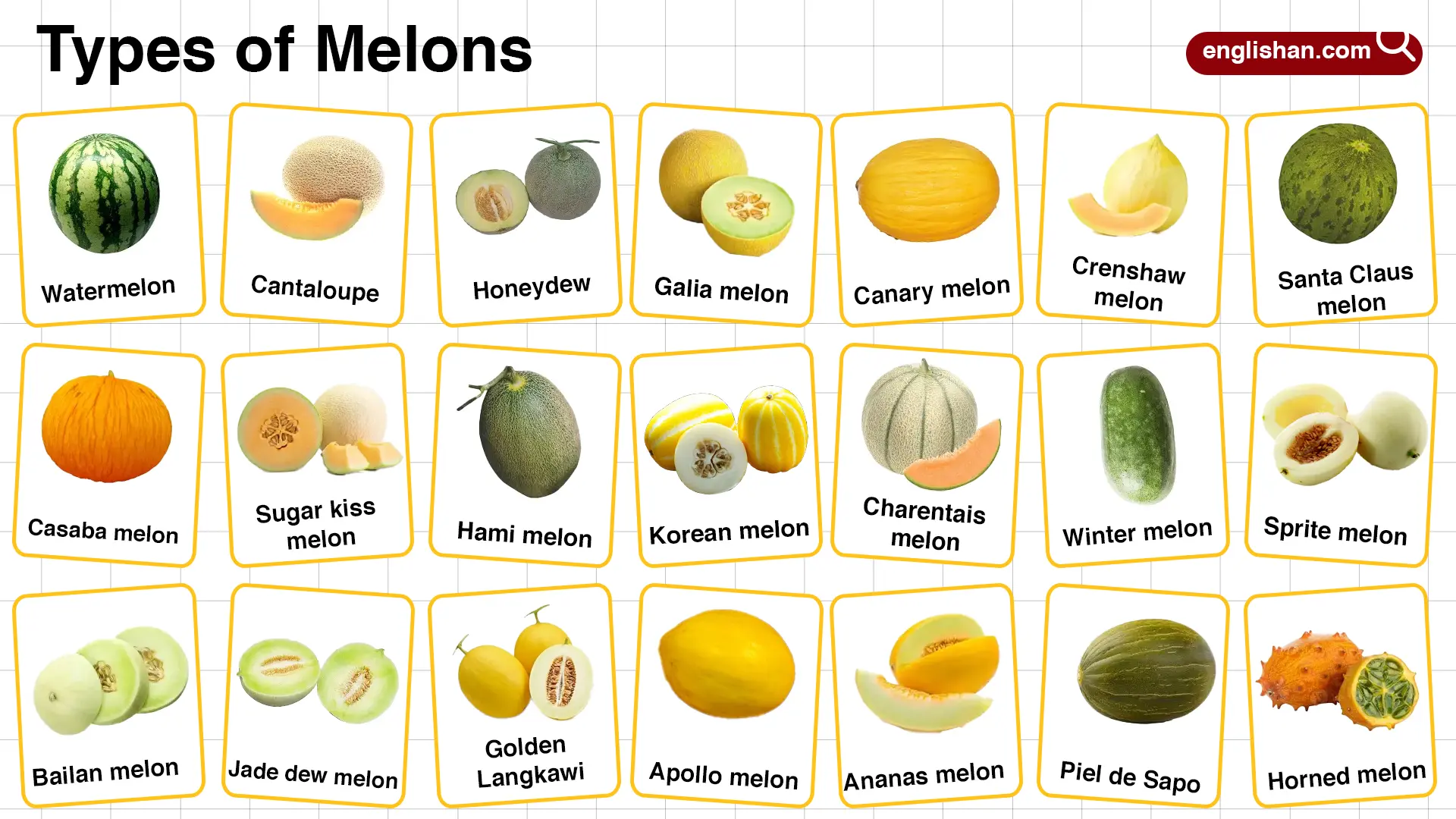
Every type of melon has a different flesh color, rind texture, sweetness level, and ripeness signal, which is why picking the right one at the store feels like guesswork without knowing what sets them apart. A cantaloupe has netted skin and deep orange flesh. A honeydew is smooth, pale green, and milder in sweetness. A watermelon is an entirely different species with a hard striped shell and bright red interior.
Melons split across two main species. Cucumis melo covers cantaloupes, honeydews, and most fragrant sweet varieties. Citrullus lanatus covers watermelons. A few fall outside both groups, like bitter melon and horned melon, each with a distinct flavor and culinary use.
Since the differences go well beyond taste, recognizing each type by its rind, flesh, aroma, and season makes choosing and using them far more practical. Here, you’ll find each melon type with its flavor, texture, peak season, growing region, and the fastest way to tell a ripe one from an unripe one.
Quick-Reference Table
| Melon | Flesh Color | Flavor | Origin |
|---|---|---|---|
| Cantaloupe | Orange | Sweet, musky | Central Asia |
| Honeydew | Pale green | Mild, honey-sweet | West Africa / Persia |
| Watermelon | Red | Juicy, refreshing | Southern Africa |
| Galia | Green | Spicy-sweet | Israel |
| Charentais | Deep orange | Intensely fragrant | France |
| Hami | Orange-green | Crisp, honey-like | China |
| Casaba | Pale green | Cucumber-like, mild | Turkey |
| Canary | Pale gold | Tangy, pear-like | East Asia |
| Crenshaw | Salmon-orange | Peachy, creamy | Hybrid (USA) |
| Korean melon | Pale yellow | Crisp, lightly sweet | Korea |
| Santa Claus | Pale green | Mild, faintly sweet | Spain |
| Sugar Kiss | Orange | Extremely sweet | Hybrid (USA) |
| Persian | Orange | Mild, floral | Iran |
| Ananas | Orange | Tropical, pineapple-like | Middle East |
| Piel de Sapo | White-green | Mildly sweet | Spain |
| Horned melon | Green-yellow | Tart, cucumber-banana | East Africa |
| Bitter melon | White-green | Strong bitter | South/Southeast Asia |
| Winter melon | White | Very mild, neutral | East Asia |
| Sprite | White-cream | Apple-sweet, crisp | Hybrid (Japan) |
| Bailan | Pale green | Soft, low-acid | China |
| Snap melon | Orange-yellow | Tart, aromatic | India |
| Jade Dew | Light green | Gentle, juicy | East Asia |
| Golden Langkawi | Gold-yellow | Rich, tropical | Malaysia |
| Sky melon | Light yellow | Balanced, delicate | Korea |
| Apollo | Orange | Soft, tropical | Hybrid |
Orange-Fleshed Melons
Orange flesh in a melon almost always signals a higher concentration of beta-carotene, which gives these varieties their warm color and a solid nutritional edge. These are among the most popular melons worldwide, and they tend to be aromatic, sweet, and soft once ripe.
Cantaloupe
Cantaloupe is the most recognized melon in North America, though its name causes some confusion. In the United States, the netted, beige-skinned muskmelon sold at every grocery store is called a cantaloupe. In Europe, the name refers to a different cultivar with a smoother, ribbed rind and even deeper orange flesh.
The American cantaloupe has a raised, net-like pattern on its skin. When ripe, the stem end gives off a sweet, musky aroma, and the fruit detaches from the vine with gentle pressure. The flesh is soft, juicy, and rich in vitamins A and C. It works well in fruit salads, breakfast bowls, prosciutto wraps, and smoothies.
Charentais
Charentais is a French cantaloupe variety that originated in the Charentes region and is strongly associated with Provence. It is smaller than a standard cantaloupe, roughly the size of a softball, with smooth grey-green skin and shallow ribs.
The flesh is deep orange and intensely fragrant. The aroma is stronger and sweeter than what most American cantaloupes produce, and the texture is notably soft and creamy. Because the skin is thin and the flesh is delicate, Charentais melons do not ship well. Most are sold and eaten locally in France, though hybrid versions bred for better durability have spread to other markets.
Sugar Kiss
Sugar Kiss is a hybrid melon developed for exceptionally high sugar content. The rind has a golden-brown netting similar to cantaloupe, and the flesh is bright orange with a soft, almost custard-like texture.
The sweetness is immediate and rich. Among all melon varieties, Sugar Kiss ranks near the top for natural sugar concentration. It is best eaten chilled, sliced into wedges, or scooped with a spoon. The season is short, and these melons are most available during mid-to-late summer in the United States.
Crenshaw
The Crenshaw melon is a hybrid of the casaba and Persian melon, developed in the 1800s by John Crenshaw. It has a distinctive pear shape with a smooth, golden-yellow rind that gives slightly when pressed at the blossom end.
Inside, the flesh is salmon-orange with a creamy, almost buttery mouthfeel. The flavor blends peach, cantaloupe, and a light tartness. Crenshaw melons are larger than most other varieties, weighing between 8 and 10 pounds at maturity. They are best served fresh, and their ripeness is easy to judge by the rind color and a mild, sweet scent near the stem.
Hami
Hami melon takes its name from Hami, a city in the Xinjiang region of China, where this variety has been cultivated for centuries. It has an oblong shape with a smooth or lightly netted rind that is pale yellow to green.
The flesh is orange near the rind and lighter toward the center, with a crunch that sets it apart from most melons. The taste blends honey sweetness with a mild cantaloupe flavor, and the texture stays firm even when fully ripe. Hami melon is a prized gift fruit in China and is eaten fresh, often chilled.
Ananas
Ananas melon gets its name from the French and Portuguese word for pineapple, and the aroma confirms why. When ripe, it releases a strong tropical scent that fills the room.
The rind is oval and slightly netted, turning from green to golden as it matures. The flesh is soft orange and very sweet, with flavor notes that lean toward pineapple and mango rather than the musky profile of a standard cantaloupe. Ananas melon is commonly grown in the Middle East and Mediterranean and is best eaten raw, scooped straight from the rind.
Persian
Persian melon is larger than a typical cantaloupe and has a smoother, less netted rind with faint green and yellow banding. The flesh is orange and mild, with a delicate floral sweetness that is less intense than Charentais or Sugar Kiss.
Because of its size, a single Persian melon produces more fruit per slice, which makes it a practical choice for serving groups. It is grown across Iran, parts of Central Asia, and California. The rind darkens to golden yellow when ripe, and the melon should feel heavy for its size when ready to eat.
Green-Fleshed Melons
Green-fleshed melons tend to be milder and less aromatic than their orange counterparts. Their sweetness builds gradually, and many of them have a smoother, more neutral flavor profile. These varieties are popular in fruit salads and cold beverages because their taste does not overpower other ingredients.
Honeydew
Honeydew is one of the most widely available melons in the world. It has a smooth, pale rind that ranges from cream to light yellow when ripe, and the flesh is a soft, translucent green.
The flavor is gentle and honey-sweet without the musky punch of a cantaloupe. Honeydew has a higher sugar content than many people expect, reaching up to 10 percent in peak-season fruit. It is richer in potassium and vitamin A than watermelon and works well in smoothies, cold soups, and fruit platters. A ripe honeydew feels slightly sticky on the surface and gives a faint, clean fragrance.
Galia
Galia melon was developed in Israel by crossing a cantaloupe with a honeydew. The outside looks like a small cantaloupe with golden netting over a yellow-green rind, but the inside reveals pale green flesh.
The flavor is a distinctive blend of spicy and sweet, with aromatic notes that lean tropical. The texture is smooth and juicy, and the melon is best served chilled. Galia melons are popular across the Mediterranean, the UK, and Southeast Asia. They ripen quickly after harvest, so buying one that is firm with a sweet scent at the blossom end is a good indicator of peak quality.
Casaba
Casaba melon traces its roots to Kasaba, a town in western Turkey. It has a wrinkled, furrowed rind that turns from green to golden yellow when ripe, and the flesh is pale green to white with a firm, almost cucumber-like texture.
Unlike most melons, casaba has very little aroma. The flavor is mild and refreshing, closer to a sweet cucumber than to a typical melon. Because casaba does not sweeten further after harvest, choosing a fully ripe one is critical. It stores longer than most melon varieties, earning it a place among the “winter melons” that last well into cooler months.
Jade Dew
Jade Dew is a smooth-skinned melon with light green flesh and a gentle, clean sweetness. It is grown in East Asia and shares some traits with honeydew, though its flavor is lighter and its texture is juicier.
The rind is thin and pale, and the melon is typically small enough to hold in one hand. It is eaten fresh, sliced and chilled, and pairs well with desserts or light fruit platters.
Bailan
Bailan melon is named after the Bailan township near Lanzhou in northwestern China, where it has been grown for decades. The flesh is pale green and soft, with a low-acid, lightly sweet taste that is smoother and less assertive than honeydew.
Bailan melons are prized for their texture, which is tender and almost melting. They are eaten fresh and are a popular summer fruit across China. The rind is white to light green and thin, making them delicate to transport.
Red-Fleshed Melons
Red-fleshed melons are dominated by one variety that stands above all others in global popularity. The vivid red color comes from lycopene, the same antioxidant found in tomatoes, and it gives these melons both their visual appeal and a measurable nutritional benefit.
Watermelon
Watermelon is the most consumed melon on Earth. It belongs to Citrullus lanatus, a separate species from the muskmelon group, and it originated in southern Africa, where wild varieties still grow.
A standard watermelon has a hard, smooth green rind with darker stripes, and the flesh is deep red and loaded with juice. About 91 percent of a watermelon is water, which makes it one of the most hydrating fruits available. The flavor is clean and sweet without the musky complexity of cantaloupes.
Watermelons come in many cultivar sizes, from personal-sized “icebox” melons weighing 5 to 8 pounds to full-sized varieties exceeding 25 pounds. Some cultivars have yellow or orange flesh instead of red, and seedless varieties dominate most grocery store shelves. A ripe watermelon has a yellow spot on the underside where it rested on the ground, and it produces a deep, hollow sound when tapped.
Sprite
Sprite melon is a small, round hybrid originally developed in Japan. The rind is ivory to cream-colored and smooth, and the flesh ranges from white to faintly pink or red depending on the variety.
The texture is noticeably crunchy, more like biting into an apple than a standard melon. The sweetness is concentrated and sharp, and the fruit is small enough to eat by hand in a few sittings. Sprite melons ripen during summer and have a short growing window.
Yellow and White-Fleshed Melons
Yellow and white-fleshed melons tend to fall on opposite ends of the flavor spectrum. Some, like the canary melon, are tangy and refreshing. Others, like winter melon, have almost no sweetness at all and are treated more like a vegetable in the kitchen.
Canary Melon
The canary melon is named for its bright yellow rind, which is smooth, slightly waxy, and hard to miss at a fruit stand. Inside, the flesh is pale gold to white with a crisp, juicy texture.
The flavor has a mild tanginess balanced by pear-like sweetness. Canary melons are football-shaped and relatively small, reaching about five inches across. They are grown in warm, dry regions across East Asia, parts of Europe, and the American Southwest. A ripe canary melon feels firm but gives a light fragrance from the blossom end.
Korean Melon
Korean melon, known as chamoe in Korea, is a small, oblong fruit with a bright yellow rind marked by white stripes running lengthwise. The flesh is pale yellow to white and very crisp.
The taste is lightly sweet and refreshing, somewhere between a cucumber and a honeydew. Unlike most melons, the rind and seeds of a Korean melon are both edible. It is eaten fresh, sliced into rounds, and is a common summer snack across Korea and parts of East Asia.
Santa Claus Melon
Santa Claus melon, also called Piel de Sapo in Spain, gets its name from its long shelf life. It can be stored for weeks after harvest, often lasting until the winter holiday season.
The rind is thick, dark green with lighter stripes, and the flesh is pale green to white with a mild, faintly sweet taste. The texture is firm and juicy without the softness of a cantaloupe. It is typically eaten raw in slices and is a staple summer-to-winter melon across Spain and parts of South America.
Sky Melon
Sky melon is a premium Korean hybrid grown indoors under controlled conditions. The flesh is light yellow with a balanced sweetness that is delicate rather than intense.
These melons are carefully cultivated to achieve consistent size, shape, and sugar content. They are typically sold at a higher price point and are treated as a luxury fruit in Korea.
Golden Langkawi
Golden Langkawi is a Malaysian hybrid melon with a golden-yellow rind and rich, sweet flesh. The flavor carries tropical notes with a depth that sets it apart from milder yellow melons.
It is grown in warm, humid regions of Southeast Asia and is eaten fresh, often chilled and served as a dessert fruit.
Cooking Melons and Savory Varieties
Not every melon is eaten as a sweet fruit. Several varieties are used in savory dishes, soups, and stir-fries, where their mild or bitter flavor works as a vegetable rather than a dessert.
Winter Melon
Winter melon, also known as ash gourd or wax gourd (Benincasa hispida), belongs to a separate genus from most other melons. It has a thick, waxy green rind coated with a white powdery bloom, and the flesh inside is white, firm, and almost flavorless when raw.
In Chinese, Vietnamese, and Indian cooking, winter melon is simmered in soups, braised in stews, and added to curries. It absorbs the flavor of whatever broth or sauce it cooks in, much like tofu. Despite the name, winter melon matures in late summer but stores well through winter because of its thick, protective rind.
Bitter Melon
Bitter melon (Momordica charantia) is a deeply ridged, bumpy-skinned gourd with a strong bitter flavor. The flesh is pale green and crunchy when young, turning more orange and softer as it matures.
It is a staple across South and Southeast Asian cuisines, stir-fried with garlic and chilies, stuffed with pork or shrimp, or cooked into curries. Bitter melon is also used in traditional medicine for its association with blood sugar regulation. The bitterness is polarizing, but it mellows with salting, blanching, or cooking in rich sauces.
Snap Melon
Snap melon is a wild-type melon grown in India and parts of Central Asia. The rind is thin, and the fruit splits open easily when ripe, which is how it got its name.
The flesh is orange-yellow with a tart, aromatic flavor. It is eaten raw in some regions and pickled or added to curries in others. Snap melon has a shorter shelf life than most commercial varieties and is rarely found outside its growing regions.
Horned Melon
Horned melon, also called kiwano or African horned cucumber, has a spiky orange rind that makes it one of the most visually distinct fruits in any produce aisle. The flesh inside is bright green and gelatinous, filled with seeds.
The taste is mild and tart, somewhere between a cucumber, a banana, and a kiwi. Horned melon is native to the Kalahari region of Africa and is grown commercially in New Zealand, Australia, and parts of the United States. It is eaten raw, squeezed over salads, or blended into drinks.

How To Pick a Ripe Melon
Choosing a ripe melon at the store or market depends on the variety, but a few universal cues apply across most types.
Weight matters. A ripe melon should feel heavy for its size. That weight comes from water content, and a heavier melon means juicier flesh.
Check the blossom end. On cantaloupes, honeydews, and most muskmelons, press gently on the end opposite the stem. It should give slightly without feeling mushy. A ripe melon also releases a sweet, fragrant aroma from this spot.
Look at the rind color. Honeydews turn from green to creamy yellow when ripe. Canary melons become bright, waxy yellow. Watermelons develop a yellow ground spot where they rested on the soil. Casabas shift from green to golden.
Listen for the sound. Tapping a watermelon should produce a deep, hollow sound. A dull thud means the fruit is underripe or overripe.
Know which melons ripen after harvest and which do not. Cantaloupes and honeydews soften and become more aromatic after picking, though they do not get sweeter. Casabas and winter melons do not ripen further once harvested, so they must be picked at the right time.
FAQs
Sugar Kiss melon ranks among the sweetest varieties, with an exceptionally high natural sugar content and a soft, custard-like texture. Hami melon is another top contender, combining honey-like sweetness with a crunchy bite that feels closer to an Asian pear than a standard melon.
In North America, cantaloupe and muskmelon are used interchangeably, but they are technically different cultivar groups. The American “cantaloupe” is actually a netted muskmelon (Cucumis melo var. reticulatus). True cantaloupes (Cucumis melo var. cantalupensis) have a smoother, ribbed rind and are more common in Europe, particularly in France and Italy.
Bitter melon belongs to the gourd family (Cucurbitaceae), the same broader family as other melons, but it is a different genus (Momordica) and a very different eating experience. It is treated as a vegetable in most cuisines rather than a fruit, and it has a pronounced bitter flavor that no sweet melon shares.
Watermelons belong to a separate species, Citrullus lanatus, while most other melons fall under Cucumis melo. The differences go beyond classification. Watermelons have higher water content (around 91 percent), a crisper texture, and a cleaner sweetness without the musky aroma that defines muskmelons and cantaloupes.
Winter melon, bitter melon, and snap melon are the three varieties most commonly used in cooked dishes. Winter melon absorbs the flavors of broths and sauces, bitter melon brings a sharp bitterness that balances rich, spicy dishes, and snap melon is pickled or simmered in curries across India.
It depends on the variety. Cantaloupes and honeydews soften and develop more aroma after harvest, but their sugar content does not increase. Watermelons, casabas, and most winter-type melons do not ripen further once they leave the vine, so picking them at the right stage is the only way to get full flavor.
You May Also Like
- 100+ Fruit Names From A To Z With Pictures
- Fruits Names For Kids With Pictures
- Fruits And Vegetables Names In English
- Yellow Fruits Names In English With Pictures
- 112 Fruits That Start With M With Pictures