

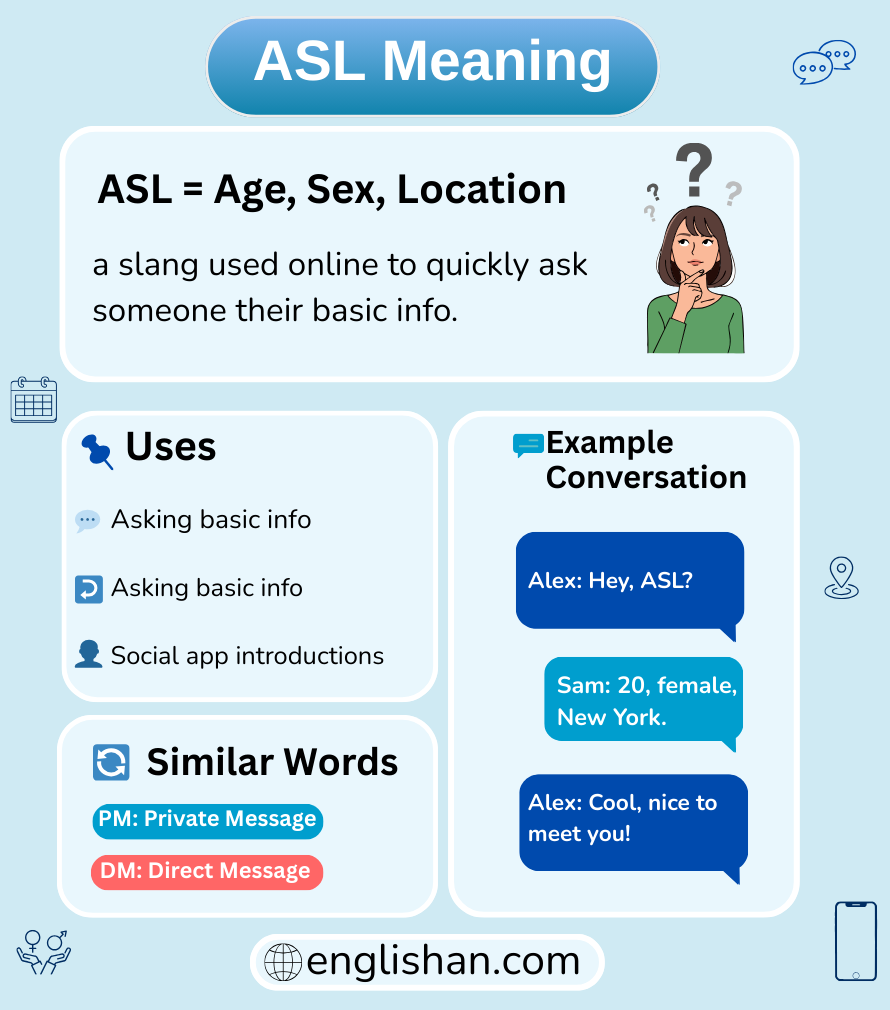
ASL meaning depends on how and where it is used. In chat culture, ASL most often stands for age, sex, location, a short question used to learn basic details about someone in a DM, chat room, or dating conversation. It appears early in exchanges and can touch on privacy, especially with people you do not know well.
In this article, we explain ASL meaning first, then how it is used across different chats. We also cover its other common sense, as hell, and the frequent mix-up with American Sign Language, followed by short examples that show how each use is understood in everyday talk.
ASL Meaning
The internet slang term ASL has two distinct definitions depending on the context. In traditional chatrooms, it functions as a request for personal demographics to identify a stranger. In modern social media captions and text messages, it serves as a casual abbreviation for the intensifier phrase “as hell.”
ASL Stands For
The acronym represents two completely different sets of words based on usage. In the context of meeting new people, it stands for Age, Sex, Location. When used as a descriptive slang term in lower-case text, it stands for the phrase As Hell. You must check the surrounding sentence to determine which phrase fits.
When To Use ASL
You should use the demographic query version only in anonymous chat environments where you cannot see a user’s profile. It is appropriate when meeting a stranger on a text-only platform. Conversely, you use the “as hell” version in casual comments or captions to exaggerate a feeling, like saying a movie was “funny asl.”
How ASL Is Used In Chats, Comments, And Captions
In direct messages and lobby chats, users type “ASL?” as a standalone question to start a conversation. In social media comments and captions, it is integrated into sentences to boost the impact of a description.
- Chatroom: “Hey there, asl?”
- Caption: “This outfit is cute asl.”
- Comment: “That jump scare was fake asl.”
How To Reply To “ASL?”
If someone asks this in a chatroom, the standard response is to list your details in a specific order. You typically reply with your age number, gender (M/F), and city or state. For example, a standard reply would look like “18/f/Florida.” You are essentially filling out a mini-bio in real time.
Example Conversations Using ASL
These dialogues illustrate the difference between using the term as a request for personal details and as a slang intensifier.
Stranger: Hello, I am new to this chat room.
User: Welcome. ASL?
Stranger: 18, male, California. How about you?
Jason: Did you see the new horror movie that just came out?
Mike: Yeah, it was scary asl. I couldn’t sleep last night.
Jason: I might skip it then, I hate jump scares.
Sarah: Why is the teacher giving us so much homework over the weekend?
Emily: I know, she is being annoying asl today.
Sarah: I guess we have to cancel our plans for Saturday.
Origin Of ASL And “A/S/L”
The demographic acronym originated in the early 1990s with the rise of text-based chat services. It was the standard greeting for a generation of internet users who needed to identify strangers without photos. The “as hell” variation emerged much later, gaining traction on social media around 2018 as users looked for faster ways to type common intensifiers.
ASL Variations Like A/S/L And ASLP
The demographic query has several common formats to clarify specific requests.
- A/S/L: The classic format with slashes to separate the words.
- ASLP: Adds a request for a Picture at the end.
- ASLM: Adds a request for Music taste or marital status.
- 18/f/cali: A standard formatted answer.
Other Related Slang Words
These terms also help identify users or emphasize descriptions.
- AF: As F***. A stronger version of “asl” (as hell).
- Loc: Short for Location.
- M/F: Male or Female.
- Deadass: Slang for “seriously” or “truthfully.”
Common Confusions
A major confusion arises between the two slang definitions. An older user might see “funny asl” and be confused why someone is asking for their age and location in the middle of a joke. Additionally, the standard acronym for American Sign Language is identical, which causes frequent misunderstandings in educational or disability discussions.
ASL Vs American Sign Language
In academic and professional contexts, ASL always refers to the visual language used by the Deaf community. This is a formal linguistic term. In internet slang, it is a casual abbreviation. Context is the only way to tell them apart; a university class labeled “ASL 101” is about signing, not chatrooms.
ASL Vs “A/S/L”
There is no difference in meaning between these two visual styles; they ask the same question. The version with slashes (A/S/L) is the vintage style popular in the 1990s and 2000s. The version without slashes is the modern, faster way to type the query.
Key Takeaway
We define this acronym as a dual-purpose slang term. Historically, it stands for “Age, Sex, Location,” serving as a demographic filter in anonymous chatrooms. In modern social media culture, it functions as a shorthand for “As Hell” to emphasize adjectives. Readers must look at the context—whether it is a question or a description—to determine which definition is being used.
FAQs
No, in comments it just means “as hell” and is very common slang.
Be cautious. Revealing your exact location to strangers is risky.
For the question, say the letters A-S-L. For “as hell,” read it as the full phrase.
Usually yes, if sent as a direct question in a private chat.
Yes, “funny asl” and “funny af” mean almost the same thing.
You May Also Like