FWIW meaning shows up when someone adds a thought without pushing it hard. The phrase stands for for what it’s worth, and it softens an opinion or extra detail in an email, work note, DM, group chat, or a Reddit comment. It signals sharing insight while leaving room for others to decide.
In this article, we explain FWIW meaning first, then how people use it at work, at school, and in casual chats. We show how it can sound like a gentle qualifier or mild disagreement, followed by short examples that help you use it smoothly.
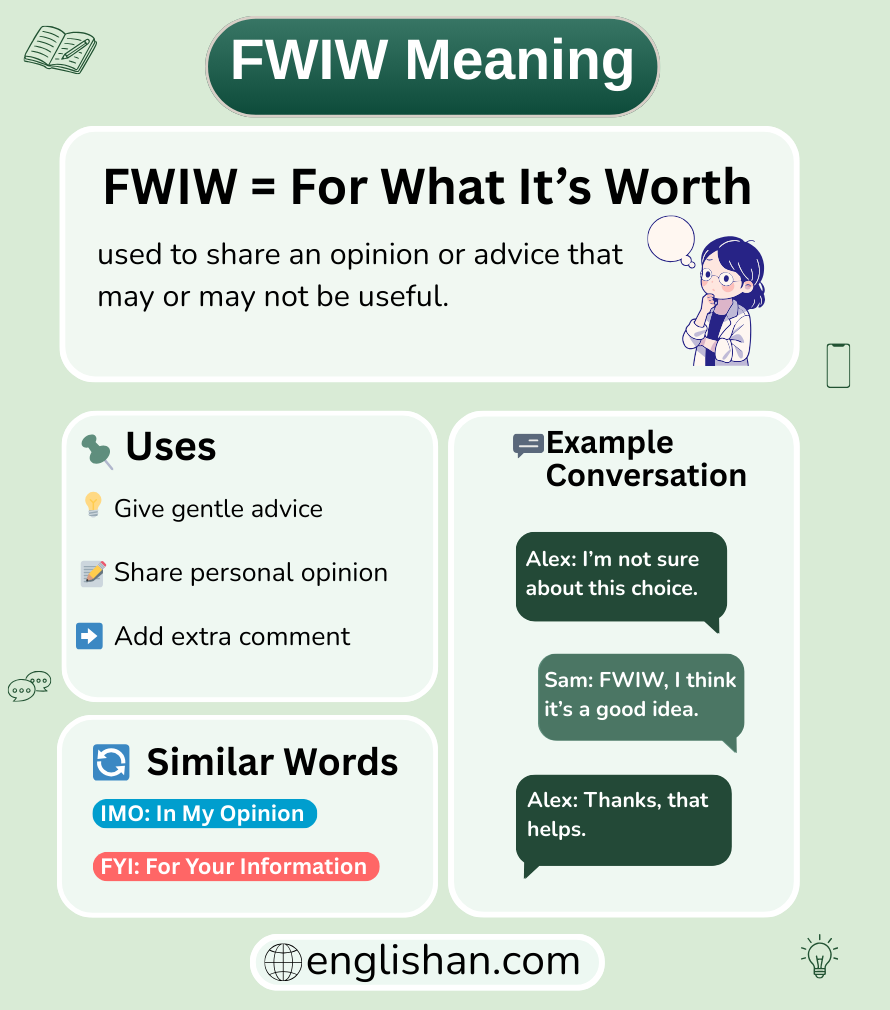
What Does FWIW Mean?
The acronym FWIW serves as a polite preface to a statement, indicating that the information follows might only have limited value. It signals that the speaker is offering a thought, opinion, or fact, but they are leaving it up to the listener to decide if it is useful. Writers use it to sound humble and non-confrontational when adding to a discussion.
What FWIW Signals About Tone
Using this term immediately lowers the intensity of a message, making the speaker sound diffident and helpful. It removes the pressure from the recipient, implying that there is no obligation to agree with or act on the suggestion. It effectively acts as a verbal shrug, suggesting, “This might help, or it might not.”
What Does FWIW Stand For?
This four-letter abbreviation stands directly for the phrase For What It’s Worth. It functions grammatically as an introductory adverbial phrase, usually placed at the start or very end of a sentence. While the full phrase is common in speech, the acronym is exclusive to written digital communication.
How To Use FWIW In Texting And Online Chats
People type this slang to soften a correction or offer an alternative viewpoint without arguing. It helps introduce personal anecdotes that are related to the topic but not essential to the main point. You will often see it used to share a small detail that might fix a problem someone is complaining about.
Where You See FWIW Most
This term appears frequently in workplace emails and collaborative platforms where professionals exchange feedback. It is also standard in internet forums and comment sections where users want to chime in on a debate without starting a fight. Unlike many slang terms, it is widely accepted in semi-formal business chats.
How To Reply To FWIW
If someone offers you advice with this tag, the best response is to simply acknowledge the input. A quick “Thanks for the heads up” or “I did not know that” shows you appreciate the effort. Even if the information is not useful, the sender intended to be helpful, so a polite receipt is standard.
Example Conversations Using FWIW
These dialogues demonstrate how friends and colleagues use the term to offer gentle suggestions or extra context.
Jason: I am completely stuck on this level of the game.
Mike: FWIW, there is a secret path behind the waterfall.
Jason: Really? I walked past that three times.
Sarah: I feel bad about cancelling our dinner plans.
Emily: FWIW, I was actually really tired and wanted to stay home anyway.
Sarah: Oh good, I am glad we are on the same page.
David: This restaurant looks expensive.
Jessica: FWIW, I heard they have a really cheap lunch special.
David: Let’s check the menu then.
Origin Of FWIW
The spoken phrase “for what it’s worth” has existed in English for centuries, but the acronym appeared in the late 1980s. It became popular on Usenet newsgroups and early email lists as a way to shorten common conversational fillers. It transitioned smoothly into modern texting and social media as a standard tool for polite discourse.
Other Related Slang Words
These acronyms also manage the tone of an opinion or share information.
- IMO: In My Opinion. States a personal belief.
- IMHO: In My Humble Opinion. A politer version of IMO.
- FYI: For Your Information. Used to share facts.
- TBH: To Be Honest. Used to admit truth.
Common Confusions
A frequent mix-up occurs between FWIW and FYI (For Your Information). While both share information, FYI is direct and factual, often sounding like an announcement or a warning. FWIW is subjective and tentative, offering advice that the listener can choose to ignore.
FWIW Vs IMO
The difference here lies in the level of confidence. IMO (In My Opinion) explicitly claims ownership of a viewpoint and asserts it as a belief. FWIW is more detached, offering a piece of data or a thought without necessarily taking a hard stance on whether it is right.
FWIW Vs IMHO
These two are very close cousins in digital slang. IMHO (In My Humble Opinion) focuses on the speaker’s humility, emphasizing that they are not an expert. FWIW focuses on the value of the information, emphasizing that the data itself might be minor or irrelevant.
Key Takeaway
We define this acronym as a polite shorthand standing for “For What It’s Worth,” used to offer information without pressure. It serves as a way to soften suggestions, share minor details, or add context to a conversation while acknowledging that the input might not be perfect. Unlike stronger opinion markers, it signals humility and allows the listener to decide the value of the statement. Remember to use FWIW when you want to be helpful but not pushy.
FAQs
Yes, it is common in business chats and quick emails.
No, it strictly means For What It’s Worth.
It can be, but usually, it is genuine and helpful.
You can write it as FWIW or fwiw; both are correct.
No, write out the full phrase in formal writing.
While usually polite, FWIW can sound passive-aggressive if used to minimize a problem. If someone is venting about a serious loss, adding a trivial “silver lining” comment prefaced by FWIW can feel insensitive. It may imply that the speaker thinks the listener is overreacting or missing the obvious.
You May Also Like