A message lands asking if you are coming, and you stare at the screen for a second. You are unsure, distracted, or just not ready to decide, so the reply needs to say that without drama.
In chats, IDK fills that gap. It mirrors I don’t know, whether the moment is casual, rushed, or playful. People use it to pause a decision, admit uncertainty, or keep the conversation moving.
Here, we will explain idk meaning and how it works across texts, comments, and quick replies, including tone, timing, and examples. You will see when it sounds natural, how it softens a message, and which close alternatives fit similar moments online.
IDK Meaning
IDK is a widely used acronym in digital communication that signals a lack of information or certainty. Users type these three letters to admit they do not have the answer to a specific question. It functions as a quick, neutral way to express ignorance without needing to explain further.
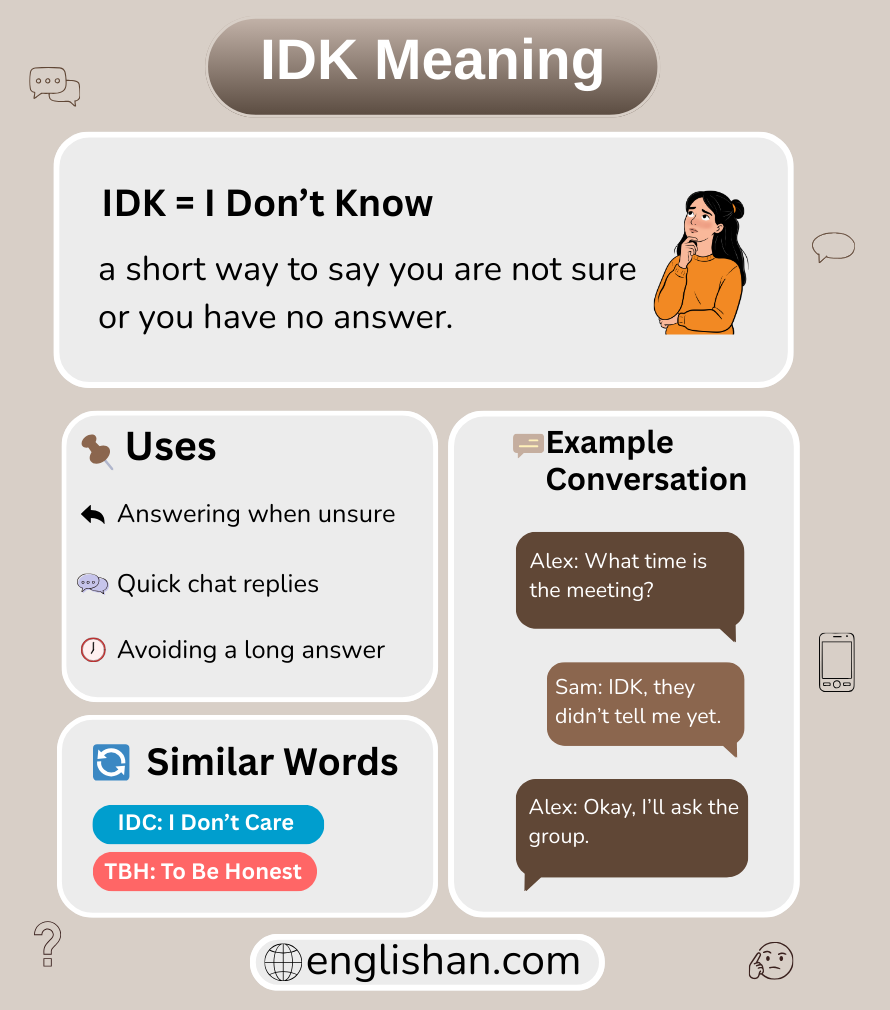
IDK Stands For
This common shorthand stands for the phrase I Don’t Know. It serves as a direct text replacement for the spoken sentence, allowing for faster replies during rapid-fire conversations. The abbreviation condenses a complete thought into a universally recognized code for uncertainty.
When To Use IDK
People use this term whenever they are asked a question they cannot answer. It fits best in casual settings like texting friends, gaming chats, or social media comments where speed matters more than grammar. It effectively closes a topic or indicates that the sender is unable to help with the inquiry.
IDK In Text Messages
In one-on-one texts, this acronym often serves as a standalone response to a direct question. It allows the sender to admit they are unsure without typing a long explanation or apology. Friends often use it to quickly decline making a decision, such as choosing a place to eat.
IDK In Comments And Captions
On social media posts, this term often appears in captions to show sarcasm or feigned confusion about a situation. Users might post a funny photo with a caption like “IDK what is happening here” to invite engagement. In this context, it acts as a humorous disclaimer rather than a serious admission of ignorance.
IDK Example Conversations
Here are a few ways friends use this abbreviation to handle questions they cannot answer.
Jordan: What time does the movie start tonight?
Casey: IDK check the website, I think it is at seven.
Sam: Why is the internet so slow today?
Taylor: Honestly IDK, maybe the router is broken again.
Alex: Do you know where I left my jacket?
Jamie: IDK I have not seen it since we got here.
IDK Origin
The term emerged in the early 2000s alongside the rise of SMS text messaging and internet chat rooms. Users adopted it as a necessary shortcut to save keystrokes on flip phones and limited character counters. It has persisted as a staple of internet vocabulary due to its extreme efficiency.
IDK Variations
Different spellings and additions change the specific tone of the phrase:
- Idk: The lowercase version, often seen as more casual or soft.
- IDEK: Adds emphasis to show extreme confusion.
- IDNK: A rare variation including the “N” from “Not,” though this is uncommon.
IDK Vs IDC
These two acronyms look similar but have opposite meanings regarding care. IDK means you lack knowledge, while IDC (I Don’t Care) means you lack interest. Confusing the two can turn a harmless admission of ignorance into an insulting statement of apathy.
IDK Vs IKR
While both start with “I,” their functions in a conversation are totally different. IDK admits you do not know something, whereas IKR (I Know, Right?) signals strong agreement with what was just said. Mixing them up causes confusion about whether you agree or are confused.
IDK Vs Dunno
Both terms mean the same thing, but they represent different ways of speaking. IDK is an acronym for the written phrase, while Dunno is a phonetic spelling of the slurred speech “don’t know.” Dunno often feels slightly more lazy or informal than the acronym.
IDK Key Takeaways
We have explored how this essential acronym helps users quickly admit a lack of knowledge. IDK stands for I Don’t Know and serves as a neutral, efficient way to answer questions when you do not have the facts. Whether typed in lowercase or caps, it remains the standard digital shrug for uncertainty.
IDK FAQs
In texting, IDK stands for I Don’t Know and signals uncertainty.
It can seem rude if used alone; adding a polite phrase helps soften it.
IDEK adds emphasis, meaning “I Don’t Even Know,” showing frustration or shock.
Avoid IDK in work emails; state “I am unsure” or “I will check” instead.
No, IDK means you lack knowledge; IDC means you do not care.
You May Also Like