NVM meaning appears when a conversation suddenly changes direction. In everyday messaging, nvm stands for never mind, used when someone solves a problem on their own, changes plans, or decides not to continue a topic. It shows up in a text message, DM, group chat, and quick replies across casual and work conversations.
In this article, we explain NVM meaning first, then how people use it in different situations. It can sound neutral, polite, or slightly annoyed, depending on the sentence around it. Short examples that follow help you recognize the feeling behind it and choose an appropriate reply.
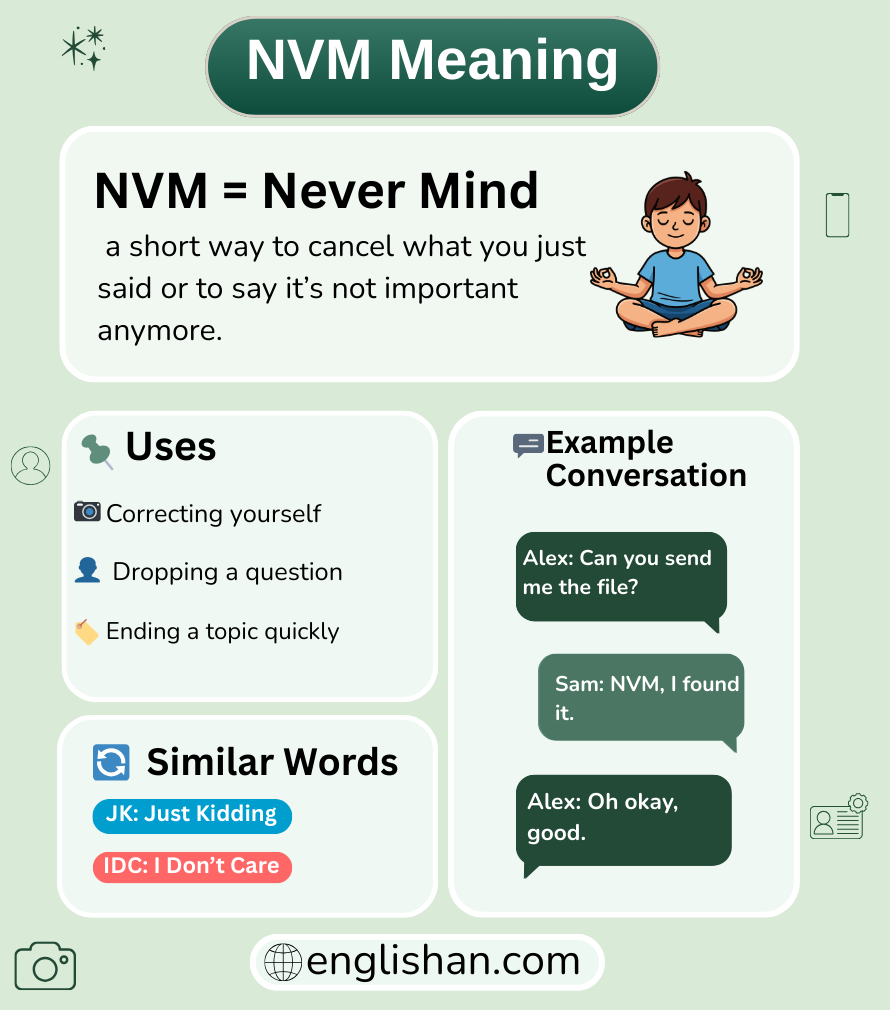
What Does NVM Mean?
The acronym NVM serves as a directive to disregard previous instructions or statements. It signals that the speaker wants to withdraw a question, cancel a plan, or drop a subject that is no longer relevant. Writers use it to quickly tell the listener that they should stop worrying about the last message sent.
What Does NVM Stand For?
This three-letter abbreviation stands directly for the phrase Never Mind. It grammatically acts as an imperative verb phrase instructing the recipient to pay no attention to a specific matter. While the spoken phrase can be polite or passive-aggressive, the text version usually leans towards being functional and brief.
How To Use NVM In Texts And Chats
People type this slang to correct a misunderstanding or to retract a question they figured out themselves. It is useful when you ask a friend for help finding an item, but then find it immediately after hitting send. You will often see it used to abruptly end a text conversation that is becoming confusing or frustrating.
How To Reply To NVM
If someone sends this to you, the best response is usually a simple acknowledgement like “Okay” or “No problem.” If the context suggests they are annoyed, you might want to ask if they are sure everything is fine. However, in most cases, they simply want to move on from the topic, so dropping it is the polite choice.
Example Conversations Using NVM
These dialogues demonstrate how friends use the term to retract questions or express mild frustration.
Jason: Hey, do you have the answer to number five on the homework?
Mike: I am checking my notes right now, give me a second.
Jason: NVM, I just found it in the textbook. Thanks anyway.
Sarah: What time are we meeting for the movie?
Emily: I thought we canceled because it is raining?
Sarah: Oh right, nvm. I forgot about the weather.
David: Why did you text me “call me” three times?
Jessica: It was an emergency, but I fixed it. Nvm.
David: Are you sure? I can still call.
Origin Of NVM
The abbreviation appeared in early internet chatrooms and SMS texting during the 1990s and early 2000s. It was created to shorten the common phrase “never mind” to save time and character space on flip phones. It became a staple of digital vocabulary because it efficiently signals the end of a topic with just three keystrokes.
Other Related Slang Words
These terms also help dismiss topics or manage conversation flow.
- NM: Never Mind (or Not Much). A shorter version.
- DW: Don’t Worry. Used to reassure someone.
- NP: No Problem. Used to accept an apology.
- TBH: To Be Honest. Used to transition topics.
Common Confusions
A frequent mix-up occurs between NVM and NM, as NM has multiple meanings depending on the context. While NVM always means “Never Mind,” NM can mean “Never Mind” or “Not Much.” Readers must look at the surrounding sentence to see if the person is answering a question or dismissing one.
NVM Vs NM
The primary difference lies in ambiguity. NVM is the clearer, safer choice because it has only one definition. NM is riskier because if you type “nm” in response to “What are you doing?”, it means “Not Much,” but if you type it after a mistake, it means “Never Mind.”
NM As “Not Much”
When used as a standard reply to “What’s up?” or “What are you doing?”, NM stands strictly for Not Much. In this specific context, it is a status update, not a retraction. It indicates boredom or a lack of activity rather than a desire to stop talking.
NVM Vs NVMD
There is no difference in meaning between these two; NVMD is simply a less common spelling. Some users add the “D” to represent the end of the word “mind,” but it is longer to type and therefore less popular. Both clearly communicate the same message of dismissal.
Key Takeaway
We define this acronym as a standard text abbreviation standing for “Never Mind,” used to retract a statement or dismiss a topic. It serves as a quick way to tell a recipient to ignore a previous message or that a problem has been solved. While generally functional and neutral, it can appear passive-aggressive if used to end an argument abruptly. Remember to use NVM when you find the answer to your own question before your friend replies.
FAQs
It can be if used to shut down a person abruptly.
No, it strictly means Never Mind.
It is too informal for professional emails; write “disregard this.”
You can write nvm or NVM; both are correct.
Read it as the full phrase “Never Mind.”
You May Also Like