The word stfu hits hard because it carries strong emotion in very few letters. It stands for shut the f up, a blunt phrase used to stop someone from talking, often during arguments or heated moments. You may hear it in a text message, group chat, gaming talk, or a comment, where profanity signals anger, shock, or sharp sarcasm.
In this article, we explain STFU meaning first, then how people use it in casual chats, school talk, and work messages. We walk through how tone shifts between joking and hostile use, followed by short examples that help you judge intent before reacting.
STFU Meaning
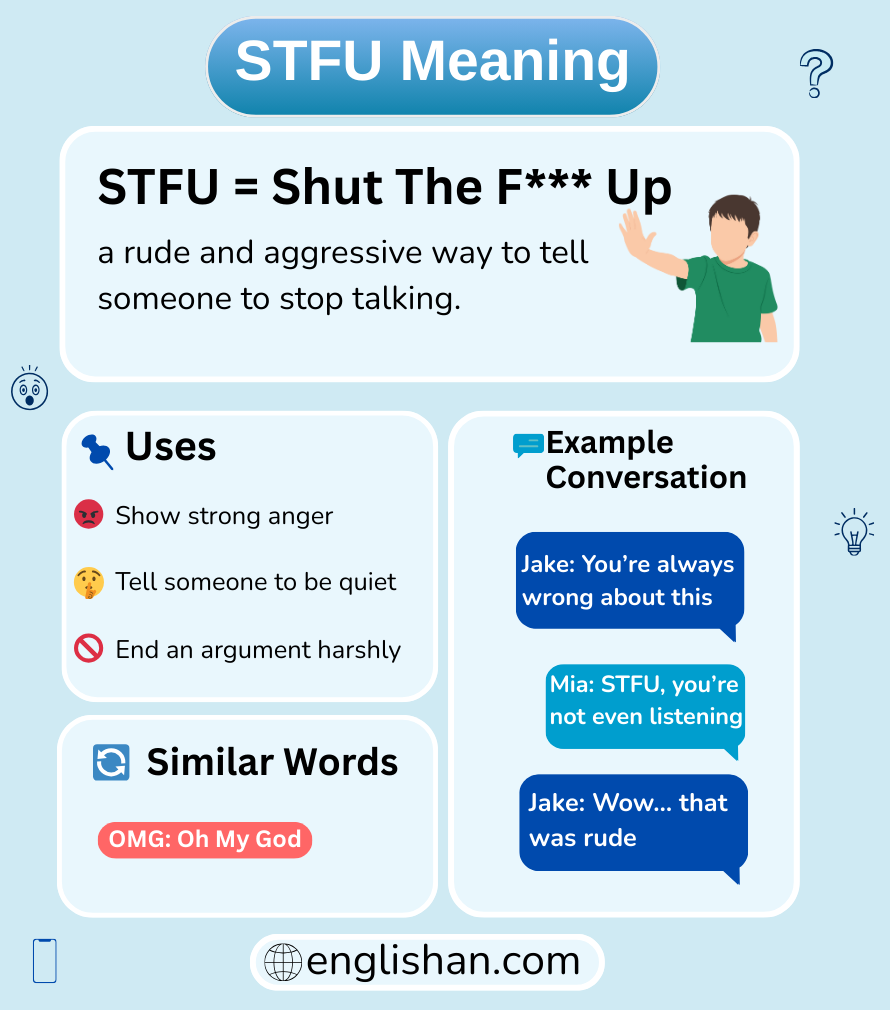
The acronym STFU functions as a highly aggressive command telling someone to stop speaking immediately. It serves as a vulgar, intensified version of “shut up,” used when annoyance has reached a breaking point. While primarily a demand for silence, it can also express extreme disbelief or shock in reaction to surprising news.
What Does STFU Stand For
This four-letter abbreviation stands directly for the phrase Shut The F* Up**. The inclusion of the profanity adds significant weight and anger to the statement, distinguishing it from a polite request for quiet. It grammatically acts as an imperative sentence, ordering the recipient to cease all communication.
How STFU Is Used In Texting And Chat
People type this slang in messages to silence trolls or end heated arguments abruptly. It creates a harsh boundary, signaling that the sender is no longer willing to listen to the other person’s input. In a completely different context, close friends use it to react to unbelievable stories, meaning “I cannot believe you just said that.”
When STFU Is Considered Rude Or Offensive
Using this term is almost always considered rude and offensive when directed at strangers, acquaintances, or authority figures. It attacks the other person’s right to speak and uses strong profanity to demean them. The only exception occurs in close friendships where insults are understood as playful banter rather than genuine hostility.
STFU Example Conversations
These dialogues demonstrate the range of the term, from genuine anger to shocked disbelief.
Jason: I think I’m going to ask your ex-girlfriend out on a date.
Mike: You better STFU right now before I get really mad.
Jason: Okay, sorry, I was just joking.
Sarah: You will never guess who I just saw at the grocery store. Beyoncé!
Emily: STFU! Are you serious? Did you get a picture?
Sarah: No, I was too scared to approach her.
David: I just accidentally deleted our entire group project.
Jessica: STFU, please tell me you have a backup save.
David: I wish I did, but it’s completely gone.
Origin Of STFU
The abbreviation originated in the late 1990s within online chatrooms and message boards as internet arguments became common. Users adopted the shorthand to type the aggressive phrase quickly without getting banned by automatic chat filters that caught full swear words. It remains a staple of internet conflict and gaming culture today.
Other Slang Words Similar To STFU
These acronyms also demand silence or dismissal in digital conversations.
- GTFO: Get The F*** Out. Used to dismiss someone entirely.
- STHU: Shut The Heck Up. A polite version of the phrase.
- Shush: A sound used to demand quiet gently.
- Zip It: A phrase meaning to close one’s mouth.
Common Confusions About STFU
A frequent misunderstanding is assuming STFU always indicates genuine anger. New users might feel hurt if a friend sends it in response to good news, not realizing it can mean “No way!” in a positive context. Context is critical; if the conversation was happy, the acronym is likely an expression of shock, not hatred.
Key Takeaway
We identify this acronym as a vulgar slang term standing for “Shut The F* Up,”** used to demand immediate silence. It serves as an intense signal of anger or annoyance, though it can occasionally express shock among close friends. Because it relies on strong profanity, it carries a disrespectful tone that is inappropriate for professional or public settings. Remember to use STFU only when you intend to be harsh or are joking with someone who understands your humor.
FAQs
Yes, it contains a strong profanity. It is not appropriate for school or polite company.
Yes, friends use it to express shock or disbelief. It acts like saying “No way!”
Yes, it is considered much more aggressive and vulgar due to the F-word.
In strict gaming chats or forums, yes. It violates many harassment policies.
You say the letters S-T-F-U. You rarely say the full phrase unless you are actually yelling.
You May Also Like