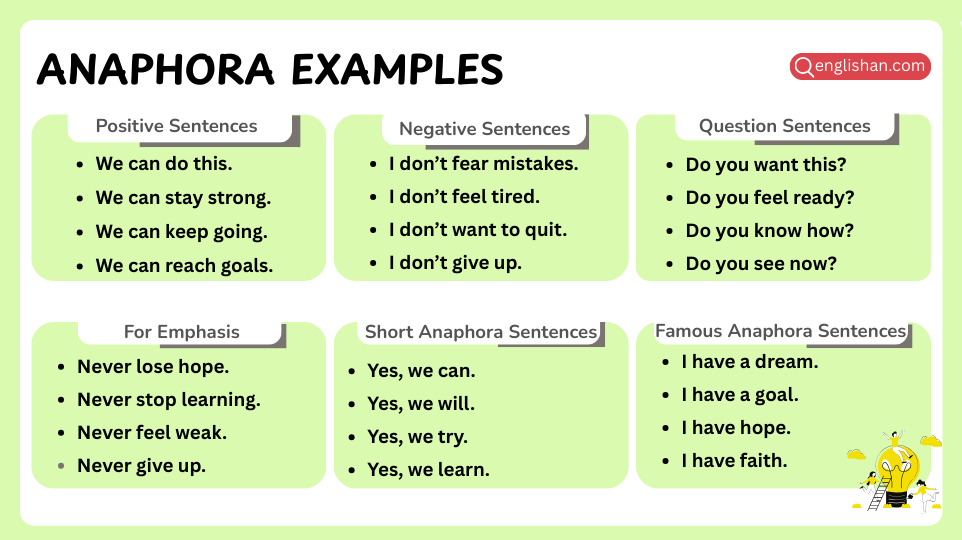
Writers and speakers often repeat a word or phrase at the beginning of sentences to create emphasis and rhythm. This technique is called anaphora, and it is used in literature, speeches, and poetry to draw attention to an idea and make language more memorable.
This article provides anaphora examples for direct practice. By reading these sentences, learners can observe how repetition shapes tone and focus, strengthening understanding through clear, practical use.
What is Anaphora?
Anaphora is a literary device in which a word or phrase is repeated at the beginning of successive sentences or clauses to create emphasis and rhythm. It is often used in speeches and writing to highlight important ideas and make them more memorable.
Example Sentences of Anaphora
Below is a list of short sentences using anaphora to practice repeated words or phrases:
- We will fight. We will win.
- I want peace. I want love.
- She said help is coming. She said stay strong.
- Every day, he runs. Every day, he reads.
- We must act. We must stay strong.
- They will succeed. They will celebrate.
- I remember the past. I remember the lessons.
- He dreams of flying. He dreams of traveling.
- You should try. You should never quit.
- I feel happy. I feel excited.
- We must learn. We must help.
- She knows the truth. She knows the way.
- I will rise. I will move forward.
- He said nothing. He said everything.
- Every night, she prays. Every night, she dreams.
- We believe in justice. We believe in equality.
- I see hope. I see light.
- They shouted together. They shouted loudly.
- We need courage. We need patience.
- I love reading. I love writing.
Positive Anaphora Example Sentences
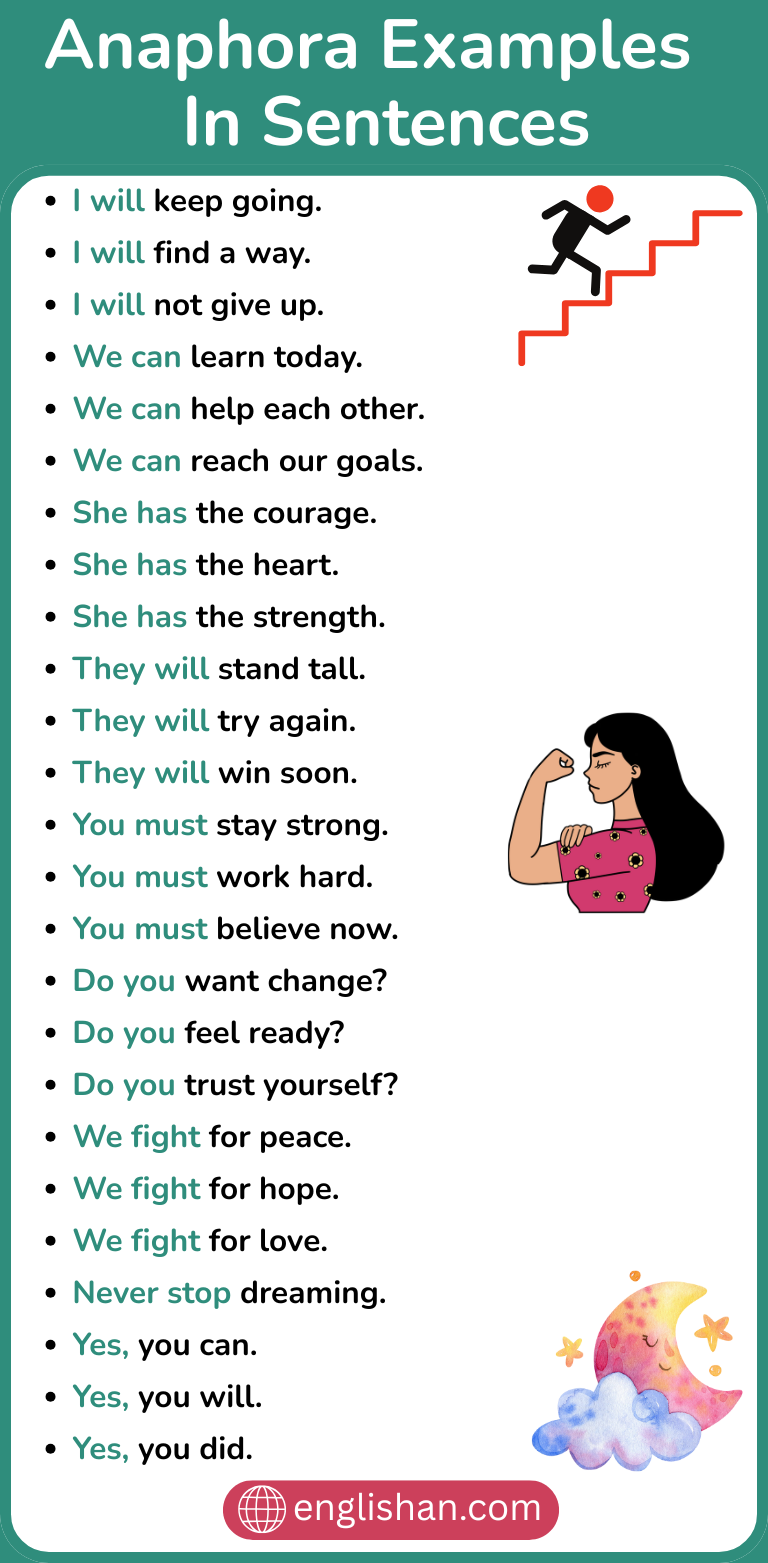
Positive anaphora sentences repeat words to express hope, confidence, or encouragement. Below is a list of positive sentences with anaphora.
- We learn from practice, we learn from mistakes, we learn from experience.
- He will take responsibility, he will stay focused, he will keep trying.
- They are ready to begin, they are willing to improve, they are prepared to succeed.
- You can ask for help, you can take your time, you can grow every day.
- We must stay patient, we must stay steady, we must stay committed.
- She will rise again, she will stay strong, she will keep going.
- I have the courage, I have the strength, I have the determination.
- Let us work together, let us learn together, let us move forward.
- They keep the hope, they keep the faith, they keep the promise.
- We remain confident, we remain steady, we remain inspired.
Negative Anaphora Example Sentences
Negative anaphora sentences repeat a word or phrase to show refusal, denial, or warnings. Below is a list of negative anaphora sentences.
- I don’t doubt myself, I don’t hide from challenges, I don’t surrender to pressure.
- I don’t follow fear, I don’t follow anger, I don’t follow doubt.
- I don’t accept excuses, I don’t waste effort, I don’t settle for less.
- We will not forget our purpose, We will not abandon each other, We will not lose our direction.
- We will not allow injustice, We will not tolerate cruelty, We will not ignore suffering.
- We will not break under strain, We will not fall under pressure, We will not stop moving forward.
- You cannot erase the past, You cannot silence the truth, You cannot rewrite reality.
- You cannot deny responsibility, You cannot refuse growth, You cannot avoid consequences.
- You cannot stop time, You cannot hold back change, You cannot control every outcome.
- They don’t speak with fear, They don’t act with doubt, They don’t walk without purpose.
- They don’t turn against each other, They don’t lose focus, They don’t forget who they are.
- They don’t seek praise, They don’t fear silence, They don’t need approval.
- She hasn’t lost her strength, She hasn’t lost her direction, She hasn’t lost her belief.
- She hasn’t stopped trying, She hasn’t stopped learning, She hasn’t stopped growing.
- She hasn’t accepted defeat, She hasn’t lowered her standards, She hasn’t stepped away.
- He won’t turn away now, He won’t hide his voice, He won’t give up the goal.
- He won’t break under judgment, He won’t fall to doubt, He won’t lose control of his path.
- He won’t end the effort, He won’t slow the progress, He won’t forget the reason.
- We cannot change yesterday, We cannot take back words, We cannot undo time.
- We cannot stay silent, We cannot stand aside, We cannot watch without acting.
- We cannot lose faith now, We cannot step backward, We cannot turn away from tomorrow.
Question Sentences With Anaphora
Questions using anaphora repeat the same start to ask for emphasis or clarity. Below is a list of question sentences with anaphora.
- Why do we run? Why do we hide? Why do we fear?
- How can we begin? How can we improve? How can we succeed?
- What will we choose? What will we lose? What will we gain?
- Who can help? Who can teach? Who can inspire?
- When did it start? When did it change? When did we forget?
- Where will we go? Where will we rest? Where will we end?
- Can you see it? Can you feel it? Can you believe it?
- Do we know enough? Do we care enough? Do we try enough?
- Will they listen? Will they learn? Will they act?
- Could you forgive? Could you understand? Could you move on?
- Shall we stay? Shall we leave? Shall we return?
- Must we fight? Must we suffer? Must we endure?
- Would you follow? Would you lead? Would you change?
- Is this our time? Is this our chance? Is this our test?
- Are we ready? Are we strong? Are we united?
- Do I matter? Do I belong? Do I fit?
- Can they see? Can they hear? Can they care?
- Why must we wait? Why must we fall? Why must we rise again?
- How long will it take? How long will we fight? How long will we hope?
- What can we learn? What can we change? What can we save?
Anaphora Sentences For Emphasis
Anaphora in sentences is often used to give strong emphasis or emotion to ideas. Below is a list of sentences using anaphora for emphasis.
- Never give up. Never surrender. Never lose hope.
- Always be kind. Always be honest. Always be yourself.
- We fight for freedom. We fight for justice. We fight for peace.
- I will rise. I will fight. I will win.
- You must believe. You must act. You must succeed.
- They stand tall. They stand proud. They stand strong.
- She speaks loud. She speaks clear. She speaks truth.
Short Anaphora Sentences
Short sentences with anaphora focus on repeating small words or phrases for quick impact. Below is a list of short anaphora example sentences.
- Yes, yes, yes!
- No, no, no!
- Go, go, go!
- Stop, stop, stop!
- Run, run, run!
- Try, try, try!
- Wait, wait, wait!
- Fight, fight, fight!
- Win, win, win!
- Jump, jump, jump!
Famous Anaphora Sentences
Famous anaphora sentences come from speeches, literature, or historic texts. Below is a list of well-known sentences using anaphora.
- I have a dream that one day… I have a dream… I have a dream… (Martin Luther King Jr.)
- It was the best of times, it was the worst of times, it was the age of wisdom, it was the age of foolishness… (Charles Dickens)
- We shall fight on the beaches, we shall fight on the landing grounds, we shall fight in the fields… (Winston Churchill)
- With malice toward none; with charity for all; with firmness in the right… (Abraham Lincoln)
- Let freedom ring from the hilltops. Let freedom ring from the mountains. Let freedom ring from every village.
Anaphora Examples In Literature And Speeches
Anaphora is common in literature and speeches to add rhythm and power. Below is a list of sentences from literature and speeches using anaphora.
- Mad world! Mad kings! Mad composition! (William Shakespeare)
- We will not tire, we will not falter, and we will not fail. (George W. Bush)
- To every thing there is a season, and a time to every purpose under heaven: A time to be born, and a time to die… (Bible)
- We shall not flag or fail. We shall go on to the end. We shall fight in France… (Winston Churchill)
- It takes a family to raise a child. It takes a community to support a family. It takes a nation to secure a future.
Anaphora Examples in Public Speaking
In public speaking, anaphora creates emphasis by repeating the same opening words across connected statements. This repetition shapes rhythm, strengthens emotional tone, and makes the message easier to follow and remember. Speakers often use anaphora to build momentum and guide listeners toward the central point of the speech.
Examples:
- We stand for justice, we stand for unity, we stand for progress.
- Let us move forward with hope, let us move forward with strength, let us move forward together.
- This is our time to act, this is our time to build, this is our time to rise.
- We remember those who came before, we remember their work, we remember their vision.
- I speak for change, I speak for courage, I speak for everyone here today.
- We choose to learn, we choose to grow, we choose to rise.
- Let our voices be heard, let our voices be seen, let our voices be known.
- We come together today, we come together in strength, we come together for change.
- I ask for patience, I ask for unity, I ask for understanding.
- We march with hope, we march with purpose, we march for tomorrow.
Difference Between Anaphora, Epistrophe, and Symploce
Anaphora, epistrophe, and symploce all use repetition for emphasis, but they differ in where the repeated words appear in a sentence or clause.
1. Anaphora
Repetition appears at the beginning of successive phrases or clauses.
Example: We rise with effort, we rise with courage, we rise with hope.
Function: Creates a forward-building rhythm and highlights the central idea.
2. Epistrophe
Repetition appears at the end of successive phrases or clauses.
Example: They worked for change, stood for change, and hoped for change.
Function: Gives closure, emotional weight, and a sense of resolve.
3. Symploce
Repetition appears at both the beginning and the end of successive phrases or clauses.
Example: We remember our past for strength, we remember our future for strength.
Function: Frames the message clearly, reinforcing meaning at two points in the line.
Each device shapes rhythm and emphasis differently. The placement of repetition determines whether the focus builds outward from the start, concludes with impact at the end, or balances meaning across both.
Function of Anaphora
The function of anaphora is to create emphasis through patterned repetition at the beginning of successive words, phrases, or clauses. This repetition strengthens meaning by drawing the reader’s or listener’s attention to the repeated element. In speech, anaphora shapes rhythm and builds momentum, helping ideas unfold with a steady cadence. In writing, it highlights a central theme, expresses emotional weight, or guides the audience toward a key conclusion.
Key purposes include:
- Emphasis of main idea: The repeated opening phrase signals which concept should be remembered.
- Emotional reinforcement: Repetition increases intensity, helping the audience feel the message more deeply.
- Clarity and structure: The repeated pattern organizes thoughts and makes complex statements easier to follow.
- Persuasion: The rhythm created by repetition can influence belief, agreement, or motivation.
- Memorability: Repeated openings make lines easier to recall, which is valuable in speeches, lessons, and public messaging.
Anaphora works most effectively when the repeated phrase is short, purposeful, and directly linked to the writer’s or speaker’s central point.
You May Also Like