Plagiarism essay writing helps students understand what copying content means and how to avoid it. This blog offers short 10-line, 250-word, and 500-word essays designed for school learning needs. These formats save time, support writing clarity, and align with school-level expectations. By using ready-made, level-based structures, students can learn proper essay writing without confusion. This topic connects to academic ethics, originality, and digital learning, offering direct value for both students and educators.
10 Lines Plagiarism Essay for Class 2 to Class 5
- Plagiarism means copying someone’s work without permission.
- It can be in writing, art, or music.
- Taking ideas without credit is also plagiarism.
- Plagiarism is not honest or fair.
- Students must write their own ideas.
- Teachers check work for copying.
- Copying homework is also plagiarism.
- Using books without naming them is wrong.
- We must always be truthful in school.
- Learning to avoid plagiarism helps us grow.

250 Words Essay on Plagiarism for Middle School
Plagiarism means using someone else’s ideas, words, or work and pretending they are your own. It often happens when students copy from books, websites, or friends without giving credit. Many times, students do not realize that even small copied parts count as plagiarism.
Plagiarism is a serious issue in schools. It can happen in homework, essays, and even group projects. Some students copy and paste information from the internet without mentioning the source. Others may forget to use quotation marks or change only a few words from the original text. These actions are still dishonest and unfair.
The effects of plagiarism are harmful. Students who plagiarize do not learn or practice their writing skills. They may get low grades, warnings, or even face school punishments. Teachers may lose trust in the student, and it can hurt their future academic chances.
To avoid plagiarism, students should write in their own words. If they use information from books or online sources, they must give credit. This can be done by using quotation marks and writing the name of the author or website. Learning how to paraphrase and summarize is also helpful.
In conclusion, plagiarism is wrong because it stops real learning and is dishonest. Every student should try to be honest, original, and careful in their writing. This not only helps them succeed in school but also teaches them to respect the work of others.
500 Words Plagiarism Essay for Upper Primary and Lower Secondary
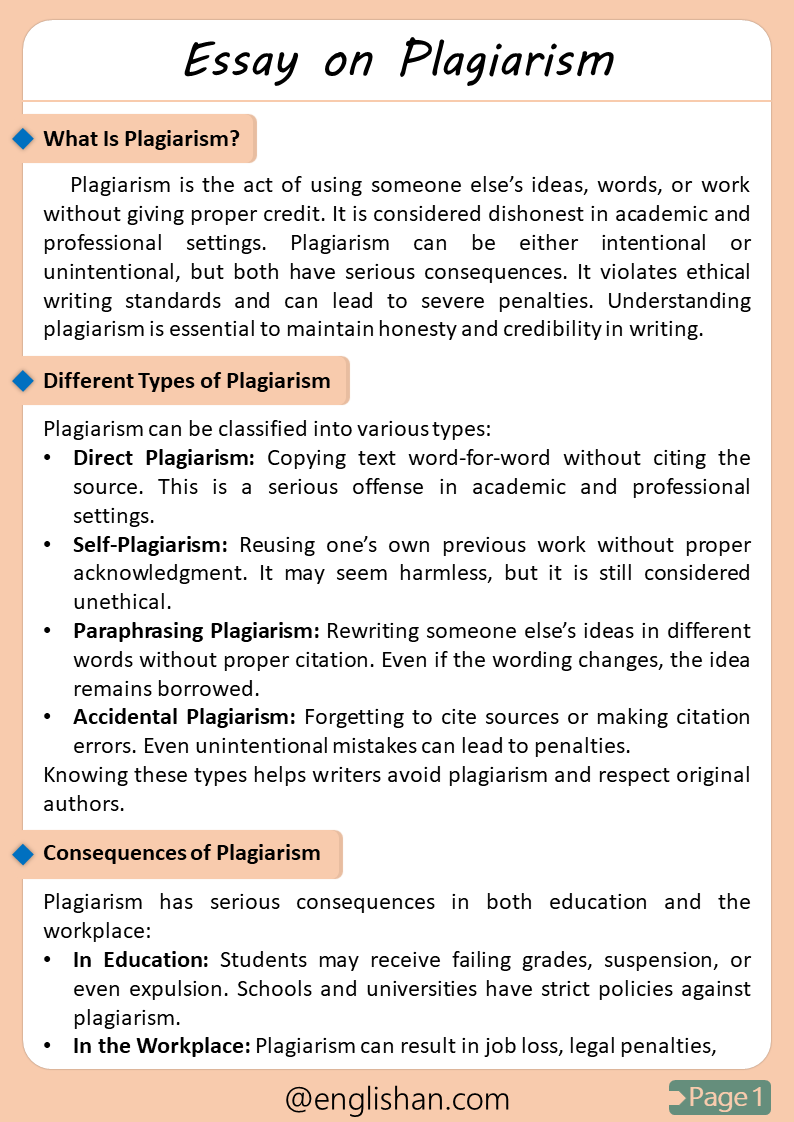
What Is Plagiarism?
Plagiarism is the act of using someone else’s ideas, words, or work without giving proper credit. It is considered dishonest in academic and professional settings. Plagiarism can be either intentional or unintentional, but both have serious consequences. It violates ethical writing standards and can lead to severe penalties. Understanding plagiarism is essential to maintain honesty and credibility in writing.
Different Types of Plagiarism
Plagiarism can be classified into various types:
- Direct Plagiarism: Copying text word-for-word without citing the source. This is a serious offense in academic and professional settings.
- Self-Plagiarism: Reusing one’s own previous work without proper acknowledgment. It may seem harmless, but it is still considered unethical.
- Paraphrasing Plagiarism: Rewriting someone else’s ideas in different words without proper citation. Even if the wording changes, the idea remains borrowed.
- Accidental Plagiarism: Forgetting to cite sources or making citation errors. Even unintentional mistakes can lead to penalties.
Knowing these types helps writers avoid plagiarism and respect original authors.
Consequences of Plagiarism
Plagiarism has serious consequences in both education and the workplace:
- In Education: Students may receive failing grades, suspension, or even expulsion. Schools and universities have strict policies against plagiarism.
- In the Workplace: Plagiarism can result in job loss, legal penalties, and damage to professional reputation. Employers value originality and integrity.
- Ethical Impact: Plagiarism disrespects the hard work of original creators and discourages creativity. It undermines academic and professional credibility.
How to Avoid Plagiarism
Plagiarism can be prevented by following ethical writing practices:
- Use Proper Citations: Always give credit to original sources using citation styles like APA, MLA, or Chicago.
- Check Your Work with Plagiarism Tools: Use tools like Turnitin or Grammarly to detect similarities and avoid mistakes.
- Paraphrase Correctly: Rewrite ideas in your own words while still citing the source to acknowledge the original author.
- Take Good Notes: Keep track of sources and references to avoid unintentional plagiarism.
- Understand Copyright Laws: Knowing copyright policies helps writers respect intellectual property rights.
The Role of Technology in Detecting Plagiarism
Technology plays a crucial role in identifying and preventing plagiarism. Plagiarism detection software, such as Turnitin and Copyscape, scans documents for similarities with published content. These tools help students, teachers, and professionals ensure originality in their work. Additionally, AI-based algorithms analyze writing patterns to detect paraphrased content. With continuous advancements, technology enhances academic integrity by making plagiarism easier to detect and avoid.
The Role of Schools and Universities
Educational institutions play a key role in preventing plagiarism by:
- Teaching students how to research and cite sources properly.
- Using plagiarism detection software to check assignments for originality.
- Enforcing strict policies against plagiarism to promote academic honesty.
- Encouraging students to develop critical thinking and independent writing skills.
Importance of Academic Integrity
Academic integrity is crucial in maintaining trust and credibility in education. Students and professionals must learn to value originality and ethical writing. Plagiarism undermines learning and devalues achievements. Honesty in writing leads to genuine knowledge and success.
Conclusion
Plagiarism is a serious issue with major consequences in academics and professional life. Understanding its types and learning how to avoid it helps students and professionals maintain integrity. Proper citation, ethical writing, and the use of plagiarism detection tools are essential for promoting originality. Schools and workplaces must continue to educate people about the importance of honesty in writing.
Difficult Words Used in 500 Plagiarism Essay
| Word | Meaning |
|---|---|
| Verbatim | Word for word |
| Paraphrasing | Rewriting in one’s own words |
| Credibility | Trustworthiness or reliability |
| Integrity | Following moral principles |
| Adherence | Commitment to a rule or belief |
| Intellectual Property | Original creations of the mind |
| Repercussions | Consequences or effects |
| Ethical | Related to morals and principles |
| Misrepresentation | Giving a false or misleading account |
| Methodologies | Systems of methods used in research |
Plagiarism Essay PDF
You May Also Like