When writing about Sir Sultan Mohammad Shah Aga Khan, it’s important to understand how he worked to uplift Muslims through education, leadership, and reform. This essay on Sir Sultan Mohammad Shah Aga Khan explains his early life, his role in founding the All-India Muslim League, and his vision for modern Muslim societies. It discusses his support for higher education, his global diplomatic efforts, and his legacy as a wise and generous leader. It’s written in 500 words to help students with homework or exams. You can download this Aga Khan essay as a free PDF or image to study or print.
10 Lines Sir Sultan Mohammad Shah Aga Khan Essay for Class 2 to Class 5
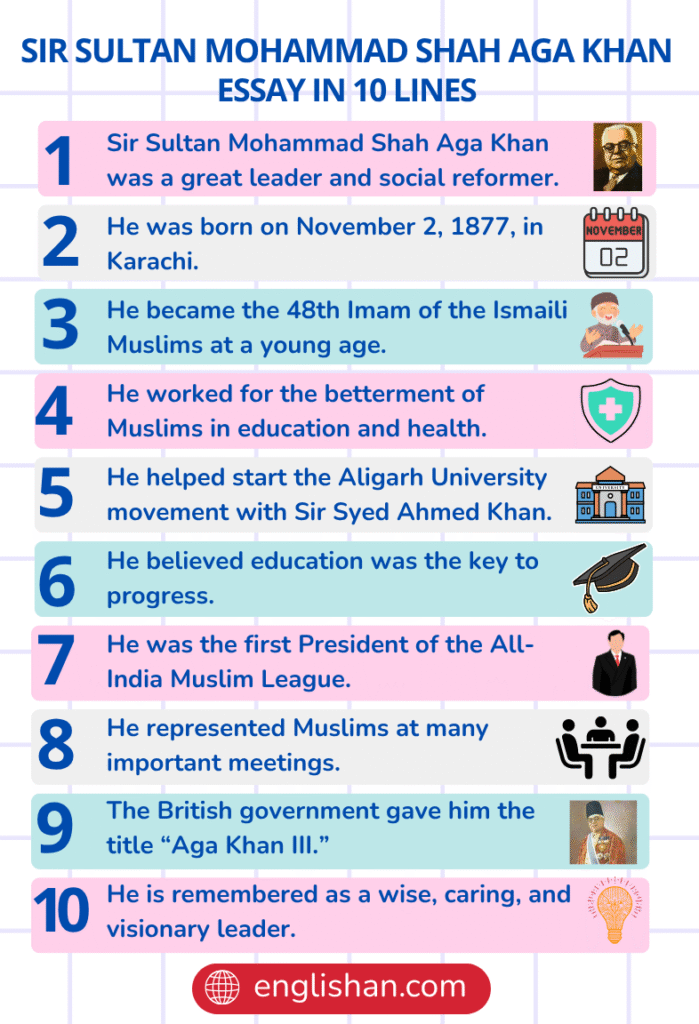
- Sir Sultan Mohammad Shah Aga Khan was a great leader and social reformer.
- He was born on November 2, 1877, in Karachi.
- He became the 48th Imam of the Ismaili Muslims at a young age.
- He worked for the betterment of Muslims in education and health.
- He helped start the Aligarh University movement with Sir Syed Ahmed Khan.
- He believed education was the key to progress.
- He was the first President of the All-India Muslim League.
- He represented Muslims at many important meetings.
- The British government gave him the title “Aga Khan III.”
- He is remembered as a wise, caring, and visionary leader.
250 Words Essay on Sir Sultan Mohammad Shah Aga Khan for Middle School
Sir Sultan Mohammad Shah Aga Khan, also known as Aga Khan III, was a prominent Muslim leader, reformer, and thinker. He was born on November 2, 1877, in Karachi and became the 48th Imam of the Ismaili Muslims at the age of eight. From a young age, he showed a strong commitment to the welfare of Muslims in the Indian subcontinent.
Aga Khan believed that education was the foundation for progress. He supported Muslim schools, scholarships, and universities. He also played a major role in supporting Sir Syed Ahmed Khan’s mission and was actively involved in the Aligarh Movement. His goal was to help Muslims become educated and successful in modern society.
In 1906, Aga Khan became the first president of the All-India Muslim League. He worked hard to promote the rights of Muslims and represented them at national and international platforms. One of his greatest achievements was leading the Simla Deputation in 1906, which demanded separate electorates for Muslims.
He was honored by the British government for his services and was given the title “His Highness” and a seat in the League of Nations. His leadership, kindness, and dedication to helping others left a lasting legacy. Today, Aga Khan is remembered as a respected and inspiring figure in Muslim history.
500 Words Sir Sultan Mohammad Shah Aga Khan Essay for Upper Primary and Lower Secondary
Early Life and Background
Born in 1877 in Karachi, Sir Sultan Mohammad Shah Aga Khan III was a prominent leader of the Ismaili Muslim community. His lineage traced back to Prophet Muhammad, and he inherited the role of the 48th Imam of the Nizari Ismailis at the age of eight. Educated in elite institutions, he developed a deep understanding of religious, social, and political affairs.
Leadership and Political Influence
Aga Khan III played a pivotal role in the political awakening of Muslims in British India. He was one of the founding members of the All-India Muslim League (1906), which later became instrumental in the creation of Pakistan. His advocacy for Muslim representation led to the separate electorate system, ensuring their political participation in colonial governance.
Transforming Education for Future Generations
Recognizing education as the key to progress, Aga Khan III established various educational institutions across South Asia and Africa. He founded the Aligarh Muslim University and contributed significantly to Oxford University’s Islamic Studies program. His vision promoted modern education while preserving Islamic values.
Philanthropy and Social Reforms
His commitment to social welfare extended beyond politics. He established hospitals, schools, and scholarships to uplift the underprivileged. Through the Aga Khan Development Network (AKDN), his legacy continues in health, education, and rural development. His focus on women’s empowerment and poverty alleviation remains a cornerstone of his humanitarian efforts.
Role in International Diplomacy
Aga Khan III was an influential diplomat, serving as President of the League of Nations (1937). His diplomatic skills contributed to peace negotiations and international cooperation. His leadership in global affairs demonstrated his commitment to harmony and progress beyond religious and national boundaries.
Efforts in Economic Development
Understanding the importance of financial stability, Aga Khan III encouraged economic development among Muslims. He established cooperative banks and financial institutions to support businesses and entrepreneurship, improving the economic conditions of his followers.
Championing Women’s Education and Empowerment
Aga Khan III was a strong advocate for women’s education and rights. He promoted equal opportunities for women and encouraged their participation in social and professional spheres, which was groundbreaking for his time.
Influence on Islamic Thought
His leadership extended to religious and cultural advancements. He emphasized a progressive interpretation of Islam, balancing modern education with traditional values. This approach helped the Ismaili community adapt and prosper.
Transforming Healthcare for Generations
Aga Khan III played a key role in improving healthcare facilities. He funded hospitals, clinics, and medical research centers, ensuring better access to quality healthcare for communities across Asia and Africa.
Contributions to Sports and Athletics
Aga Khan III had a deep interest in sports and promoted physical well-being. He played a crucial role in supporting horse racing and other athletic initiatives, encouraging a balanced lifestyle among his followers.
Support for Cultural and Artistic Heritage
Recognizing the importance of cultural preservation, Aga Khan III supported artistic and architectural endeavors. He funded the restoration of historical sites and encouraged artistic expression within the Muslim world.
Enduring Legacy and Global Impact
Sir Sultan Mohammad Shah Aga Khan passed away in 1957, leaving a profound impact on Muslim identity, education, and global diplomacy. His grandson, Aga Khan IV, continues his mission through various philanthropic and development initiatives. His vision for a progressive, educated, and united Muslim world remains relevant today.
Conclusion of Sir Sultan Mohammad Shah Aga Khan Essay
Sir Sultan Mohammad Shah Aga Khan was a pioneering leader who dedicated his life to political, social, and educational reforms. His contributions continue to shape communities worldwide. His vision of empowerment, education, and diplomacy remains a guiding force.

Difficult Words Used in 500 Sir Sultan Mohammad Shah Aga Khan Essay
| Word | Meaning |
|---|---|
| Philanthropist | A person who promotes the welfare of others, especially by donating money to good causes. |
| Diplomacy | The profession or skill of managing international relations. |
| Electorate | A body of people allowed to vote in an election. |
| Empowerment | The process of becoming stronger and more confident, especially in controlling one’s life. |
| Legacy | Something handed down from the past, such as achievements or traditions. |
Sir Sultan Mohammad Shah Aga Khan Essay PDF
You May Also Like