

If your puzzle shows that Y is the only vowel, you’re probably asking, “What five letter words use only Y?” That’s when you need words with Y and no A, E, I, O, or U. Below, you’ll find five letter words with Y as the only vowel so you can choose your next guess with confidence.
5 Letter Words With ‘Y’ as the Only Vowel
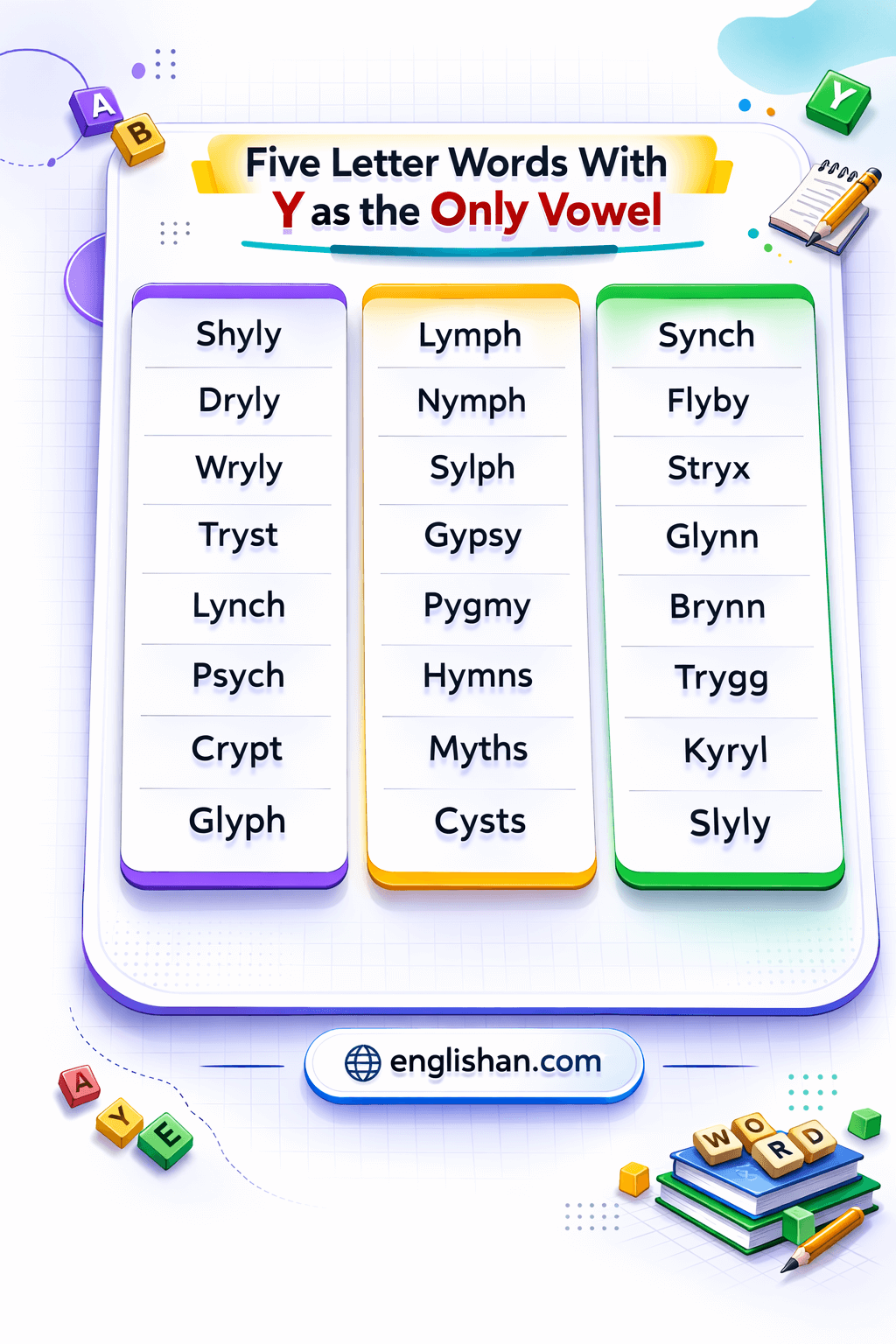
| Shyly | Dryly | Wryly |
| Tryst | Lynch | Psych |
| Crypt | Glyph | Lymph |
| Nymph | Sylph | Gypsy |
| Pygmy | Hymns | Myths |
| Cysts | Synch | Flyby |
| Stryx | Glynn | Brynn |
| Trygg | Kyryl | Slyly |
FAQs
These are five-letter words that use Y and do not use A, E, I, O, or U. Examples include crypt, glyph, lymph, nymph, psych, tryst, myths, hymns, cysts, synch, shyly, slyly, wryly, dryly, and flyby.
Yes. Examples include crypt, cysts, dryly, flyby, glyph, hymns, lymph, myths, mythy, nymph, psych, shyly, slyly, sylph, synch, synth, tryst, wryly, rhymy, thymy, wynds, wynns, and myrrh.
Commonly used examples include crypt, myths, hymns, nymph, tryst, shyly, slyly, wryly, dryly, and flyby.
Yes. Examples include shyly, slyly, wryly, dryly, mythy, rhymy, thymy, wynds, and wynns.
You May Also Like
- 5 Letter Words with 1 Vowel Only
- Five Letter Words with A as the Only Vowel
- Five Letter Words with E as the Only Vowel
- 5 Letter Words with I as the Only Vowel
- 5 Letter Words with O as the Only Vowel
- 5 Letter Words with U as the Only Vowel
- Consonants and Vowels Worksheets
- 5 Letter Words Starting with Y
- 5 Letter words with Y as the 2nd letter
- 5 Letter Words with Y in the Middle
- 5 Letter Words Ending in Y