Mixed conditionals often cause a brief pause for learners. When a sentence starts in the past but lands in the present, the timing can feel unsettled, requiring a second look to grasp the full meaning. This happens because mixed conditionals act as a bridge, connecting two different time frames to show how a cause in one era produces a result in another.
For instance, we can link a past action to a present result: “If I had studied harder, I would have a better job now.” Or, we can link a permanent trait to a past event: “If I were more careful, I would not have broken my phone.”
In this guide, I will walk you through these structures with a calm, step-by-step approach. We will explore the specific rules of verb tense, how these sentences flow in natural conversation, and how mastering them provides the precision you need to express complex ideas with confidence.
What Are Mixed Conditionals?
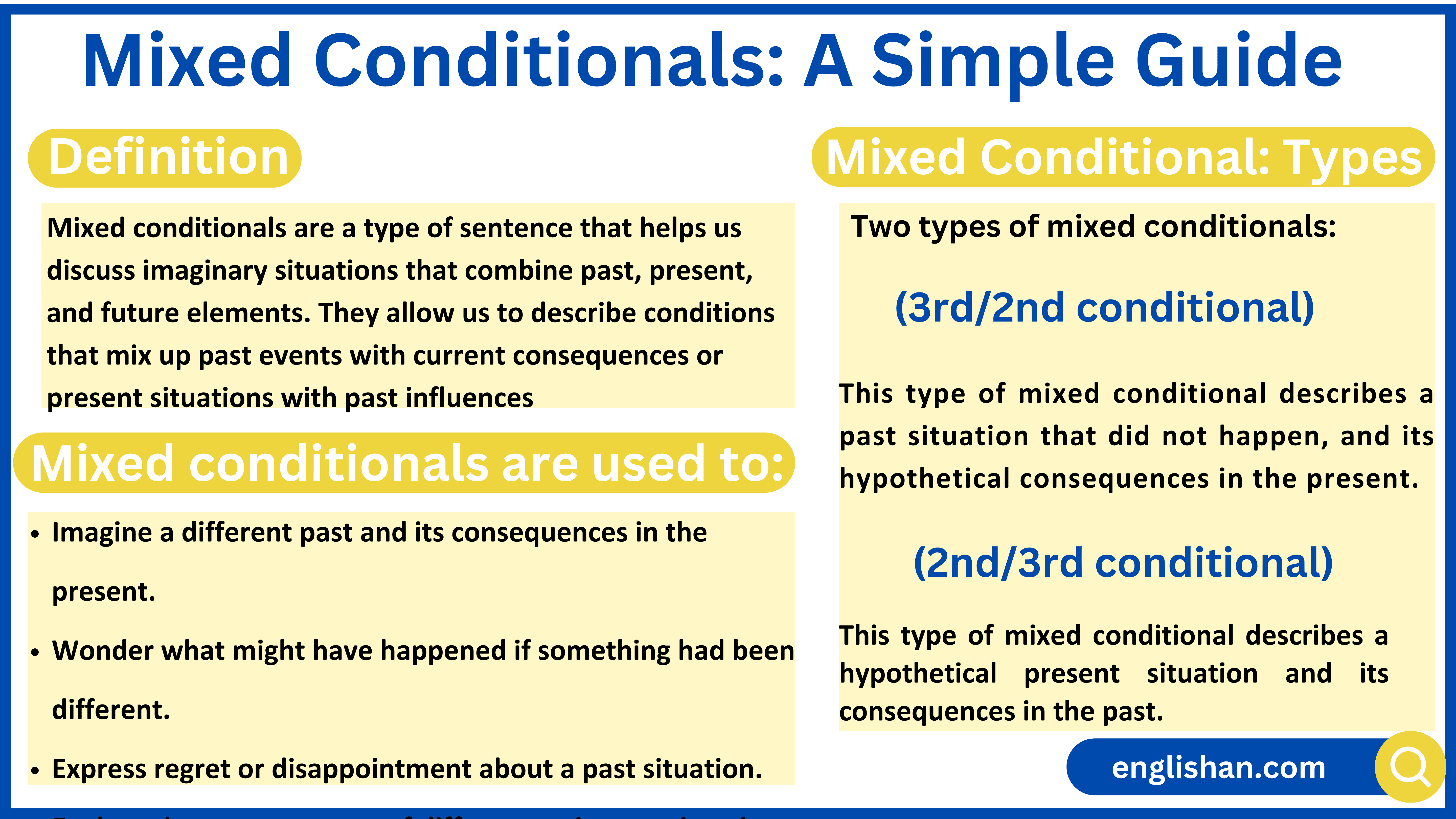
Mixed conditionals are conditional sentences that connect two different time frames in one statement.
- A present condition with a past result commonly uses a past form in the if-clause and would have in the result.
- They link a past condition to a present or future result, or a present condition to a past result.
- The condition and the result belong to different time periods.
- The if-clause expresses the condition, and the main clause expresses the result.
- Verb forms indicate time meaning, not clause order.
- A past condition with a present result commonly uses had in the if-clause and would in the result.
Mixed Conditionals Structure
Mixed conditionals use two clauses that point to different times. The if-clause gives the condition, and the main clause gives the result. The verb forms signal whether the condition is past or present, and whether the result is past, present, or future.
- Past condition → present result: If + had + past participle, would + base verb
- If I had studied harder, I would feel more confident now.
- If she had taken the job, she would live in Dubai now.
- If they had left earlier, they would be here already.
- Past condition → future result: If + had + past participle, would + base verb + time marker
- If we had booked sooner, we would travel next week.
- If he had saved more, he would buy a car next month.
- If I had applied on time, I would start the course in January.
- Present condition → past result: If + past simple, would have + past participle
- If I were more careful, I would have noticed the error.
- If she spoke French, she would have handled the call.
- If they lived closer, they would have arrived on time.
- Clause order: either clause can come first.
- Comma rule: use a comma when the if-clause comes first.
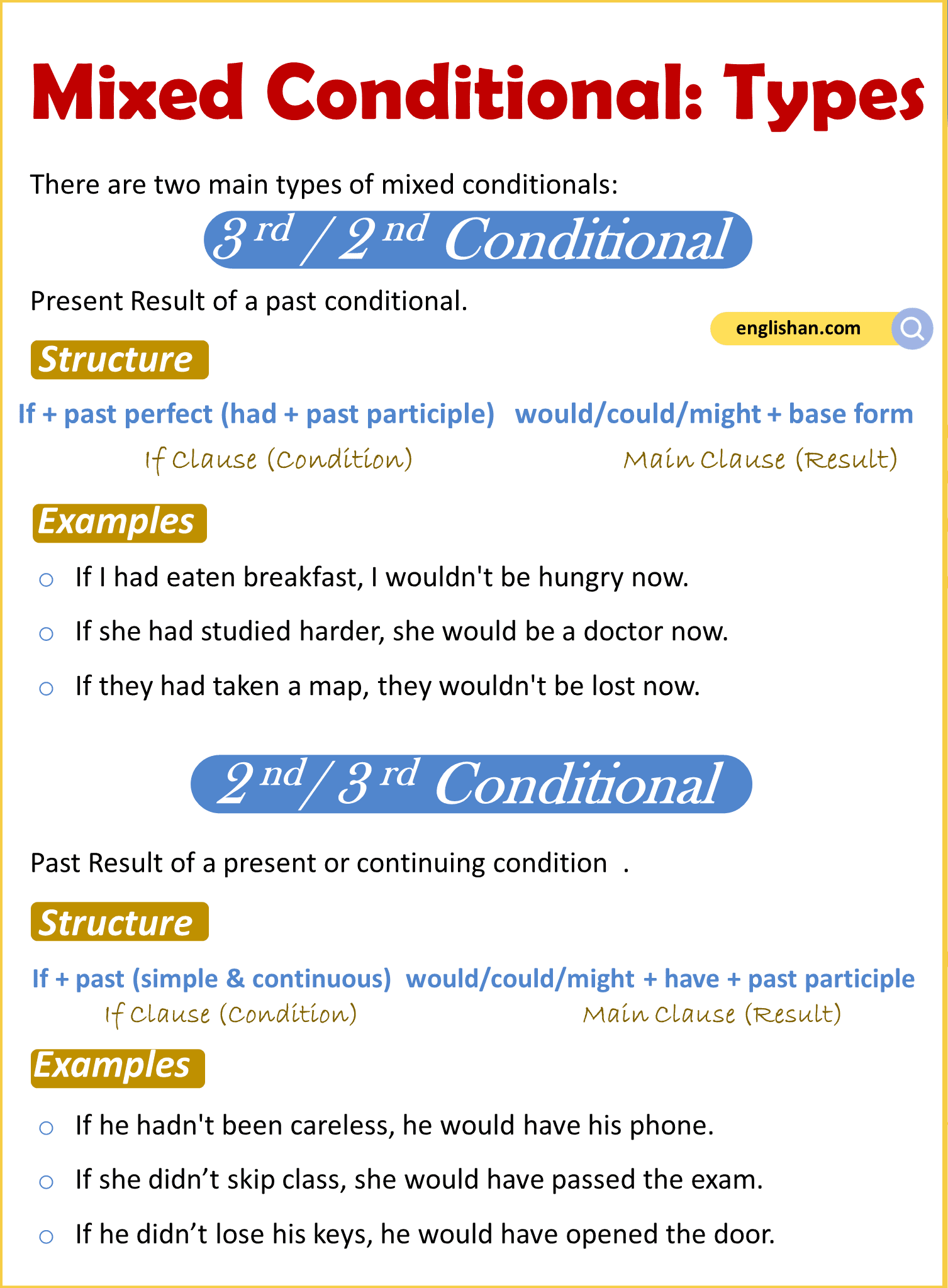
Mixed Conditionals Types
There are two main types of mixed conditionals:
Mixed Third Second Conditional
This type of mixed conditional describes a past situation that did not happen, and its hypothetical consequences in the present. It’s like imagining what could have been different if something had happened differently in the past.
| If Clause (Condition) | Main Clause (Result) |
|---|---|
| If + past perfect (had + past participle) | would/could/might + base form |
| If this thing had happened | that thing would happen. |
Mixed Second Third Conditional
This type of mixed conditional describes a hypothetical present situation and its consequences in the past. It’s like imagining what might have been if things were different in the present.
| If Clause (Condition) | Main Clause (Result) |
|---|---|
| If + past (simple and continuous) | would/could/might + have + past participle |
| If this thing happened | that thing would have happened. |
Mixed Conditionals With Modal Verbs
Mixed conditionals can use modal verbs to change the strength of the result. The if-clause still signals the time, but the main clause uses a modal to express certainty, ability, permission, advice, or possibility.
- Past condition → present result with modals: If + had + past participle, modal + base verb
- If I had trained more, I could run 10 km now.
- If she had slept earlier, she might feel better today.
- If they had invested sooner, they would have more savings now.
- Present condition → past result with modals: If + past simple, modal + have + past participle
- If I were more careful, I could have avoided that mistake.
- If he knew the route, he might have reached on time.
- If they lived nearer, they would have attended the meeting.
- Common modals used: could, might, would, should
- Modal meaning shift: could ability, might possibility, should advice, would expected result
Mixed Conditionals Rules
Mixed conditionals follow fixed verb patterns to show different time links. The if-clause signals the condition time, and the main clause signals the result time. The pairing must match the meaning you intend.
- Keep the time link consistent: past condition with present result, or present condition with past result
- Use past perfect in the if-clause for a past unreal condition: had + past participle
- Use would + base verb for a present unreal result
- Use would have + past participle for a past unreal result
- Use past simple in the if-clause for a present unreal condition
- Use were for unreal meaning with I, he, she, it: if I were, if he were
- Do not use would in the if-clause in standard mixed conditionals
- Add a time marker when needed to prevent time confusion: now, today, already, then, yesterday, next week
- Keep one condition and one result per sentence to avoid tangled meaning
- Use a comma only when the if-clause comes first
Mixed Conditionals Examples
- If he hadn’t been careless, he would have his phone.
- If she didn’t skip class, she would have passed the exam.
- If he didn’t lose his keys, he would have opened the door.
- If I knew his phone number, I would have called him.
- If I had studied harder, I would have passed the exam.
- If they had called earlier, we would have saved them seats.
- If they had taken the bus, they wouldn’t have been late.
- If he didn’t eat so much junk food, he would have better health.
Mixed Conditionals Common Practical Mistakes
- Using would in the if-clause
- Wrong: If I would have studied, I would feel confident now.
- Right: If I had studied, I would feel confident now.
- Using past simple instead of past perfect for a past unreal condition
- Wrong: If she accepted the offer, she would live here now.
- Right: If she had accepted the offer, she would live here now.
- Using would have for a present result
- Wrong: If they had left earlier, they would have been here now.
- Right: If they had left earlier, they would be here now.
- Using would + base verb for a past result
- Wrong: If I were more careful, I would avoid the mistake yesterday.
- Right: If I were more careful, I would have avoided the mistake yesterday.
- Dropping have after a modal in a past result
- Wrong: If he knew the answer, he could passed the test.
- Right: If he knew the answer, he could have passed the test.
- Using was instead of were for unreal meaning
- Wrong: If I was taller, I would have played basketball.
- Right: If I were taller, I would have played basketball.
FAQs
Mixed conditionals are conditional sentences that combine elements of different types of conditionals, typically mixing the structure of the second and third conditionals.
Mixed conditionals are used to express hypothetical situations in the past with consequences in the present, or vice versa.
The structure formula of mixed conditionals typically follows this pattern: if (past tense) in the if-clause (condition) + (present or future tense) in the main clause (result).
Unlike traditional conditionals, mixed conditionals combine different time frames, creating a mix of past and present/future.
You May Also Like