
Spiders are small but fascinating creatures with a unique body structure that helps them move, hunt, and survive in different environments. Unlike insects, spiders have eight legs and a body divided into two main parts: the cephalothorax and the abdomen. They also have special features like fangs to catch prey and spinnerets that produce silk for webs. Each part of a spider plays an important role in how it lives and functions. In this article, we’ll explore the parts of a spider and understand their basic functions with the help of a labeled diagram.
List of Spider Parts Names
- Palps (Pedipalps)
- Chelicerae (Fangs)
- Eyes
- Sternum
- Fovea
- Legs
- Coxa
- Trochanter
- Femur
- Patella
- Tibia
- Metatarsus
- Tarsus
- Tarsal Claw
- Spinnerets
- Cephalothorax (Prosoma)
- Abdomen (Opisthosoma)
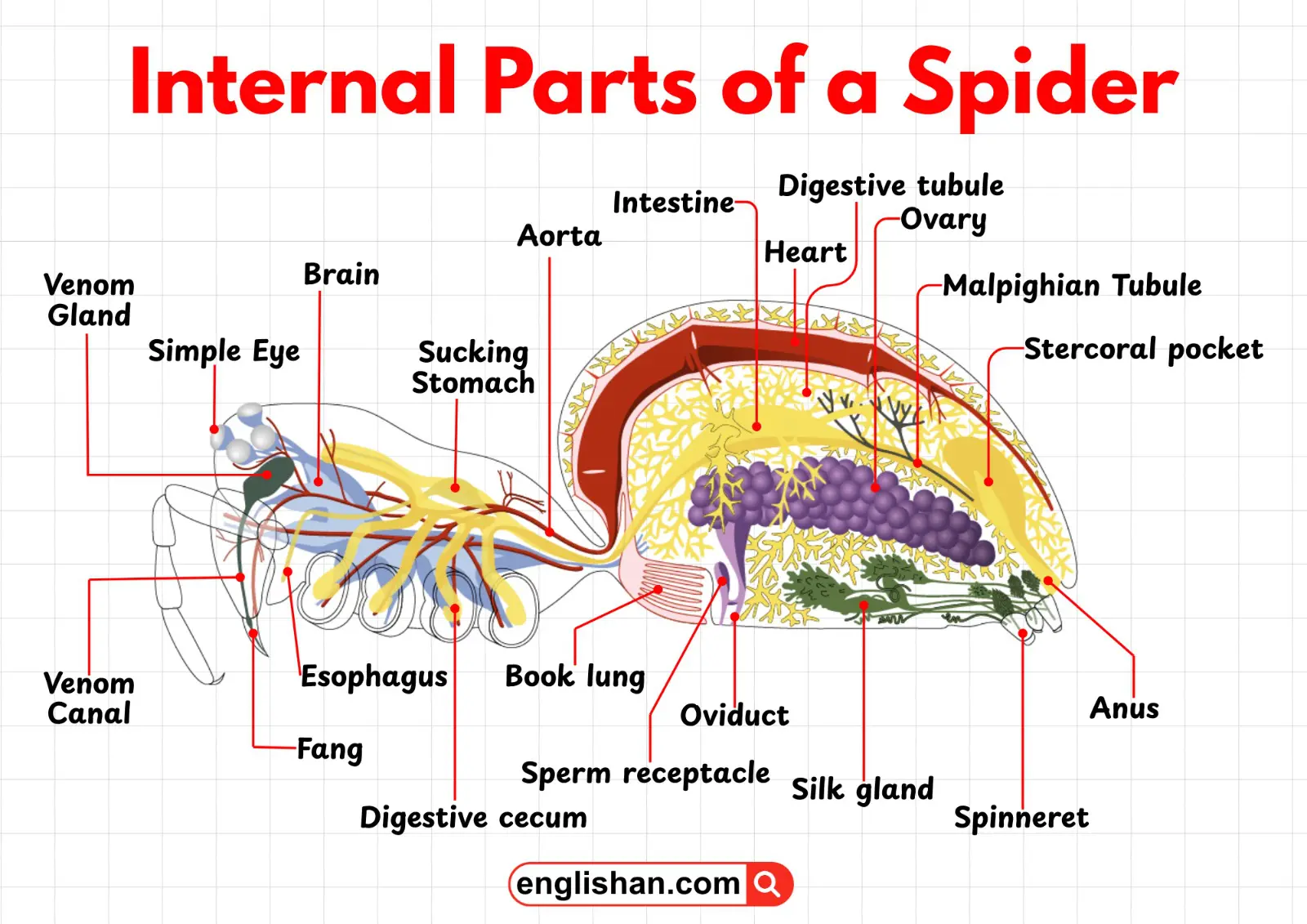
- Venom Gland
- Venom Canal
- Simple Eye
- Brain
- Esophagus
- Fang
- Sucking Stomach
- Digestive Cecum
- Aorta
- Intestine
- Heart
- Digestive Tubule
- Ovary
- Malpighian Tubule
- Stercoral Pocket
- Book Lung
- Oviduct
- Sperm Receptacle
- Silk Gland
- Spinneret
- Anus
Parts of a Spider Diagram With Names
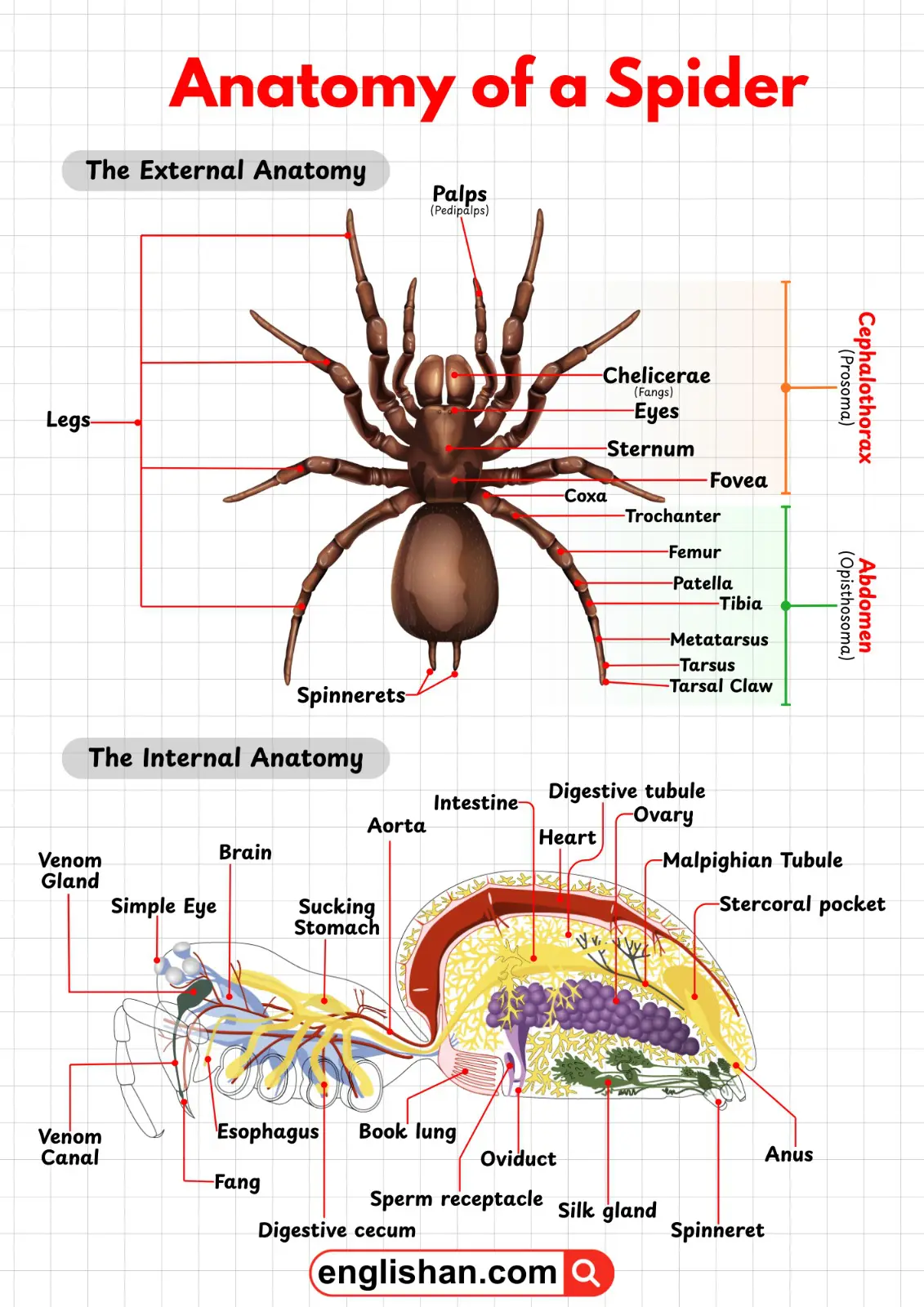
Spiders are small but highly specialized arachnids, and their bodies are made up of several important parts that help them move, hunt, and survive. The body is divided into two main sections: the cephalothorax and the abdomen. The cephalothorax holds the eyes, fangs, and mouthparts, which spiders use to sense their surroundings and capture prey. It is also where the eight legs attach, allowing spiders to walk, climb, and react quickly. The abdomen contains vital organs and the spinnerets, which produce silk used for building webs, wrapping prey, and creating safety lines. Each part of a spider, from its legs to its spinnerets, works together to help it hunt, protect itself, and live successfully in its environment.
External Parts of a Spider
Palps (Pedipalps)
Palps are short appendages located on either side of a spider’s mouth. They act like tiny hands, helping the spider sense the environment, handle and manipulate food, and in male spiders, they are specialized to transfer sperm to the female during mating.
Chelicerae (Fangs)
Chelicerae are powerful jaw-like structures at the front of the spider’s head. They contain venom glands and are used to inject venom into prey, immobilize it, and begin the digestion process before ingestion.
Eyes
Most spiders have six to eight simple eyes. They detect light, movement, and in some species, shapes. While vision quality varies, eyes are essential for hunting, navigation, and avoiding predators.
Sternum
The sternum is the hardened plate on the underside of the cephalothorax. It protects vital internal organs and provides an attachment point for muscles that control the legs.
Fovea
The fovea is a small depression on the top of the cephalothorax. It serves as a point of attachment for muscles controlling the spider’s legs and internal movement.
Legs
Spiders have eight jointed legs. They are used for walking, climbing, capturing prey, detecting vibrations, and sensing the environment. Legs are highly flexible and adapted to the spider’s lifestyle.
Coxa
The coxa is the first segment of each leg, connecting the leg to the spider’s body. It acts as a pivot point for movement.
Trochanter
The trochanter is a small segment between the coxa and femur. It serves as a joint, allowing the leg to bend smoothly.
Femur
The femur is the longest segment of the leg. It provides strength and leverage, enabling the spider to move quickly and precisely.
Patella
The patella functions like a knee, connecting the femur to the tibia. It allows the leg to bend, contributing to jumping, climbing, and crawling movements.
Tibia
The tibia is a long segment that assists in locomotion and may bear sensory hairs or spines for detecting vibrations and prey.
Metatarsus
The metatarsus is the segment between the tibia and tarsus. It adds flexibility and helps in precise leg positioning during movement or hunting.
Tarsus
The tarsus is the foot segment of the leg. It often ends with claws or adhesive pads to help the spider grip surfaces, silk threads, or prey.
Tarsal Claw
The tarsal claw is a curved hook at the end of each leg. It allows the spider to securely hold surfaces, prey, and silk threads.
Spinnerets
Spinnerets are tube-like structures at the rear of the abdomen. They produce silk for building webs, draglines, egg sacs, and other functions.
Cephalothorax (Prosoma)
The cephalothorax is the fused head and thorax. It houses the brain, eyes, mouthparts, and legs, functioning as the spider’s central control and movement center.
Abdomen (Opisthosoma)
The abdomen is the soft, posterior part of the spider. It contains the digestive system, reproductive organs, silk glands, and respiratory structures.
Internal Parts of a Spider
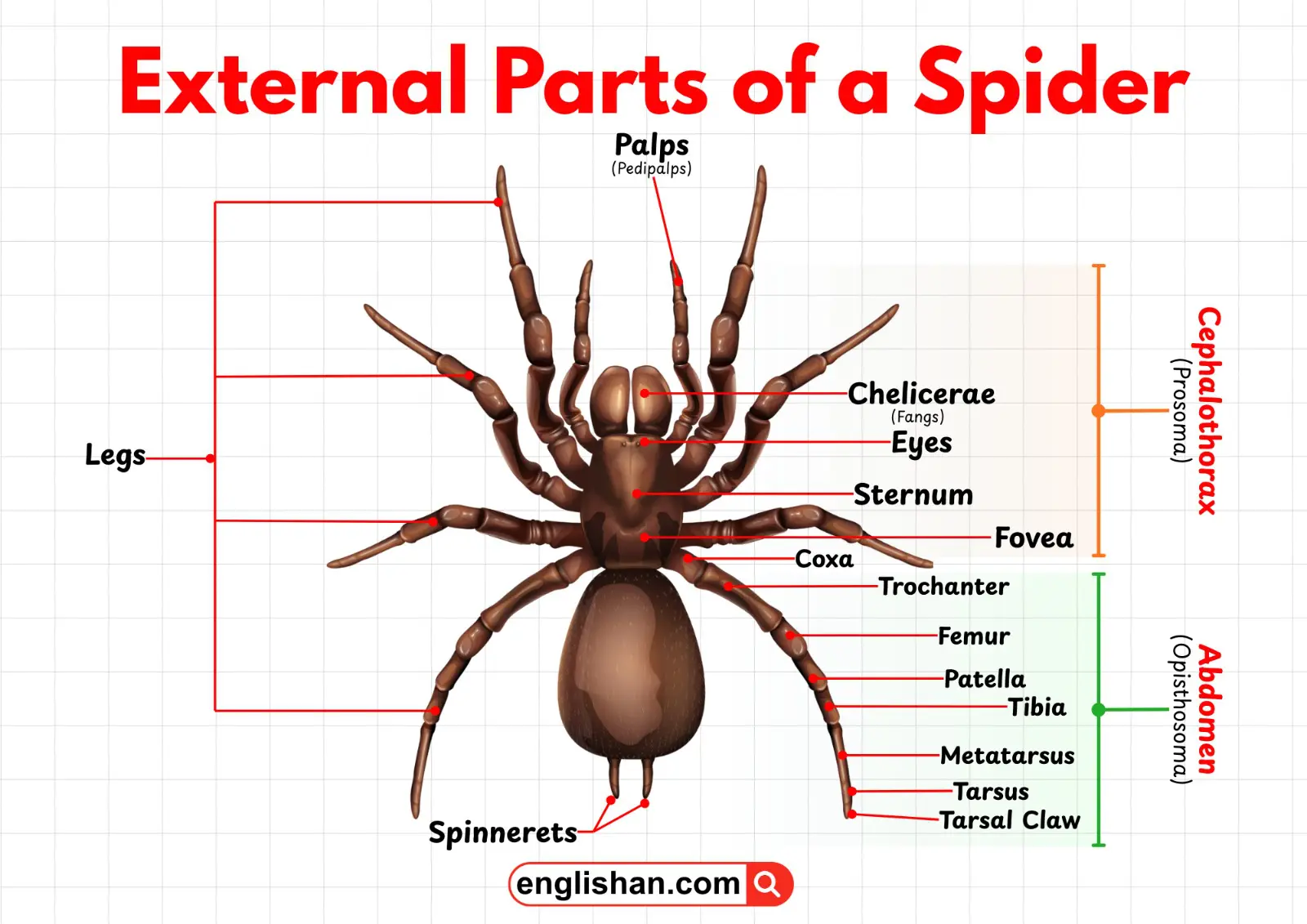
Venom Gland
The venom gland produces venom that is used to paralyze or kill prey and aid in digestion.
Venom Canal
The venom canal is a tube within the fang that transports venom from the gland to the prey.
Simple Eye
The simple eye detects light and motion, helping the spider sense its surroundings and locate prey.
Brain
Located in the cephalothorax, the brain processes sensory input, controls movement, and coordinates complex behaviors.
Esophagus
The esophagus is a tube connecting the mouth to the sucking stomach, allowing liquid food to travel into the digestive system.
Fang
The fang is part of the chelicerae. It delivers venom to prey and assists in breaking down food externally before ingestion.
Sucking Stomach
This muscular organ sucks in liquefied food from the prey and pumps it into the digestive cecum for further processing.
Digestive Cecum
Digestive ceca are sac-like organs in the abdomen that secrete enzymes to break down food and absorb nutrients.
Aorta
The aorta is the main artery that distributes hemolymph (the spider’s blood) throughout the body.
Intestine
The intestine absorbs nutrients from digested food and distributes them to the body.
Heart
The tubular heart pumps hemolymph through the open circulatory system, supplying nutrients and oxygen to the body.
Digestive Tubule
These small channels carry nutrients from the cecum to different tissues in the spider’s body.
Ovary
The ovary is the female reproductive organ that produces eggs.
Malpighian Tubule
These are excretory organs that remove waste from the hemolymph and help regulate water balance.
Stercoral Pocket
A storage area for solid waste before it is expelled through the anus.
Book Lung
A respiratory organ consisting of stacked, leaf-like structures that allow gas exchange with the air.
Oviduct
The tube that carries eggs from the ovary to the outside of the body.
Sperm Receptacle
A female structure that stores sperm until the eggs are fertilized.
Silk Gland
Glands that produce silk threads for webs, egg sacs, draglines, and other functions.
Spinneret
The external tip of the silk gland that controls the production and release of silk.
Anus
The anus is the exit point for solid waste from the digestive system.
Key Takeaway
Spiders are fascinating little creatures with two main body parts—the cephalothorax and abdomen. They have eight legs, multiple eyes, and special mouthparts called fangs that help them catch and eat prey. Their silk-producing spinnerets let them build webs, egg sacs, and safety lines, while internal organs like the brain, heart, and book lungs keep them alive and active. Basically, spiders are tiny, well-equipped hunters perfectly designed to survive and thrive in almost any environment.
You May Also Like