A train moves through cities and countryside as a long, ordered machine, with each section carrying a distinct identity. Students studying transport, parents helping with school topics, and readers interested in rail travel often need the right words when reading diagrams, books, or station material tied to trains.
In this blog post, we explain the parts of a train by starting with the locomotive and continuing through the carriages, couplers, bogies, wheels, doors, windows, pantograph, and brakes. We focus on the most common passenger and freight layout first, since names can vary by train type. The labeled diagram that follows helps connect each term to its exact position.
List of All Parts of a Train
- Locomotive
- Diesel Engine
- Electric Traction Motor
- Turbocharger
- Alternator
- Rectifier
- Inverter
- Gearbox
- Drive Shaft
- Fuel Tank
- Fuel Pump
- Air Compressor
- Air Reservoirs
- Air Dryer
- Radiator
- Cooling Fan
- Batteries
- Battery Box
- Horn
- Cab
- Driver Seat
- Control Station
- Throttle Handle
- Brake Handle
- Instrument Panel
- Windshield
- Wiper
- Pilot
- Coupler
- Draft Gear
- Buffer
- Carriage
- Coach
- Passenger Car
- Freight Car
- Car Body
- Side Wall
- End Wall
- Underframe
- Floor
- Roof
- Headlights
- Marker Lights
- Bogie
- Bogie Frame
- Motor Bogie
- Trailer Bogie
- Suspension Springs
- Shock Absorber
- Axle
- Axle Box
- Wheelset
- Wheel
- Flange
- Bearings
- Brakes
- Brake Cylinder
- Brake Disc
- Brake Pad
- Brake Pipe
- Hand Brake
- Sand Dome
- Sand Pipe
- Sand Box
- Pantograph
- Third Rail Shoe
- Train Door System
- External Doors
- Internal Doors
- Door Control Unit
- Windows
- Emergency Exit Window
- Corridor
- Compartment
- Seats
- Luggage Rack
- Grab Handle
- Toilet
- Toilet Tank
- Water Tank
- Wash Basin
- Ventilator
- Air Vent
- HVAC Unit
- Lighting System
- Ceiling Lights
- Emergency Lights
- Communication Cord
- Emergency Alarm
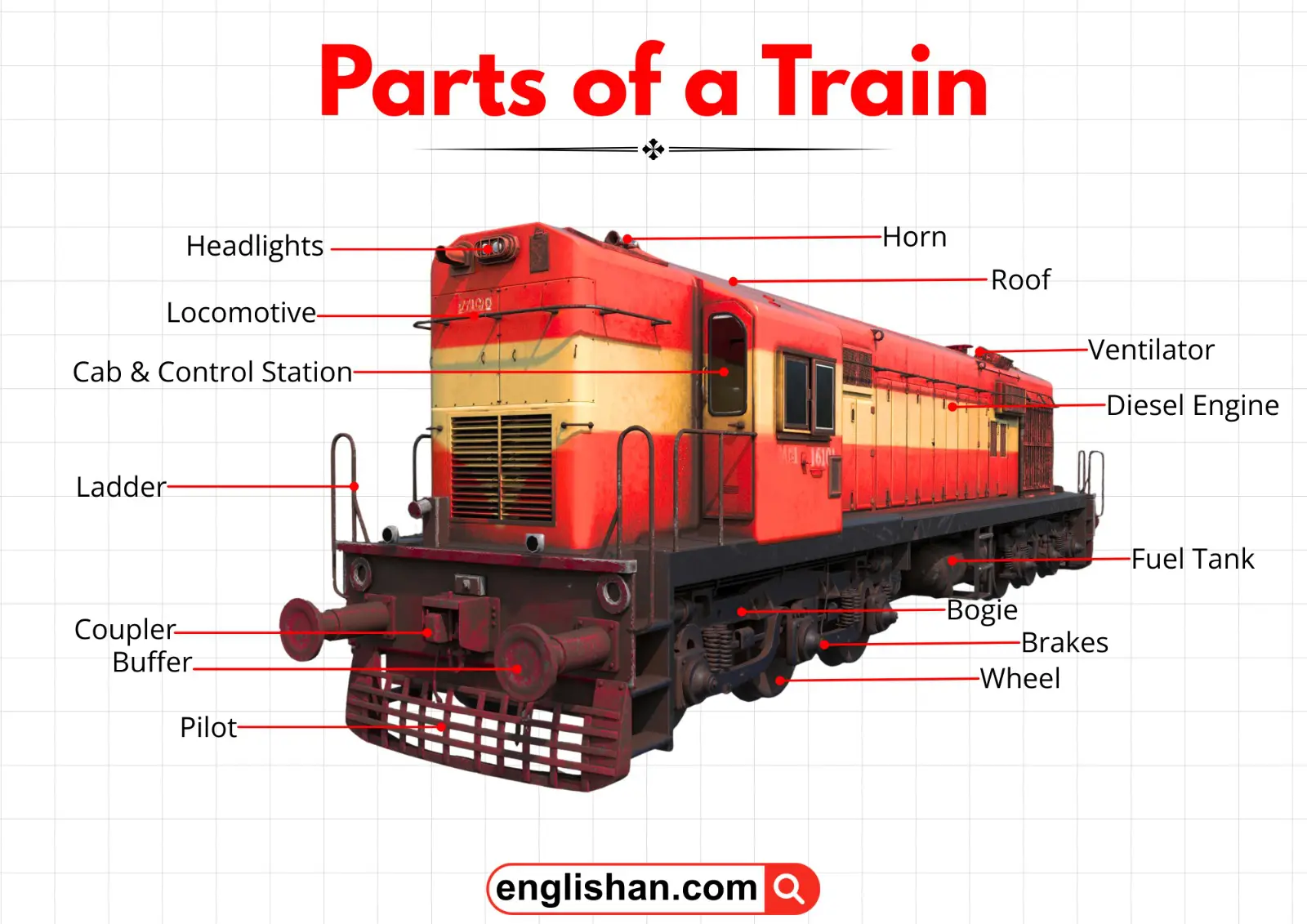
Train Parts Diagram With Names
A train operates as a linked mechanical and electrical system where power creation, motion control, and passenger spaces work in sequence. Each part contributes to a fixed stage of movement, control, or support, allowing energy to turn into guided rail travel.
Locomotive
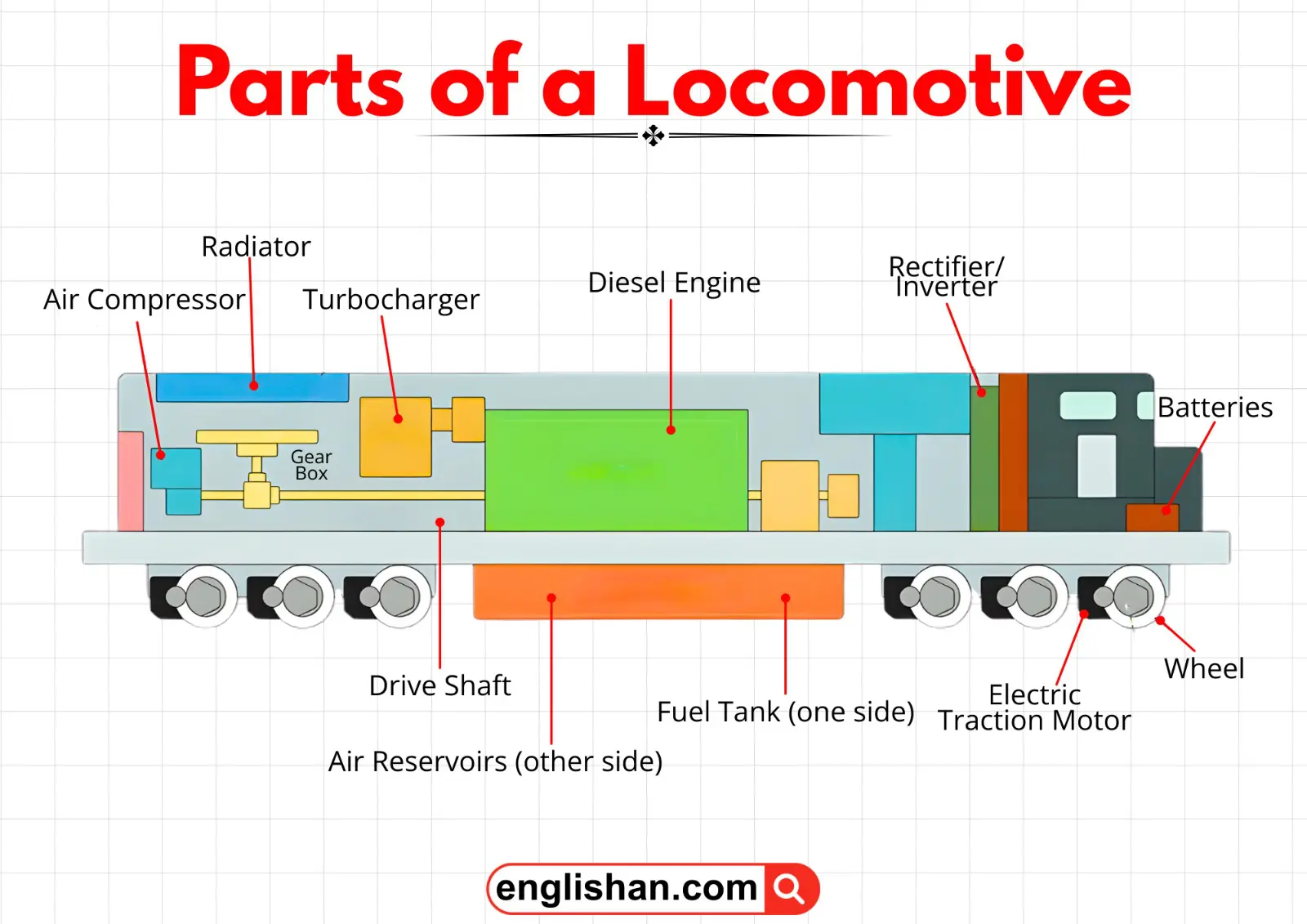
The locomotive acts as the power source of the train. It generates energy, converts it into usable motion, and supplies electricity and air to other systems.
Diesel Engine
The diesel engine produces mechanical power through controlled fuel combustion. Its operation depends on three core factors:
- Fuel injection and ignition timing
- Internal rotation that produces torque
- Continuous power output during travel
Together, these actions form the base energy source.
Turbocharger
The turbocharger improves engine performance by forcing more air into the cylinders. This process results in:
- Higher air pressure during intake
- Improved fuel combustion
- Increased engine efficiency
As a result, power output rises without increasing engine size.
Alternator
The alternator converts mechanical rotation into electrical energy. That electrical supply supports:
- Traction motors
- Control systems
- Lighting and onboard equipment
In turn, electrical flow stays continuous.
Fuel Tank
The fuel tank stores diesel needed for engine operation. Its function relies on:
- Safe fuel containment
- Controlled fuel delivery
- Stable supply during long runs
This keeps combustion uninterrupted.
Air Compressor
The air compressor generates compressed air for multiple train systems. Pressurized air supports:
- Braking operation
- Door movement
- Pneumatic controls
Air pressure becomes available on demand.
Air Reservoirs
Air reservoirs store compressed air supplied by the compressor. Stored pressure ensures:
- Immediate braking response
- Stable air supply
- Balanced system demand
Radiator
The radiator removes excess heat from the engine cooling system. Heat control depends on:
- Coolant circulation
- Airflow across cooling surfaces
As a result, engine temperature stays regulated.
Batteries
Batteries store electrical energy for non propulsion use. They provide:
- Startup power
- Backup electricity
- Support for auxiliary systems
Horn
The horn produces warning sound using air or electricity. Its role includes:
- Audible signaling
- Trackside alerts
Cab
The cab provides the operating space for the driver. All primary controls and displays remain accessible here.
Control Station
The control station contains the interfaces used to manage train movement. These include:
- Speed control devices
- Braking controls
- System indicators
Direct input governs operation.
Pilot
The pilot is a protective structure at the front of the locomotive. It functions by:
- Deflecting obstacles
- Protecting underbody parts
Carriage
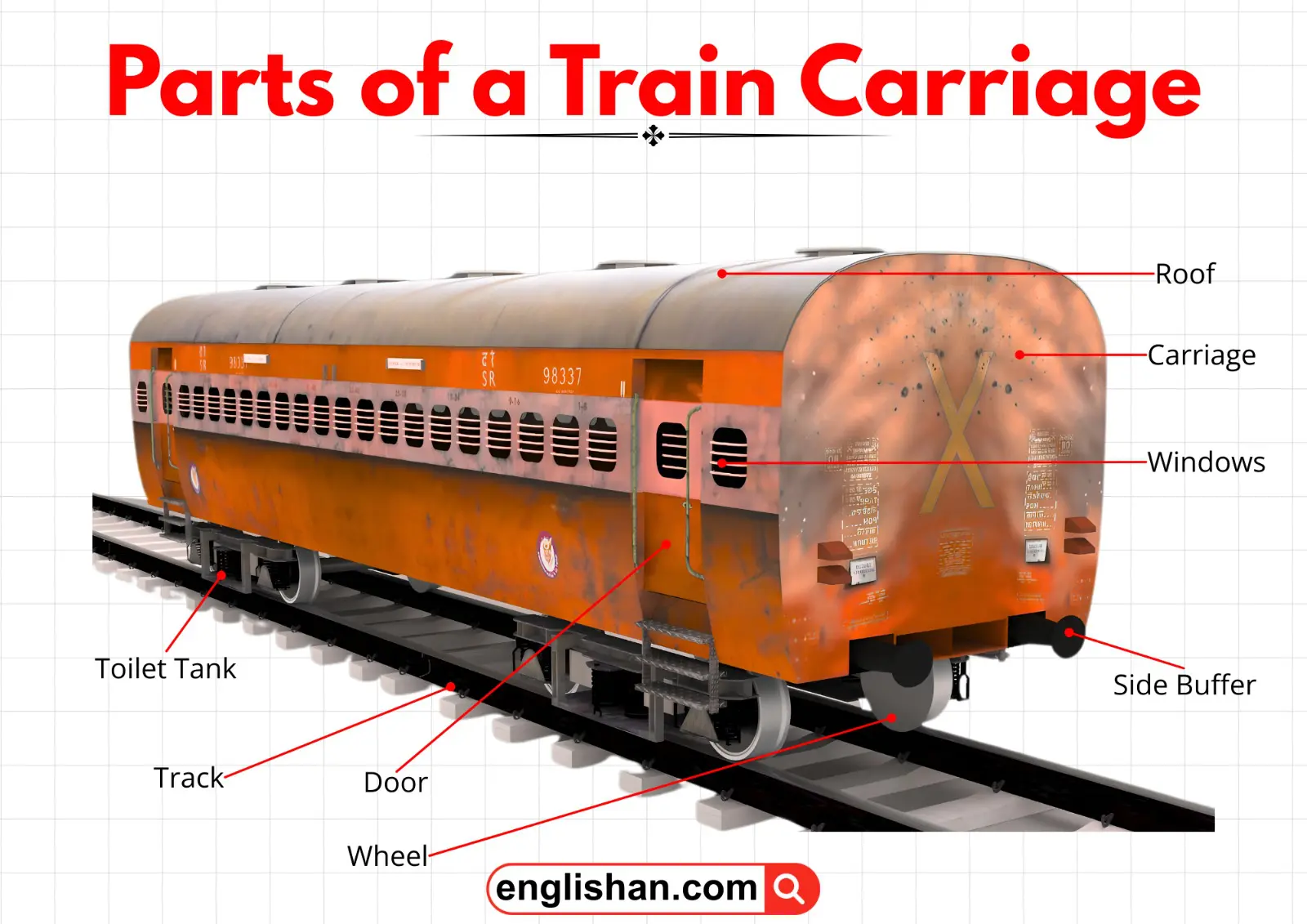
Carriages form the transport units attached behind the locomotive. They support passengers or cargo while remaining mechanically linked.
Coach
A coach is designed for passenger travel. Its layout includes:
- Seating arrangements
- Lighting systems
- Climate control features
Car Body
The car body forms the outer shell of a carriage. It provides:
- Structural strength
- Protection from external forces
Underframe
The underframe supports the car body and mounted equipment. Its structure allows:
- Load distribution
- Secure equipment mounting
Floor
The floor forms the interior walking surface. It supports:
- Passenger movement
- Interior fittings
Train Door System
The train door system controls entry and exit. Coordinated movement ensures:
- Controlled opening
- Secure locking
External Doors
External doors open toward platforms. Their operation manages:
- Passenger boarding
- Passenger exit
Internal Doors
Internal doors separate interior spaces. They regulate:
- Passenger flow
- Section access
Windows
Windows allow visibility and light. Their design supports:
- Safety glazing
- Sealed insulation
Roof
The roof covers the carriage structure. It provides:
- Weather protection
- Support for mounted equipment
Running Gear
Running gear supports the train on rails and enables controlled motion.
Headlights
Headlights illuminate the track ahead. They provide:
- Forward visibility
- Signal presence
Bogie
A bogie is the wheeled framework beneath the carriage. It allows:
- Rotation on curves
- Load sharing
Motor Bogie
A motor bogie contains traction motors. These:
- Convert electrical energy into motion
- Drive the wheels directly
Trailer Bogie
A trailer bogie supports weight without propulsion. It ensures:
- Smooth rolling
- Directional guidance
Wheelset
A wheelset consists of two wheels on one axle. This setup:
- Maintains alignment
- Supports guided rolling
Wheel
Each wheel contacts the rail surface. Its function includes:
- Load carrying
- Force transfer
Brakes
Brakes regulate speed and stopping. The system applies force through:
- Air pressure
- Electrical control
Friction Brake Equipment
Friction brake equipment slows motion by contact. It works by:
- Pressing pads or shoes
- Converting motion into heat
Coupler
The coupler connects train cars together. It allows:
- Force transmission
- Secure alignment
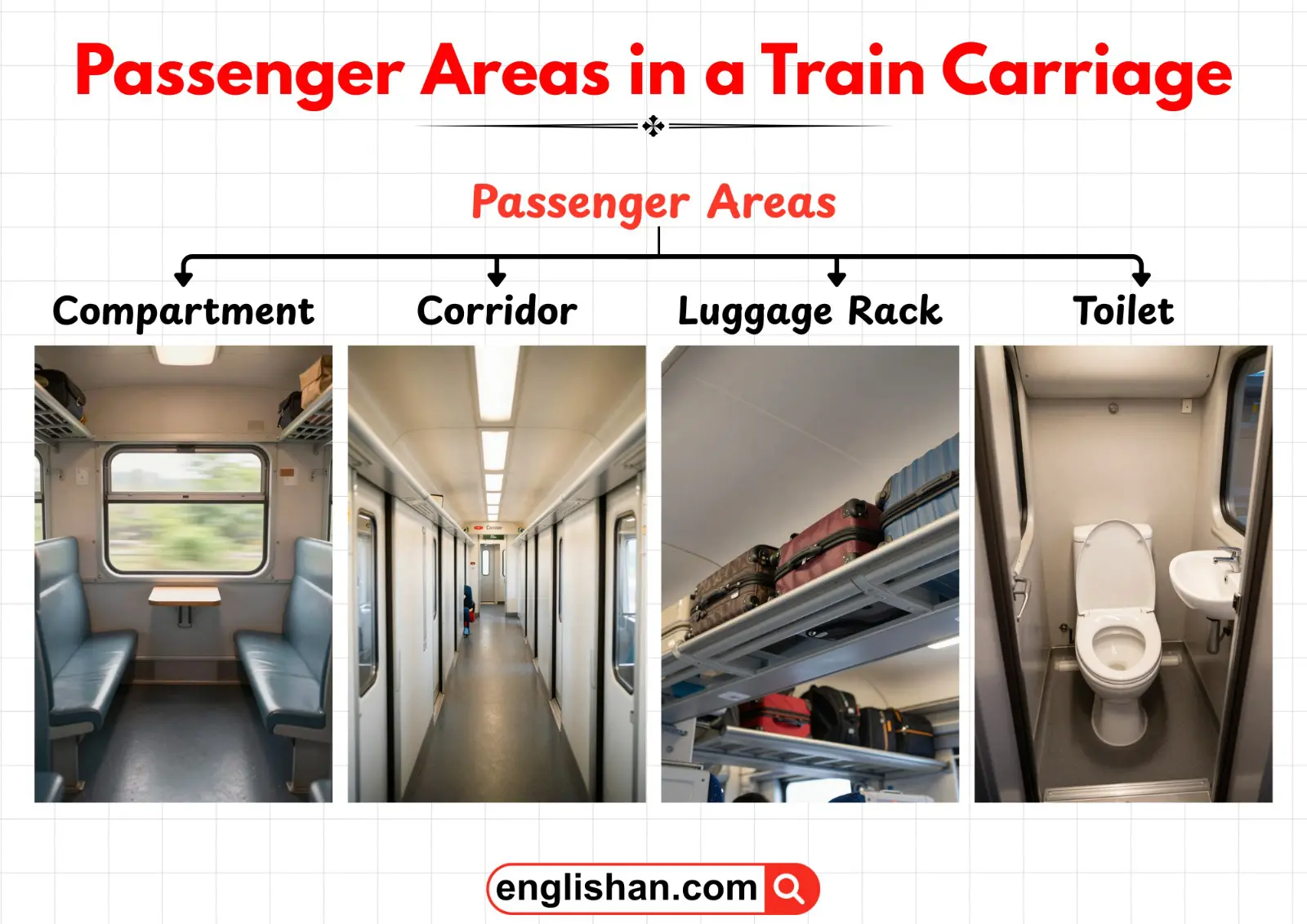
Passenger Areas
Passenger areas support comfort and movement inside the train.
Compartment
A compartment forms an enclosed seating space. It provides:
- Seating separation
- Privacy
Corridor
The corridor connects compartments. It supports:
- Continuous movement
- Interior access
Luggage Rack
Luggage racks hold passenger items. They allow:
- Overhead storage
- Load distribution
Toilet And Toilet Tank
This system manages onboard sanitation. It includes:
- Waste collection
- Secure storage tanks
Key Takeaways
A train functions as a transport system built around propulsion, motion control, guidance, and passenger support. The locomotive generates power, mechanical and electrical systems convert it into movement, bogies and wheels guide travel, brakes regulate speed, and carriages support passengers. Energy flows from engine to alternator, through motors to wheels, then dissipates during braking. Some variation exists in propulsion and carriage design, and we summarize the parts of a train as one chain where mechanical power becomes controlled rail movement.
You May Also Like