Turtles are incredible creatures, known for their slow, steady movements and unique, hard shells that protect them from predators. Their bodies are perfectly adapted for both land and water, with strong legs, webbed feet, and sharp claws that help them move, dig, and catch food. Even their heads, tails, and eyes have special features that play an important role in their survival. In this article, we’ll explore the different parts of a turtle and how each one helps these amazing animals thrive.
List of Turtle Parts With Names
- Eyes
- Neck Shield
- Vertebrae Shield
- Costal Shield
- Marginal Shield
- Supracaudal Shield
- Head
- Forelimb
- Shell
- Claws
- Hindlimb
- Tail
- Esophagus
- Trachea
- Lungs
- Heart
- Stomach
- Liver
- Intestines
- Bladder
- Rectum
- Cloaca
- Anus
Parts of a Turtle Diagram With Names
Turtles are fascinating creatures with bodies designed for protection, movement, and survival in both water and on land. The shell, made of the carapace and plastron, protects their internal organs, while the head contains the eyes, nostrils, and mouth for sensing the environment and feeding. Their legs and claws help them walk, swim, and dig, and the tail aids in balance and movement. Each part, from the scutes on their shell to their beak-like mouth, plays an important role in keeping the turtle safe, mobile, and well-adapted to its surroundings.
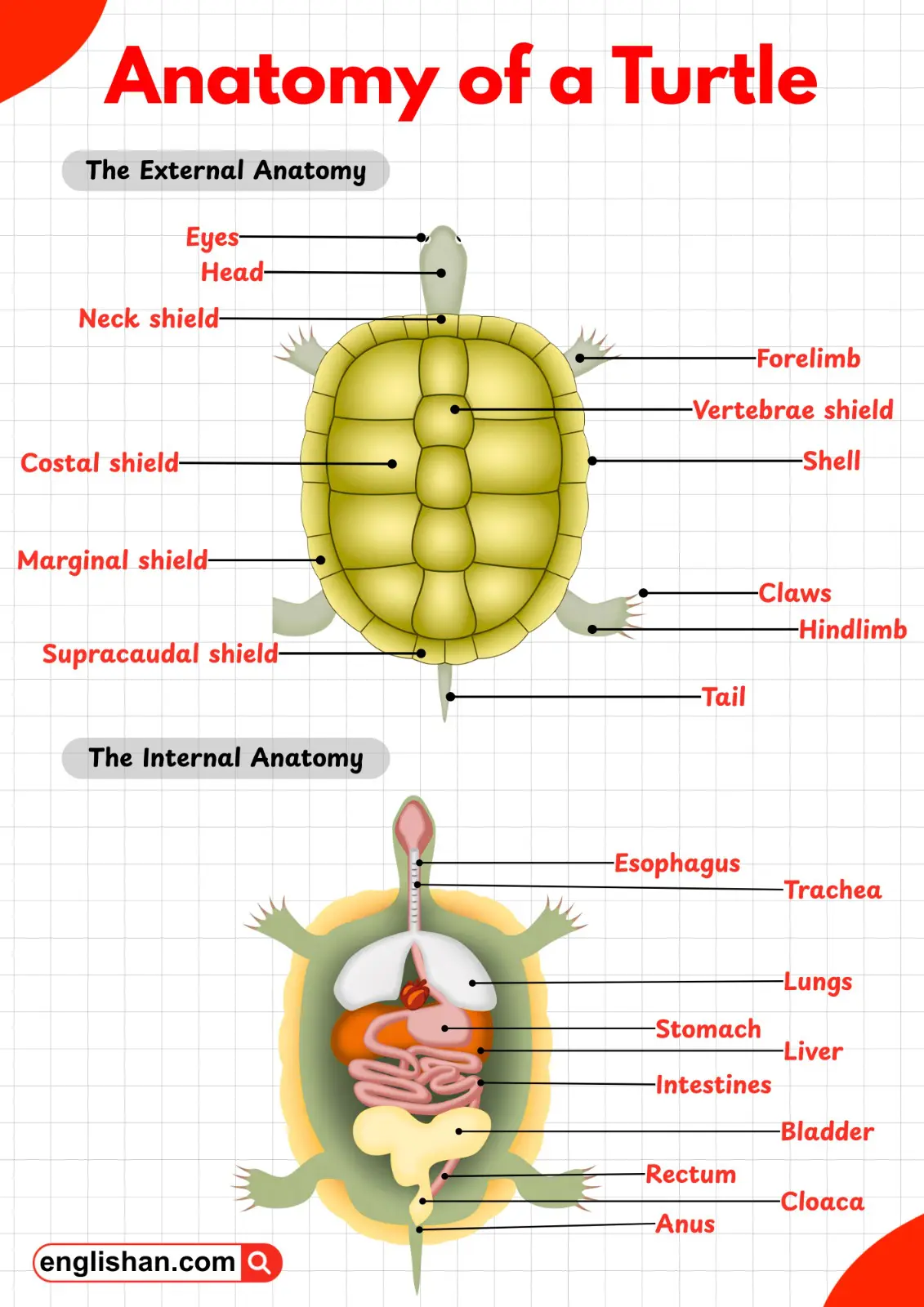
External Parts of a Turtle
Eyes
The eyes of a turtle are positioned on the sides of the head, allowing a wide field of vision to detect predators and food. Turtles have protective eyelids and, in many species, a special transparent membrane that protects the eye underwater while still allowing clear vision. Their eyesight helps them navigate both land and aquatic environments.
Neck Shield
The neck shield is a protective plate located near the front edge of the shell. It helps safeguard the turtle’s neck when the head retracts inside the shell. This structure adds extra defense against predators and physical injury.
Vertebrae Shield
The vertebrae shield runs along the center of the turtle’s shell and aligns with the spinal column underneath. These hard plates provide strong protection to the backbone while also contributing to the shell’s overall strength and structure.
Costal Shield
Costal shields are the large plates located on either side of the vertebrae shields. They cover the rib area and protect vital internal organs. These shields form a major portion of the shell and help distribute pressure evenly when the turtle is attacked or compressed.
Marginal Shield
Marginal shields form the outer edge of the shell. They act like a protective border, helping shield the turtle from impacts and bites. These plates also contribute to the turtle’s streamlined body shape.
Supracaudal Shield
The supracaudal shield is located at the rear end of the shell above the tail. It protects the tail base and the opening of the shell from damage. This shield is often broader and stronger because the rear area is vulnerable to predators.
Head
The turtle’s head contains the brain, sensory organs, mouth, and jaw muscles. It is specially adapted for feeding, breathing, and sensing the environment. Many turtles can retract their heads into the shell for protection.
Forelimb
Forelimbs are the front legs used for movement, digging, swimming, or crawling depending on the species. Aquatic turtles often have webbed feet or flippers, while land turtles possess strong, sturdy limbs for walking.
Shell
The shell is the turtle’s most distinctive feature and acts as a natural armor. It is made of bone covered by keratin plates and is fused with the ribs and spine. The shell protects internal organs and provides structural support for the body.
Claws
Claws are sharp, hard structures at the ends of the limbs. They help turtles dig nests, grasp surfaces, capture food, and defend themselves. Their size and shape vary according to habitat and lifestyle.
Hindlimb
Hindlimbs are the back legs that provide propulsion during walking or swimming. In aquatic turtles, they help steer and push through water, while in terrestrial turtles they support body weight and movement on land.
Tail
The tail extends from the rear of the shell and contains muscles, nerves, and part of the digestive and reproductive openings. It helps with balance and may also play a role in mating behaviors.

Internal Parts of a Turtle
Esophagus
The esophagus is a muscular tube that carries food from the mouth to the stomach. In turtles, it may contain small projections that help guide food downward and prevent it from moving back upward.
Trachea
The trachea, or windpipe, transports air from the mouth and nose to the lungs. It ensures efficient breathing and allows turtles to exchange oxygen and carbon dioxide.
Lungs
Turtles breathe using lungs rather than gills. Their lungs are large and positioned near the top of the shell cavity, allowing effective breathing even when floating in water. Lung expansion helps regulate buoyancy in aquatic species.
Heart
The turtle’s heart pumps blood throughout the body, delivering oxygen and nutrients to tissues. It typically has three chambers, allowing partial separation of oxygen-rich and oxygen-poor blood.
Stomach
The stomach breaks down food using digestive acids and enzymes. It begins the chemical digestion process, turning food into smaller particles that can be absorbed later in the intestines.
Liver
The liver is a large organ responsible for producing bile, detoxifying harmful substances, and storing nutrients. It plays an essential role in metabolism and digestion.
Intestines
The intestines absorb nutrients and water from digested food. They further break down food materials and prepare waste for elimination from the body.
Bladder
The bladder stores urine before it is expelled. In some turtles, it also helps store water, which is useful for survival in dry environments.
Rectum
The rectum is the final section of the digestive tract where waste material is temporarily stored before leaving the body.
Cloaca
The cloaca is a shared chamber used for digestive, urinary, and reproductive functions. It serves as a central exit point for waste and reproductive materials.
Anus
The anus is the external opening through which solid waste leaves the turtle’s body. It marks the end of the digestive system and works together with the cloaca during excretion.

Key Takeaway
As we learned, turtle anatomy is divided into external and internal structures that work together for protection, movement, breathing, and survival. The external anatomy, including the shell, shields, limbs, claws, and tail, provides strong defense and helps the turtle move efficiently in land or water. The internal anatomy consists of vital organs such as the lungs, heart, stomach, liver, intestines, and cloaca, which manage respiration, circulation, digestion, and waste removal. Together, these systems allow turtles to adapt successfully to their environments while maintaining protection through their unique body structure.
You May Also Like