
Blinds are a popular window covering that add style to any room while helping control light and privacy. Whether you have vertical, horizontal, or roller blinds, each comes with several key parts that work together to make them functional and easy to use. Knowing these parts can make installation and maintenance much simpler. In this article, we’ll explore the parts of blinds with their names and functions.
List Of Blinds Parts With Names
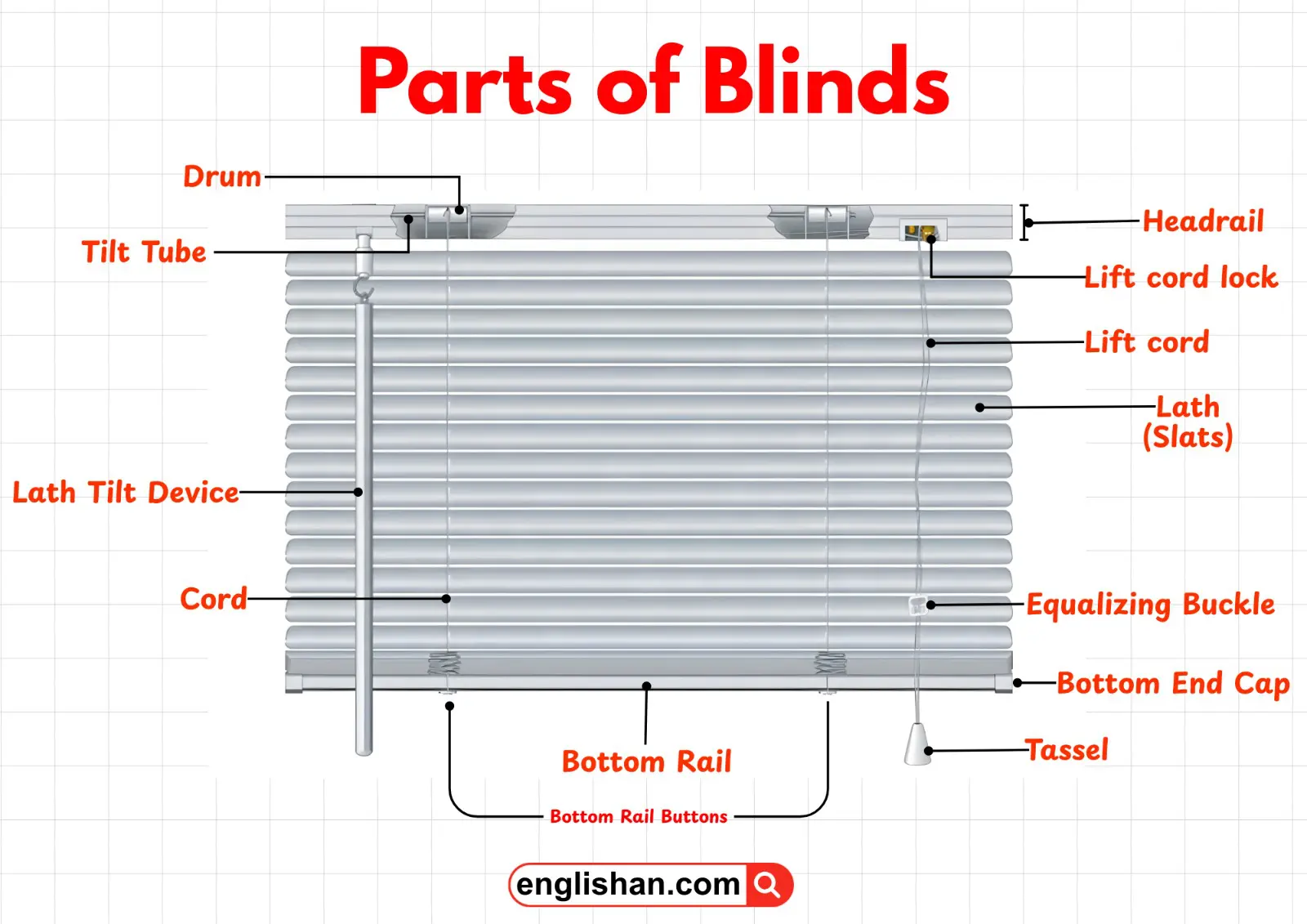
- Drum
- Tilt Tube
- Lath Tilt Device
- Cord
- Headrail
- Lift Cord Lock
- Lift Cord
- Lath (Slats)
- Equalizing Buckle
- Bottom End Cap
- Tassel
- Bottom Rail
- Bottom Rail Buttons
Parts of Blinds Diagram With Names
Blinds are a functional and stylish window covering made up of several important components that work together to control light, privacy, and room aesthetics. The slats or vanes block or allow sunlight depending on how they are tilted, while the headrail houses the main operating mechanism for raising, lowering, or tilting the blinds. The lift cords and tilt rods help you adjust the height and angle of the slats smoothly. Bottom rails keep the blinds straight and balanced, and brackets securely hold the entire system in place. Every part, from the cord locks to the end caps, plays a key role in smooth operation, durability, and maintaining the overall look of your blinds.
Headrail Mechanism
Headrail
The headrail is the top horizontal bar of the blinds that houses most of the internal operating components. It acts as the main structural support and is usually made of metal or durable plastic. The headrail is mounted to the window frame or wall and contains mechanisms like the tilt system and cord lock that allow the blinds to function smoothly.
Drum
The drum is a small rotating component inside the headrail that helps guide and control the lift cords. When the blinds are raised or lowered, the drum rotates and winds or unwinds the cords. This ensures the blinds move evenly and prevents the cords from tangling.
Tilt Tube
The tilt tube is a long rod located inside the headrail that runs across the width of the blinds. When the tilt mechanism is operated, this tube rotates, causing the slats to tilt open or closed. It connects the tilt device to the ladder strings that control the angle of the slats.
Lift Cord Lock
The lift cord lock is a safety mechanism located inside the headrail that holds the blinds at the desired height. When the user pulls the lift cord, the lock releases and allows the blinds to move. Once the desired height is reached, the lock grips the cord to keep the blinds securely in place.
Control & Operating Parts
Lift Cord
The lift cord is the cord used to raise or lower the blinds. It runs through the slats and connects to the bottom rail. Pulling the cord lifts the blinds upward, while releasing it lowers them. The lift cord works together with the cord lock to keep the blinds at the selected height.
Cord
The cord refers to the operating string that helps control the blind system. It works with the internal mechanisms to operate different functions such as lifting or tilting the blinds. These cords are usually made from strong, wear-resistant materials to ensure durability.
Tassel
The tassel is the small decorative piece attached to the end of the operating cord. It provides a comfortable grip for the user when pulling the cord and also helps keep the cord ends neat and organized.
Lath Tilt Device
The lath tilt device is the mechanism responsible for adjusting the angle of the slats. When the user rotates the tilt control, this device turns the tilt tube inside the headrail, which then tilts the slats. This allows users to control the amount of light entering the room and maintain privacy.
Slat System
Lath (Slats)
The laths, also known as slats, are the horizontal strips that make up the main body of the blinds. They can be made from materials like wood, faux wood, aluminum, or plastic. By tilting the slats, users can control light, airflow, and privacy while still maintaining visibility if desired.
Equalizing Buckle
The equalizing buckle is a small connector that helps balance and align the cords or ladder strings running through the slats. It ensures that the slats move evenly when the blinds are raised or lowered, preventing one side from lifting higher than the other.
Bottom Components
Bottom Rail
The bottom rail is the weighted bar located at the bottom of the blinds. Its main purpose is to provide stability and keep the blinds hanging straight. The bottom rail also connects to the lift cords, allowing the entire blind system to move up and down smoothly.
Bottom Rail Buttons
The bottom rail buttons are small caps or plugs located on the underside of the bottom rail. They cover the holes where lift cords pass through and help secure the cords in place. These buttons also allow easy access if adjustments to the cord length are needed.
Bottom End Cap
The bottom end cap is a protective cover placed on the ends of the bottom rail. It prevents damage to the rail, gives the blinds a finished appearance, and helps keep internal parts from being exposed.
Key Takeaway
As we learned, blinds are made of several key parts that work together to control light, privacy, and style. The slats or vanes adjust sunlight, the headrail houses the operating mechanism, lift cords and tilt rods let you move and angle the slats, the bottom rail keeps the blinds balanced, and brackets hold everything securely. Every component plays an important role in smooth operation and durability.
You May Also Like