
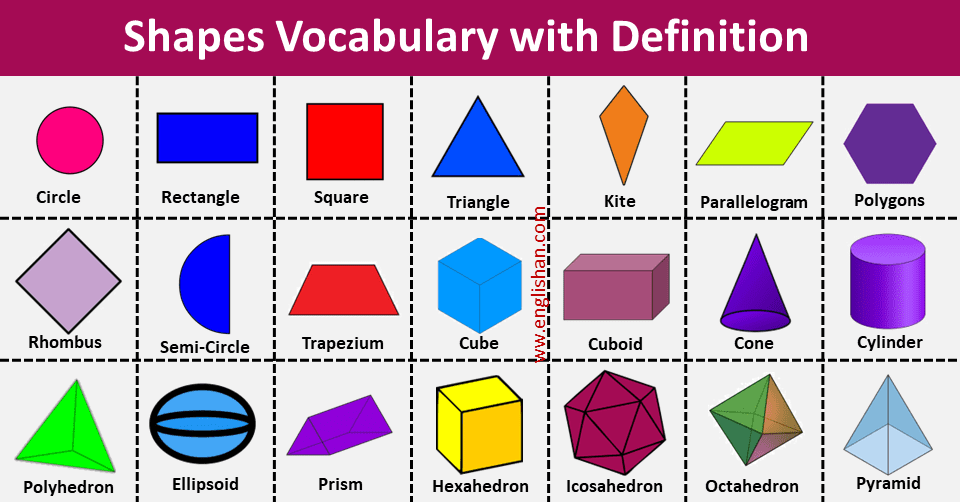
Learning shapes names helps learners build a strong visual vocabulary, which supports everyday descriptions and early geometry skills. By recognizing and naming 2D and 3D shapes, students can understand instructions, describe objects clearly, and follow directions in school subjects like math, science, and drawing. This picture-based list introduces common shapes in English using simple words and visuals, ideal for ESL learners, young kids, and classroom use.
Basic and Common Shapes Name List
This section introduces general learners to the most common shapes seen in everyday life. These shapes form the foundation for recognizing patterns, drawing objects, and describing things clearly.
Basic 2D Shapes
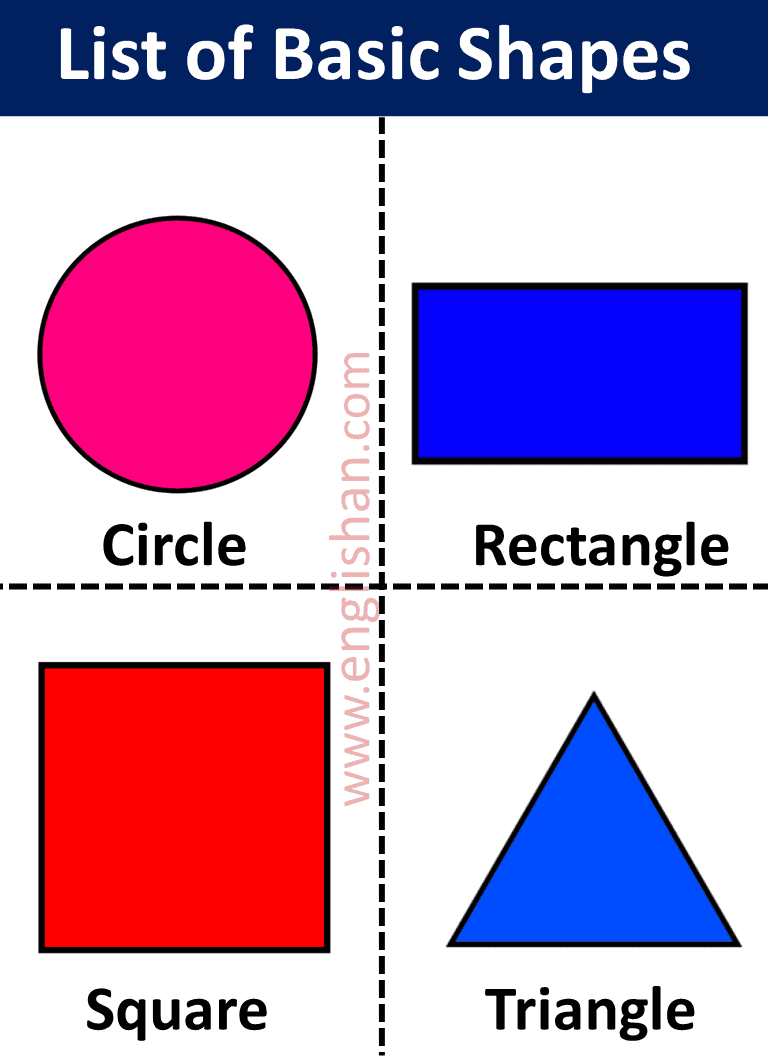
2D shapes are flat and can be drawn on paper. They have length and width but no depth. Below is a list of essential 2D shapes along with their simple definitions:
- Circle: A round shape with no sides or corners. It looks the same from every direction.
- Square: A shape with four equal sides and four right angles. All sides and angles are the same.
- Triangle: A shape with three straight sides and three corners. It is the simplest polygon.
- Rectangle: A four-sided shape with opposite sides equal and four right angles.
- Oval: A stretched-out circle that looks like an egg.
- Star: A shape with five or more pointed arms that extend from the center.
- Heart: A curved shape often used to show love, with a point at the bottom.
- Diamond: A tilted square with equal sides but slanted angles.
- Arrow: A line with a pointed head showing direction.
- Crescent: A curved shape like a part of the moon.
- Cross: Two lines that meet in the middle, like a plus sign.
- Semicircle: A half-circle made by dividing a circle into two equal parts.
- Line: A straight mark with no curves or thickness.
- Ring: A circular shape with a hole in the middle, like a doughnut.
These shapes are seen in drawings, designs, signs, and everyday objects. Learning them builds strong shape vocabulary.
Easy Shapes for Kids to Learn
For kids, shapes become easier to learn when matched with objects they use or see every day. Here are examples:
- Circle
- Square
- Triangle
- Rectangle
- Oval
- Diamond (Rhombus)
- Star
- Heart
- Crescent
- Pentagon
- Hexagon
- Octagon
- Trapezoid
- Parallelogram
3D Shapes for Kids
- Cube
- Sphere
- Cone
- Cylinder
- Pyramid
- Rectangular Prism
- Triangular Prism
- Hemisphere
- Tetrahedron
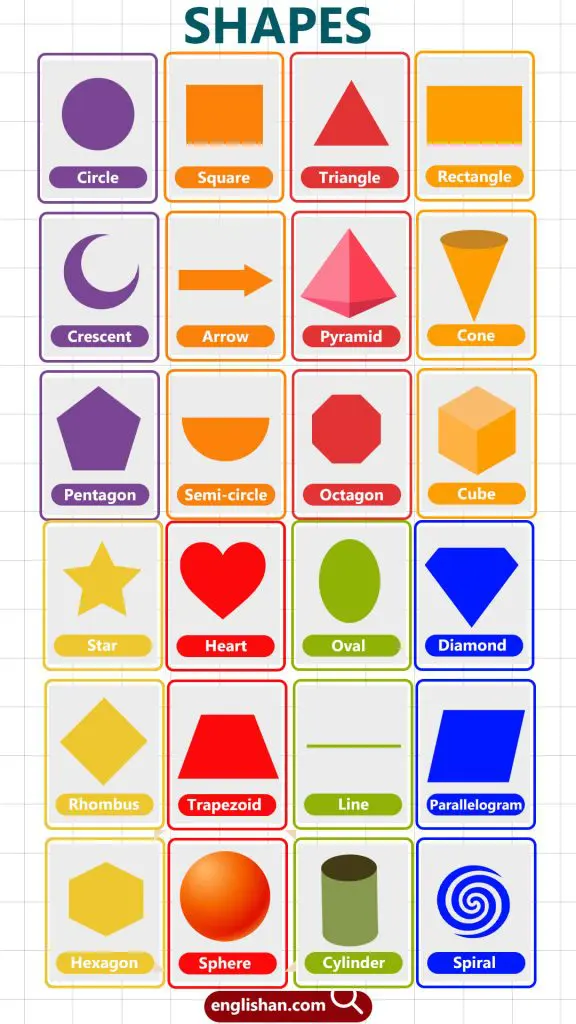
These familiar comparisons help children connect visuals with names.
2D Shapes Names and Their Types
This section dives deeper into flat shapes that have two dimensions: length and width. These shapes do not have any volume and are often drawn, printed, or used in signs and textbooks.
Geometric Shapes Names and Definitions
- Circle: A shape with all points the same distance from the center. It has no corners or edges.
- Triangle: A three-sided polygon. It has three angles and is the simplest polygon.
- Square: A four-sided shape where all sides are equal, and all angles are 90 degrees.
- Rectangle: Like a square but with unequal adjacent sides. All angles are still 90 degrees.
- Pentagon: A polygon with five straight sides and five angles.
- Hexagon: A six-sided polygon often found in honeycomb patterns.
- Heptagon: A polygon with seven sides.
- Octagon: An eight-sided shape, commonly used for stop signs.
- Nonagon: A polygon with nine sides.
- Decagon: A polygon with ten equal sides.
These shapes are used in both learning and design. They appear in geometry, architecture, logos, and visual art.
Quadrilateral Shapes Names and Examples
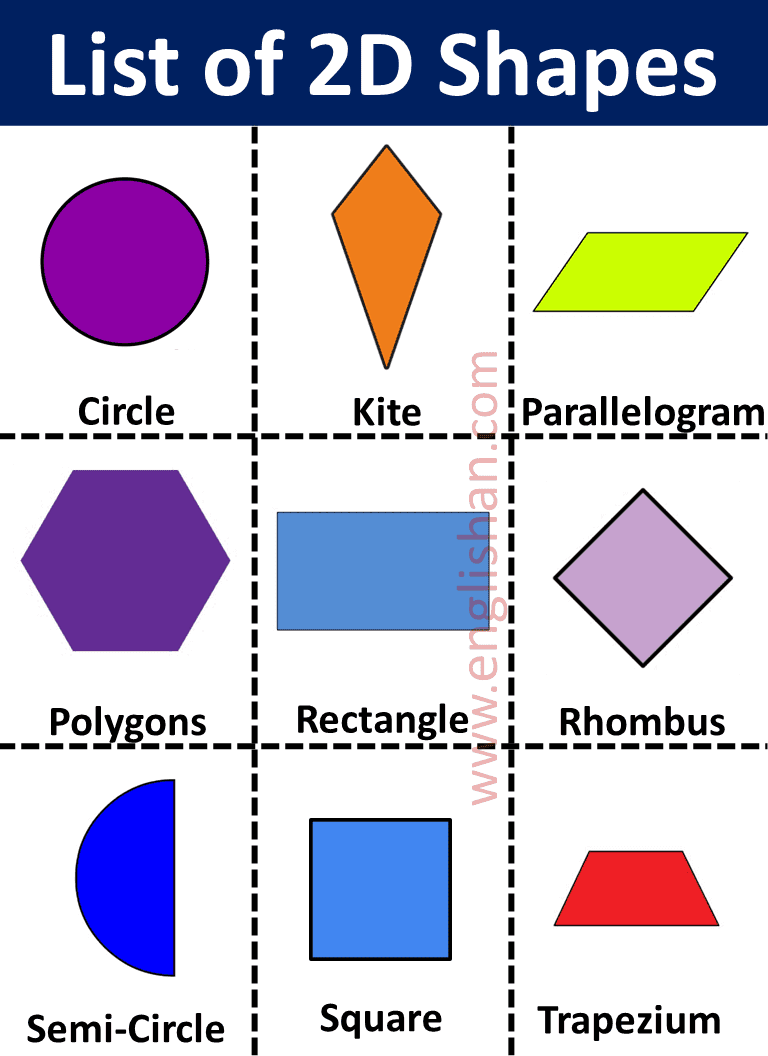
Quadrilaterals are four-sided shapes. Some have equal sides, others have parallel sides, but all have four angles.
- Square: All four sides and angles are equal.
- Rectangle: Opposite sides are equal; all angles are 90 degrees.
- Rhombus: Four equal sides with opposite angles being equal, like a tilted square.
- Parallelogram: Opposite sides are equal and parallel, with slanted angles.
- Trapezoid: Only one pair of opposite sides is parallel.
- Kite: Two pairs of sides next to each other are equal in length.
These shapes appear in everyday objects like books, windows, and drawing tools.
Common Polygons by Number of Sides
- Triangle: Has 3 straight sides.
- Quadrilateral: Has 4 sides, including squares and rectangles.
- Pentagon: Has 5 equal or unequal sides.
- Hexagon: Has 6 sides, often used in floor tiles.
- Heptagon: Has 7 sides.
- Octagon: Has 8 sides, used in stop signs.
- Nonagon: Has 9 straight edges.
- Decagon: Has 10 equal sides and angles.
- Hendecagon: Has 11 sides.
- Dodecagon: Has 12 straight sides.
Polygons are used in geometry to build complex patterns and in architecture to design structural layouts.
Diamond Shape Name and Category
- Diamond: Also known as a rhombus. It has four equal sides and opposite angles that are equal. It appears like a tilted square.
This shape is often used in playing cards, floor patterns, and fashion design. Its slanted corners make it distinct from a square.
3D and Solid Shapes Names
3D shapes have depth, width, and height. They appear in the physical world and are used to describe real objects we can touch and see.
3D Shapes Names in English
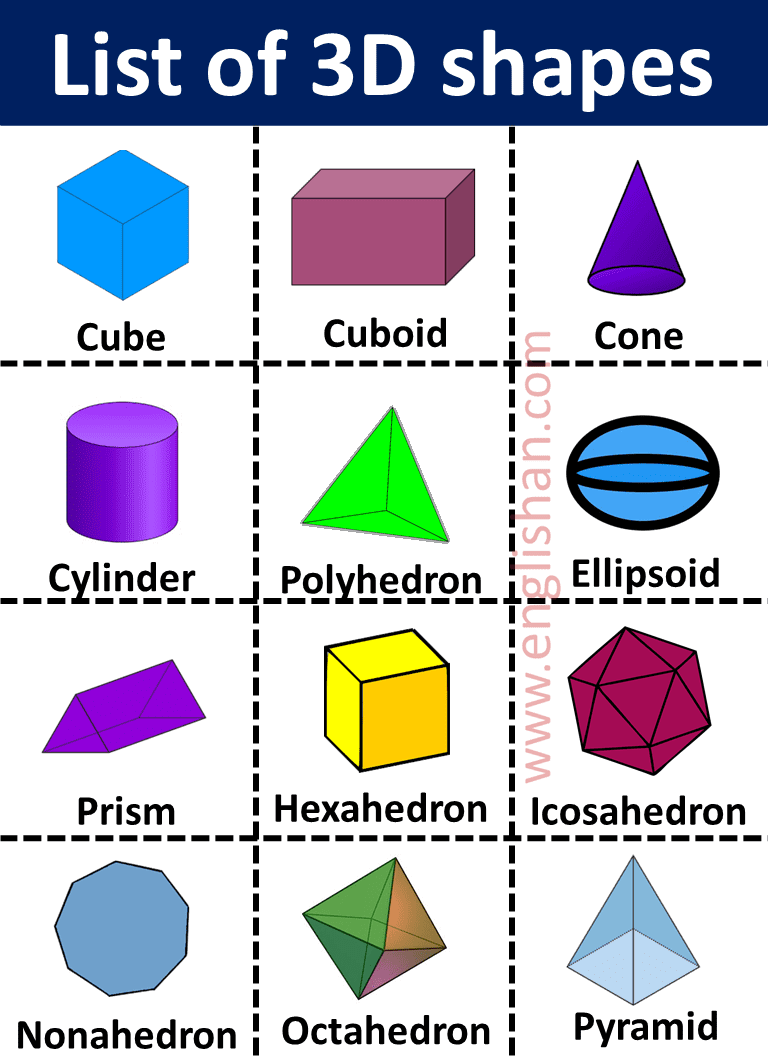
- Cube: Has six equal square faces.
- Cuboid: Like a cube but with rectangles as faces.
- Cylinder: Has two circular faces and one curved surface.
- Cone: Has a circular base that narrows to a point.
- Sphere: Perfectly round with no faces, edges, or corners.
- Pyramid: A base (often square) with triangular sides that meet at a point.
- Prism: Has two identical ends and flat sides.
- Hemisphere: A half-sphere shape.
- Tetrahedron: A pyramid with a triangular base.
- Torus: A donut-shaped object with a central hole.
These shapes appear in boxes, toys, tools, and buildings.
Everyday Objects That Match Solid Shapes
- Cube: Dice, sugar cube, Rubik’s cube.
- Cuboid: Bricks, books, pencil box.
- Sphere: Football, globe, marble.
- Cone: Ice cream cone, party hat, funnel.
- Cylinder: Battery, soda can, candle.
- Pyramid: Egyptian pyramids, camping tent.
- Prism: Shoebox, crystal block.
Learning these shapes helps children understand how forms look and behave in space.
Real-World Objects with 3D Shape Names
- Cube: Gift box, wooden block.
- Sphere: Basketball, apple, ornament.
- Cone: Traffic cone, party hat, carrot.
- Cylinder: Water bottle, glass, tube.
- Pyramid: Tent roof, stacking toy.
- Prism: Geometry tools, aquarium base.
This practical knowledge helps learners describe and compare objects around them.
Triangle-Based Shapes and Usage
Triangles are one of the most important geometric shapes. They’re used in construction, design, and learning basic geometry.
Triangle Shapes and Names Explained
- Equilateral Triangle: All sides and angles are equal.
- Isosceles Triangle: Two sides and angles are equal.
- Scalene Triangle: All sides and angles are different.
- Right-Angled Triangle: One angle is exactly 90 degrees.
- Acute Triangle: All angles are less than 90 degrees.
- Obtuse Triangle: One angle is more than 90 degrees.
Triangles appear in roofs, bridges, road signs, and math tools.
Triangle Shaped Objects Names in Daily Life
- Pizza slice: Triangle with curved side.
- Road signs: Yield and warning signs.
- Ruler set squares: School tools with triangular edges.
- Flags: Pennant flags used in events.
- Roofs: Triangle gables in buildings.
- Paper plane wings: Folded into triangle shapes.
- Tent tops: Triangular when viewed from the side.
- Musical triangle: Metal bar bent into a triangle.
These shapes are easy to find in both nature and man-made objects.
FAQs
Here are some common names of 2D and 3D shapes:
2D Shapes:
1. Circle
2. Square
3. Rectangle
4. Triangle
5. Pentagon
6. Hexagon
7. Octagon
8. Parallelogram
9. Rhombus
10. Trapezoid
3D Shapes:
1. Sphere
2. Cube
3. Cone
4. Cylinder
5. Pyramid
6. Rectangular Prism
7. Torus
8. Hemisphere
9. Ellipsoid
10. Octahedron
These are basic examples of both 2D and 3D shapes.
Here are examples of a 2D shape and a 3D shape:
2D Shape:
1. Circle – A flat, round shape with no edges or corners.
3D Shape:
1. Sphere – A 3D shape that is round and has no edges or corners, like a basketball.
3D shapes are three-dimensional objects that have length, width, and height (depth). Here are some common 3D shapes:
1. Hexagonal Prism
2. Dodecahedron
3. Icosahedron
4. Ellipsoid
5. Frustum
6. Triangular Prism
7. Pentagonal Prism
8. Toroid
You May Also Like