
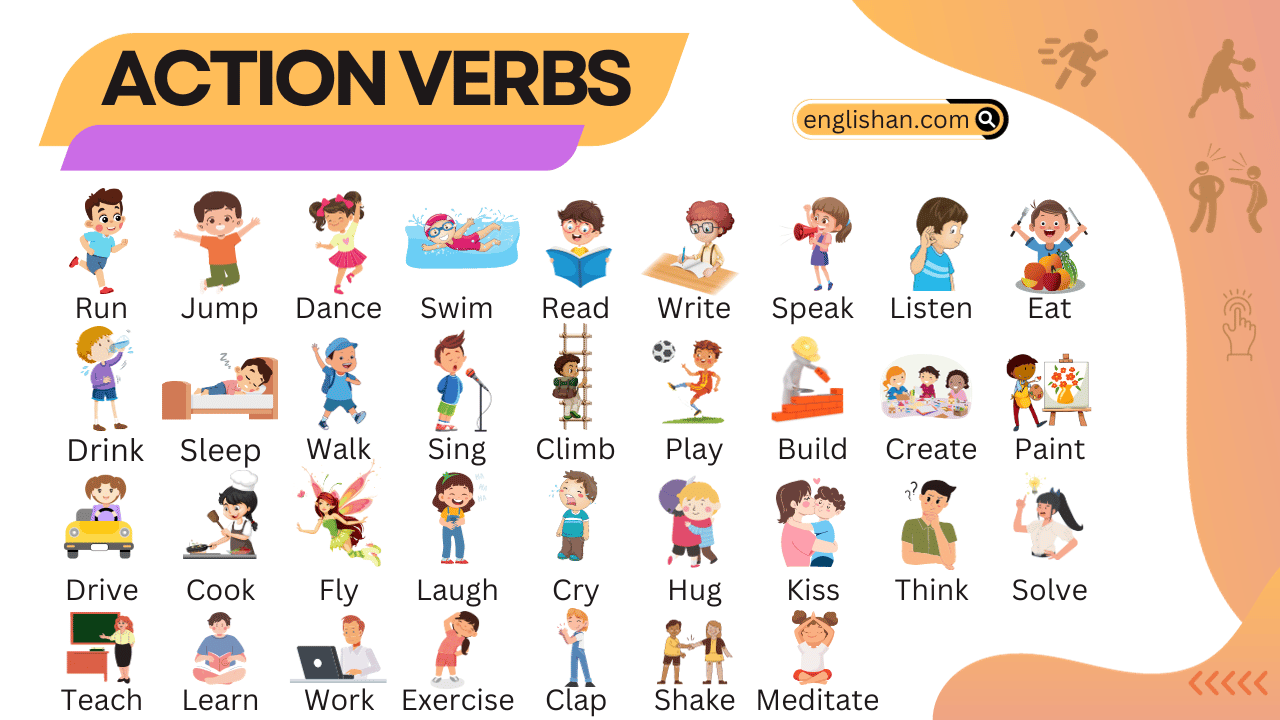
Describing what someone is doing gives a sentence its meaning because it connects the subject to real activity. When you need to explain a physical movement or a hidden thought, action verbs serve as the essential core of your message. This category includes common examples like “run,” “study,” or “love” that show exactly what is happening.
We have grouped a comprehensive list of action verbs to help you build accurate sentences for school or daily conversation. Learning these words improves your ability to communicate details effectively while you write or speak. This list invites you to strengthen your foundation in English grammar today.
What Are Action Verbs?
Action verbs describe the actions that someone or something performs. They tell us what the subject of the sentence is doing. For example, in the sentence “The cat jumps,” the verb “jumps” is an action verb because it describes what the cat is doing.
Practice: Action Verbs Worksheets
200 Common Action Verbs List
Here’s a comprehensive list of 200 common action verbs that you can start using in your daily conversations. These verbs will help you express a wide range of actions clearly and effectively.
| Run | Lift | Measure |
| Walk | Fall | Weigh |
| Say | Throw | Shake |
| Eat | Catch | Stir |
| Think | Bring | Spill |
| Read | Send | Clean |
| Write | Build | Dirt |
| Play | Break | Fold |
| Sing | Choose | Unfold |
| Dance | Lose | Pack |
| Jump | Win | Unpack |
| Talk | Hurt | Decorate |
| Listen | Heal | Ruin |
| Watch | Draw | Combine |
| Sleep | Paint | Separate |
| Drink | Search | Connect |
| Drive | Find | Disconnect |
| Laugh | Hide | Charge |
| Cry | Seek | Discharge |
| Begin | Cut | Increase |
| End | Grow | Decrease |
| Call | Cook | Improve |
| Move | Taste | Worsen |
| Wait | Smell | Embrace |
| Ask | Hear | Reject |
| Answer | Travel | Compliment |
| Work | Fly | Insult |
| Open | Swim | Predict |
| Close | Dive | Reflect |
| Help | Sit | Compete |
| Buy | Stand | Complain |
| Sell | Wear | Whisper |
| Teach | Tear | Scream |
| Learn | Share | Enter |
| Remember | Give | Exit |
| Forget | Take | Invite |
| Try | Receive | Banish |
| Stop | Offer | Capture |
| Start | Refuse | Release |
| Pull | Accept | Repeat |
| Push | Discuss | Replace |
| Lead | Argue | Collect |
| Follow | Agree | Distribute |
| Whistle | Disagree | Include |
| Shout | Protect | Exclude |
| Whisper | Attack | Expand |
| Describe | Defend | Shrink |
| Mention | Climb | Generate |
| Claim | Slide | Extinguish |
| Deny | Shine | Guide |
| Confirm | Dim | Mislead |
| Suggest | Gather | Revive |
| Admire | Scatter | Suppress |
| Criticize | Lead | Advance |
| Praise | Follow | Retreat |
| Blame | Whistle | Embark |
| Repair | Shout | Disembark |
| Destroy | Whisper | Accelerate |
| Discover | Describe | Decelerate |
| Invent | Mention | Enrich |
| Measure | Claim | Impoverish |
| Weigh | Deny | Appreciate |
| Shake | Confirm | Depreciate |
| Stir | Suggest | Magnify |
| Spill | Admire | Minimize |
| Clean | Criticize | Uphold |
| Dirt | Praise | Overturn |
| Fold | Blame | Flourish |
| Unfold | Repair | Wither |
| Pack | Destroy | Merge |
| Unpack | Discover | Split |
| Decorate | Invent | Assemble |
| Ruin | Measure | Dismantle |
| Combine | Weigh | Elevate |
| Separate | Shake | Lower |
| Connect | Stir | Illuminate |
| Disconnect | Spill | Darken |
| Charge | Clean | Tighten |
| Discharge | Dirt | Loosen |
| Increase | Fold | Fortify |
| Decrease | Unfold | Weaken |
| Improve | Pack | Empower |
| Worsen | Unpack | Disempower |
| Embrace | Decorate | Revitalize |
| Reject | Ruin | Deplete |
| Compliment | Combine | Illuminate |
| Insult | Separate | Darken |
| Predict | Connect | Tighten |
| Reflect | Disconnect | Loosen |
| Compete | Charge | Fortify |
| Complain | Discharge | Weaken |
| Whisper | Increase | Empower |
| Scream | Decrease | Disempower |
| Enter | Improve | Revitalize |
| Exit | Worsen | Deplete |
| Invite | Embrace | Merge |
| Banish | Reject | Split |
| Capture | Compliment | Assemble |
| Release | Insult | Dismantle |
| Repeat | Predict | Elevate |
| Replace | Reflect | Lower |
| Collect | Compete | Illuminate |
| Distribute | Complain | Darken |
| Include | Whisper | Tighten |
| Exclude | Scream | Loosen |
| Expand | Enter | Fortify |
| Shrink | Exit | Weaken |
| Generate | Invite | Empower |
| Extinguish | Banish | Disempower |
| Guide | Capture | Revitalize |
| Mislead | Release | Deplete |
| Revive | Repeat | Illuminate |
| Suppress | Replace | Darken |
| Advance | Collect | Tighten |
| Retreat | Distribute | Loosen |
| Embark | Include | Fortify |
| Disembark | Exclude | Weaken |
| Accelerate | Expand | Empower |
| Decelerate | Shrink | Disempower |
| Enrich | Generate | Revitalize |
| Impoverish | Extinguish | Deplete |
| Appreciate | Guide | Merge |
| Depreciate | Mislead | Split |
| Magnify | Revive | Assemble |
| Minimize | Suppress | Dismantle |
| Uphold | Advance | Elevate |
| Overturn | Retreat | Lower |
| Flourish | Embark | Illuminate |
| Wither | Disembark | Darken |
| Merge | Accelerate | Tighten |
| Split | Decelerate | Loosen |
| Assemble | Enrich | Fortify |
| Dismantle | Impoverish | Weaken |
| Elevate | Appreciate | Empower |
| Lower | Depreciate | Disempower |
| Illuminate | Magnify | Revitalize |
| Darken | Minimize | Deplete |
| Tighten | Uphold | Empower |
| Loosen | Overturn | Disempower |
| Fortify | Flourish | Revitalize |
| Weaken | Wither | Deplete |
| Empower | Merge | Empower |
| Disempower | Split | Disempower |
| Revitalize | Assemble | Revitalize |
| Deplete | Dismantle | Deplete |
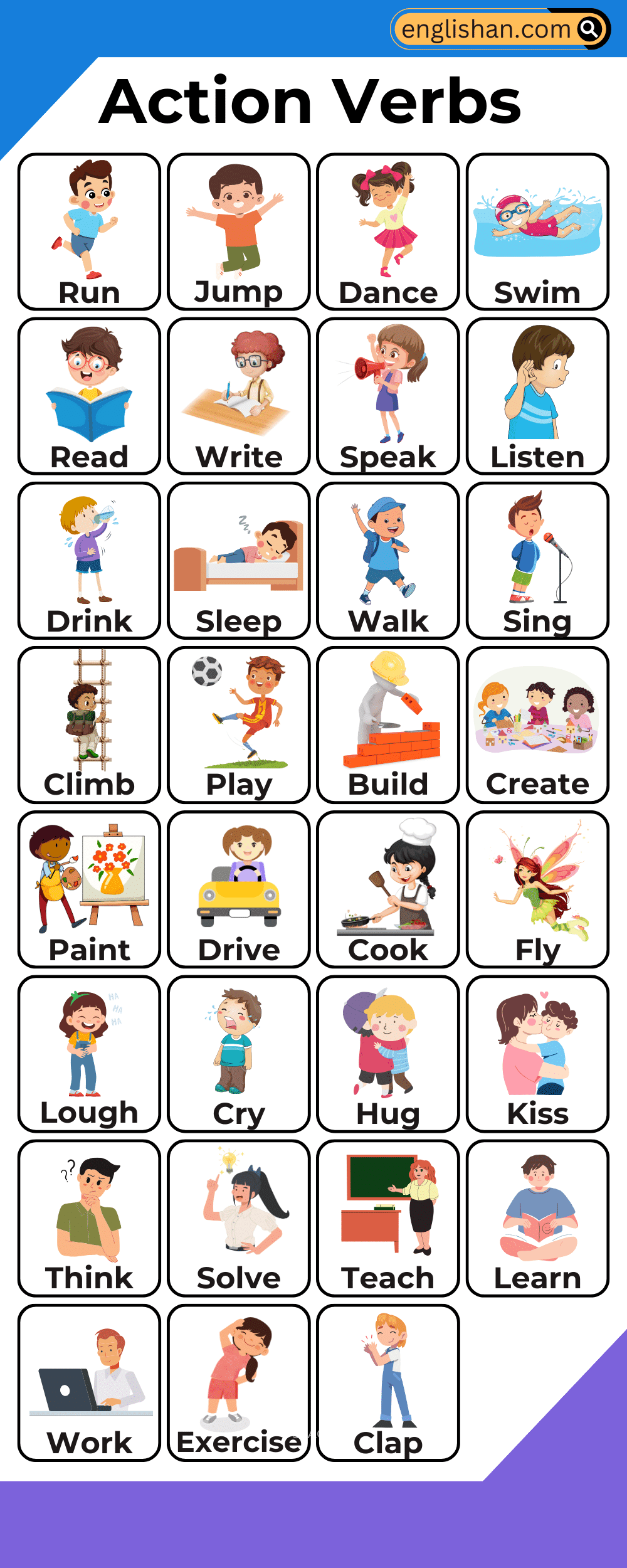
List of Basic Action Verbs
Walk: move on foot at a steady pace.
- She walked along the small path.
Run: move quickly using long steps.
- He ran to reach the gate.
Jump: push upward off the ground.
- She jumped over the short fence.
Lift: raise something using strength.
- He lifted the heavy box.
Carry: hold and move something from one place to another.
- She carried the bag upstairs.
Push: apply force to move something away.
- He pushed the door open.
Pull: draw something toward yourself.
- She pulled the rope firmly.
Grab: take hold of something quickly.
- He grabbed the handle fast.
Hold: keep something steady in your hands.
- She held the cup carefully.
Drop: let something fall freely.
- He dropped the keys by mistake.
Raise: move something upward.
- She raised her hand to speak.
Lower: move something downward.
- He lowered the blinds slowly.
Open: move something so it becomes unclosed.
- She opened the drawer silently.
Close: bring something together until shut.
- He closed the window tightly.
Catch: take hold of something in motion.
- She caught the ball easily.
Throw: send something forward through the air.
- He threw the ring toward the target.
Kick: strike something with the foot.
- She kicked the ball forward.
Bend: curve your body or object downward.
- He bent to tie his shoes.
Stretch: extend your body or limbs outward.
- She stretched her arms widely.
Turn: rotate or change direction.
- He turned the knob quickly.
Spin: rotate something around a point.
- She spun the top on the table.
Shake: move something back and forth fast.
- He shook the bottle gently.
Wave: move the hand back and forth to signal.
- She waved at the taxi.
Stack: place items in an ordered pile.
- He stacked the books neatly.
Shift: move something from one position to another.
- She shifted the chair sideways.
Smell: detect a scent through the nose.
- She smelled the fresh roses.
Taste: test a flavor using the tongue.
- He tasted the soup before serving.
Fall: move downward without control.
- The leaves fell across the yard.
Drop: let something fall freely.
- She dropped the spoon accidentally.
Drag: pull something along a surface.
Emotion and Feeling Verbs (Action-Based)
Comfort: ease someone’s stress or sadness.
- She comforted her friend after the news.
Soothe: calm someone who feels upset.
- He soothed the crying child.
Console: support someone who feels sorrow.
- She consoled him with kind words.
Encourage: give someone confidence to act.
- He encouraged her to try again.
Reassure: reduce worry through steady words.
- She reassured him about the result.
Cheer: lift someone’s mood with energy.
- They cheered their teammate warmly.
Calm: bring someone back to a quiet state.
- He calmed the restless dog.
Motivate: push someone toward effort or progress.
- She motivated the group to continue.
Inspire: spark new ideas or hope in someone.
- He inspired her with a simple story.
Uplift: raise someone’s spirit or mood.
- The message uplifted the whole team.
Steady: help someone regain emotional balance.
- She steadied him during the moment.
Brighten: make someone feel more positive.
- He brightened her day with a visit.
Support: give emotional strength through action.
- She supported her friend during the task.
Ease: reduce emotional discomfort.
- He eased her tension with calm talk.
Balance: help someone manage feelings wisely.
- She balanced her emotions well.
Express: show a feeling through words or actions.
- He expressed his worry politely.
Release: let go of strong or trapped feelings.
- She released her stress by walking.
Soften: reduce the intensity of a feeling.
- He softened his tone to avoid conflict.
Strengthen: build someone’s emotional courage.
- She strengthened his confidence.
Affirm: confirm someone’s worth or effort.
- He affirmed her progress kindly.
Steer: guide someone’s feelings in a firm way.
- She steered him toward calmer thoughts.
Regulate: control emotions through chosen actions.
- He regulated his anger with deep breaths.
Empower: give a sense of control or ability.
- She empowered the team through trust.
Acknowledge: recognize someone’s feeling directly.
- He acknowledged her concern clearly.
Validate: show someone their feelings matter.
- She validated his worry with patience.
Intellectual Verbs for Thinking
Think: form ideas using the mind.
- He thought about the next step.
Analyze: study something in detail.
- She analyzed the data again.
Decide: reach a clear choice.
- He decided to change his plan.
Reason: form conclusions using logic.
- She reasoned through the puzzle.
Reflect: think quietly about something.
- He reflected on the day’s events.
Judge: form an opinion after thought.
- She judged the idea fairly.
Consider: think about something carefully.
- He considered every option.
Review: examine something again.
- She reviewed the notes twice.
Evaluate: judge value or quality.
- He evaluated the report.
Compare: look at differences or similarities.
- She compared two ideas.
Examine: look closely for details.
- He examined the frame.
Estimate: make a careful guess.
- She estimated the cost quickly.
Plan: outline steps before acting.
- He planned the full process.
Predict: guess what may happen next.
- She predicted a calm outcome.
Deduce: reach a conclusion from clues.
- He deduced the answer easily.
Assume: accept something as true for now.
- She assumed he would call.
Question: challenge an idea or claim.
- He questioned the final step.
Recall: bring a memory back to mind.
- She recalled the earlier rule.
Imagine: create mental pictures or ideas.
- He imagined a quiet day.
Organize: arrange thoughts in order.
- She organized her points well.
Solve: find an answer to a problem.
- He solved the puzzle fast.
Infer: form a conclusion from signs.
- She inferred the meaning quickly.
Conclude: reach the final idea after thinking.
- He concluded the debate.
Focus: direct attention on one thing.
- She focused on the task.
Study: examine deeply to learn.
- He studied the pattern.
Communication Action Verbs List
Say: speak words aloud.
- She said the answer calmly.
Tell: give information to someone.
- He told her the full story.
Ask: request information or help.
- She asked a clear question.
Reply: respond with words.
- He replied without delay.
Explain: make something clear.
- She explained the rule simply.
Describe: give details with words.
- He described the scene briefly.
Announce: share news publicly.
- She announced the results.
Whisper: speak in a very soft voice.
- He whispered the hint.
Shout: speak loudly with force.
- She shouted for help.
Discuss: talk through ideas.
- They discussed the plan.
Argue: express disagreement clearly.
- He argued his point firmly.
Clarify: make meaning easy to understand.
- She clarified the final step.
Mention: refer to something briefly.
- He mentioned the new idea.
State: say something in a clear way.
- She stated her position.
Express: show thoughts or feelings through words.
- He expressed his concern openly.
Confess: admit something honestly.
- She confessed her mistake.
Declare: announce something strongly.
- He declared the plan complete.
Respond: answer after hearing something.
- She responded quickly.
Comment: share an opinion.
- He commented on the result.
Persuade: convince someone through words.
- She persuaded him to stay.
Promise: give a firm verbal commitment.
- He promised to return.
Suggest: offer an idea or option.
- She suggested a short break.
Confirm: make sure something is correct.
- He confirmed the address.
Notify: inform someone officially.
- She notified the team right away.
Complain: speak about a problem with dissatisfaction.
- He complained about the delay.
Physical Movement Verbs
Jump: move upward suddenly.
- She jumped over the log.
Climb: move upward using hands and feet.
- He climbed the ladder.
Slide: move smoothly over a surface.
- She slid across the seat.
Crawl: move on hands and knees.
- He crawled under the table.
Sprint: run very fast for a short time.
- She sprinted toward the gate.
Drift: move slowly without control.
- The boat drifted sideways.
Tackle: physically bring something or someone down.
- He tackled the heavy task.
Leap: jump a long distance.
- She leaped across the gap.
Dash: move quickly in one direction.
- He dashed into the room.
Swing: move back and forth in an arc.
- She swung on the rope.
Kick: strike with the foot.
- He kicked the ball high.
Punch: hit with a closed fist.
- She punched the pad strongly.
Lift: raise upward using effort.
- He lifted the crate easily.
Drag: pull something along the ground.
- She dragged the bag slowly.
Twist: turn something sharply.
- He twisted the handle once.
Rotate: spin around a center point.
- She rotated the wheel.
Shake: move something quickly back and forth.
- He shook the jar firmly.
Roll: move forward by turning over and over.
- She rolled the barrel ahead.
Pivot: turn on a fixed point.
- He pivoted to face her.
Stride: walk with long, confident steps.
- She strode across the hall.
Crouch: lower the body toward the ground.
- He crouched behind the chair.
Hunt: chase or search actively.
- She hunted for the file.
Slam: shut or hit with great force.
- He slammed the door fast.
Flip: turn something over in the air.
- She flipped the coin upward.
Toss: throw lightly with a small movement.
- He tossed the keys across.
Daily Routine Verbs
Wake: stop sleeping and become alert.
- She woke before sunrise.
Rise: move from lying or sitting to standing.
- He rose from the couch.
Dress: put on clothes.
- She dressed for the day.
Wash: clean yourself or objects with water.
- He washed his hands carefully.
Brush: clean or smooth using a brush.
- She brushed her hair quickly.
Cook: prepare food with heat.
- He cooked a warm meal.
Boil: heat liquid until it bubbles.
- She boiled water for tea.
Stir: move food around in a bowl or pan.
- He stirred the soup gently.
Eat: take in food.
- She ate breakfast fast.
Drink: consume liquid.
- He drank a glass of water.
Pack: place items into a bag or box.
- She packed her things neatly.
Clean: remove dirt or dust.
- He cleaned the desk area.
Organize: arrange items in order.
- She organized her shelf well.
Wipe: remove dirt using a cloth.
- He wiped the table clean.
Fold: bend something over itself neatly.
- She folded the laundry tightly.
Charge: connect a device to power.
- He charged his phone early.
Check: look over something to confirm.
- She checked her schedule twice.
Prepare: get something ready for use.
- He prepared lunch in advance.
Leave: go out of a place.
- She left home at eight.
Return: come back to a place.
- He returned in the evening.
Relax: rest to reduce stress.
- She relaxed with music.
Tidy: make a space neat.
- He tidied the room quickly.
Sort: separate items into groups.
- She sorted the papers.
Store: put items away for later use.
- He stored boxes in the closet.
Unpack: take items out of a bag or box.
- She unpacked her things calmly.
Work and Career Action Verbs List
Manage: direct tasks or people toward goals.
- She managed the small team well.
Plan: lay out steps for a task.
- He planned the weekly agenda.
Lead: guide others through tasks.
- She led the meeting clearly.
Train: teach skills through practice.
- He trained the new members.
Report: give information formally.
- She reported the results on time.
Present: show information to an audience.
- He presented the new design.
Update: bring information up to date.
- She updated the document quickly.
Review: check work for accuracy.
- He reviewed the file twice.
Approve: give official permission.
- She approved the final layout.
Organize: arrange tasks in order.
- He organized the project steps.
Plan: structure future work.
- She planned the next phase.
Draft: write a first version.
- He drafted the summary fast.
Edit: improve text by correcting it.
- She edited the page carefully.
Complete: finish a task fully.
- He completed the checklist early.
Submit: send work for review.
- She submitted her form online.
Coordinate: bring different tasks together.
- He coordinated the full schedule.
Negotiate: discuss to reach agreement.
- She negotiated the timeline calmly.
Arrange: put things in a set order.
- He arranged the files neatly.
Monitor: watch progress or performance.
- She monitored the data daily.
Assist: help someone with a task.
- He assisted the new worker.
Design: create structure or layout.
- She designed a clean interface.
Calculate: work out numbers or totals.
- He calculated the cost quickly.
Record: write or store information.
- She recorded the meeting points.
Direct: guide work firmly.
- He directed the team smoothly.
Implement: carry out a planned idea.
- She implemented the update effectively.
Expand: make something larger or broader.
- She expanded her notes for clarity.
Narrow: reduce the range or width.
- He narrowed the topic down.
Present: show information formally.
- She presented her idea confidently.
Measure: find the size or amount of something.
- He measured the length precisely.
Weigh: compare heaviness or importance.
- She weighed all the options.
Calculate: work out a number or amount.
- He calculated the total cost.
Creative and Artistic Verbs
Paint: apply color using a brush.
- She painted a bright mural.
Draw: create lines to form images.
- He drew a clean sketch.
Sketch: make a quick rough drawing.
- She sketched the idea fast.
Compose: create music or text.
- He composed a soft melody.
Design: plan the form of something.
- She designed a simple layout.
Craft: make objects by hand.
- He crafted a wooden frame.
Carve: cut material to form shapes.
- She carved a smooth pattern.
Sculpt: shape stone or clay.
- He sculpted a small figure.
Play: perform music on an instrument.
- She played the piano well.
Sing: produce musical sounds with the voice.
- He sang the chorus loudly.
Act: perform in a play or film.
- She acted the scene confidently.
Edit: refine a creative piece.
- He edited the video carefully.
Film: record motion using a camera.
- She filmed the short clip.
Shoot: take photos or videos.
- He shot clear images.
Blend: mix colors or sounds.
- She blended the tones smoothly.
Mix: combine elements to form something new.
- He mixed the track properly.
Write: create words on paper or screen.
- She wrote a short poem.
Draft: make an initial version of content.
- He drafted the outline quickly.
Refine: improve something step by step.
- She refined the design gently.
Arrange: set musical or visual elements in order.
- He arranged the score neatly.
Color: add color to artwork.
- She colored the drawing slowly.
Frame: set an image inside borders.
- He framed the picture well.
Animate: make images move.
- She animated the short scene.
Tune: adjust sound to the right pitch.
- He tuned the guitar quietly.
Travel and Movement Verbs
Drive: operate a vehicle on roads.
- He drove along the hillside.
Ride: sit on and control a bike or animal.
- She rode the bicycle home.
Sail: travel over water using wind.
- He sailed the small boat.
Fly: move through the air.
- She flew to another city.
Arrive: reach a place finally.
- He arrived right on time.
Depart: leave a place to begin travel.
- She departed early in the morning.
Return: come back after travel.
- He returned home late.
Roam: move without a fixed plan.
- She roamed the open field.
Wander: walk without a clear direction.
- He wandered near the lake.
Explore: travel to discover new places.
- She explored the hillside trail.
Navigate: find or guide a path.
- He navigated the forest route.
Climb: move upward on a surface.
- She climbed the rocky path.
Hike: walk long distances outdoors.
- He hiked through the valley.
Stroll: walk slowly and calmly.
- She strolled along the shore.
Tour: travel to see places of interest.
- He toured the old town.
Cruise: travel smoothly by vehicle or ship.
- She cruised down the highway.
Commute: travel regularly to work.
- He commuted by train daily.
Board: step onto a vehicle.
- She boarded the bus quickly.
Exit: leave a vehicle or building.
- He exited the train fast.
Cross: go from one side to another.
- She crossed the bridge slowly.
Approach: move nearer to something.
- He approached the station gates.
Track: follow a route or target.
- She tracked the trail carefully.
Scan: look around an area quickly.
- He scanned the horizon.
Follow: move behind someone or something.
- She followed the guide closely.
Advance: move forward with purpose.
- He advanced along the narrow path.
Conflict and Resolution Action Verbs List
Argue: express disagreement with reasons.
- They argued about the change.
Debate: discuss different views calmly.
- She debated the point well.
Challenge: question or test something.
- He challenged the final claim.
Confront: face someone or something directly.
- She confronted the issue firmly.
Defend: protect against harm or blame.
- He defended his position carefully.
Attack: act with force against someone or something.
- She attacked the problem quickly.
Block: stop something from moving forward.
- He blocked the attempt quietly.
Resist: push back against pressure.
- She resisted the demand.
Resolve: find a clear solution.
- He resolved the dispute early.
Settle: bring a conflict to an end.
- They settled the argument fast.
Avoid: keep away from conflict.
- She avoided the heated talk.
Calm: cool down rising tension.
- He calmed the group with a word.
Negotiate: talk to reach agreement.
- She negotiated the terms fairly.
Persuade: influence someone’s choice.
- He persuaded her to agree.
Reconcile: restore peace after conflict.
- They reconciled their views quickly.
Delay: slow an action during conflict.
- He delayed his reply wisely.
Redirect: change the course of conflict.
- She redirected the discussion smoothly.
Limit: reduce harmful action.
- He limited the backlash early.
Counter: respond to an opposing move.
- She countered the claim with facts.
Prevent: stop something before it begins.
- He prevented further trouble.
Control: guide a tense moment with firmness.
- She controlled the room calmly.
Withdraw: step back to reduce tension.
- He withdrew from the dispute.
Address: take action to fix an issue.
- She addressed the concern clearly.
Patch: repair small breaks in agreement.
- He patched the misunderstanding fast.
Nature and Environment Verbs
Grow: increase in size or amount.
- The plant grew quickly after rain.
Bloom: open fully like a flower.
- The rose bloomed in spring.
Sprout: begin to grow from a seed.
- The seed sprouted overnight.
Wilt: lose freshness and strength.
- The leaves wilted in the heat.
Erode: wear away slowly by natural forces.
- The waves eroded the cliffside.
Drift: move slowly without control.
- The fog drifted across the valley.
Sink: move downward into a surface.
- The stone sank into the mud.
Rise: move upward naturally.
- The river rose after the storm.
Settle: come to rest in one place.
- The dust settled on the shelf.
Melt: change from solid to liquid.
- The snow melted under the sun.
Freeze: become solid due to cold.
- The water froze overnight.
Flow: move smoothly like water.
- The stream flowed between rocks.
Flood: cover an area with water.
- The river flooded the fields.
Scatter: spread things across an area.
- The wind scattered dry leaves.
Gather: bring elements together.
- The clouds gathered before rain.
Burst: break open suddenly.
- The pod burst and released seeds.
Glow: shine with soft light.
- The fireflies glowed along the path.
Dim: reduce brightness.
- The sky dimmed as clouds built up.
Roar: make a loud natural sound.
- The waterfall roared through the gorge.
Shake: move violently by force.
- The ground shook during the quake.
Crack: split something with force.
- The branch cracked under pressure.
Sway: move gently back and forth.
- The trees swayed in the wind.
Shatter: break into many pieces.
- The ice sheet shattered under weight.
Absorb: take something in fully.
- The soil absorbed the rainfall.
Advanced and Less Common Verbs
Ascend: move upward steadily.
- The climber ascended the steep ridge.
Descend: move downward.
- The hikers descended the hill.
Emerge: come into view from hiding.
- A shape emerged from the mist.
Initiate: begin an action or process.
- She initiated the test sequence.
Sustain: keep something going for a long period.
- The engine sustained its speed.
Facilitate: make an action easier.
- The tool facilitated quick repair.
Accelerate: increase speed.
- The vehicle accelerated smoothly.
Decelerate: reduce speed.
- The bike decelerated before the turn.
Manipulate: control something with skill.
- She manipulated the controls precisely.
Mobilize: organize to take action.
- The team mobilized at once.
Utilize: make use of something for a task.
- He utilized the data well.
Execute: carry out an action fully.
- The crew executed the plan correctly.
Delegate: assign tasks to others.
- The manager delegated the heavy work.
Compile: gather items into one set.
- She compiled all records quickly.
Coordinate: make different parts work together.
- They coordinated every step.
Reinforce: make something stronger.
- The builders reinforced the frame.
Activate: set something into motion.
- He activated the main switch.
Trigger: cause an action to begin.
- The alarm triggered the response team.
Consolidate: bring separate parts together.
- The system consolidated the files.
Rectify: correct something that is wrong.
- She rectified the mistake quickly.
Revise: change something for improvement.
- He revised the draft carefully.
Retrieve: bring something back.
- She retrieved the lost bag.
Accelerate: move faster toward a goal.
- The project accelerated after review.
Administer: apply or manage something formally.
- He administered the process safely.
Abstract Thought Verbs
Imagine: form a mental picture.
- She imagined a peaceful scene.
Envision: picture something as possible.
- He envisioned the final design.
Perceive: become aware using senses.
- She perceived a soft sound.
Interpret: understand the meaning of something.
- He interpreted the sign correctly.
Conceive: form a new idea or plan.
- She conceived a clever solution.
Realize: become aware of something clearly.
- He realized the hidden issue.
Foresee: predict something before it happens.
- She foresaw a sudden change.
Contemplate: think deeply for a period.
- He contemplated the result quietly.
Speculate: guess based on limited facts.
- She speculated about the cause.
Question: doubt or challenge an idea.
- He questioned the final step.
Focus: direct attention strongly.
- She focused on one task.
Visualize: build a mental image.
- He visualized the structure easily.
Deduce: reach a conclusion from clues.
- She deduced the answer quickly.
Conclude: form a final judgment.
- He concluded the review calmly.
Assess: judge something carefully.
- She assessed the risk clearly.
Analyze: break something into parts to study.
- He analyzed the pattern.
Compare: look at similarities or differences.
- She compared two results.
Reflect: think carefully about something.
- He reflected on the message.
Recall: bring a memory back.
- She recalled the event clearly.
Debate: think through different sides of an idea.
- He debated the options quietly.
Prioritize: decide what matters most.
- She prioritized the urgent tasks.
Organize: arrange thoughts neatly.
- He organized his ideas fast.
Plan: prepare steps for later action.
- She planned the next phase.
Probe: search mentally for deeper meaning.
- He probed the issue further.
List of Phrasal Action Verbs
Break down: stop working or lose control.
- The car broke down suddenly.
Carry out: complete a task or duty.
- She carried out the plan exactly.
Figure out: find an answer after thinking.
- He figured out the puzzle.
Give up: stop trying.
- She never gave up on her goal.
Turn off: stop power or flow.
- He turned off the engine.
Turn on: start a device or system.
- She turned on the heater quickly.
Pick up: collect or lift something.
- He picked up the package.
Put down: place something on a surface.
- She put down the tray carefully.
Look into: investigate or explore.
- He looked into the issue deeply.
Work out: solve a problem or exercise.
- She worked out the answer.
Set up: arrange or prepare something.
- He set up the chairs early.
Back up: support or create a copy.
- She backed up the files.
Cut off: stop supply or access.
- He cut off the water flow.
Check in: register or report arrival.
- She checked in at the counter.
Check out: leave or confirm completion.
- He checked out quickly.
Calm down: reduce tension or emotion.
- She calmed down after breathing slowly.
Hurry up: move faster.
- He hurried up to reach the exit.
Break up: separate or end a connection.
- They broke up the group fight.
Carry on: continue without stopping.
- She carried on with her work.
Point out: highlight something important.
- He pointed out the error.
Try out: test something new.
- She tried out the new method.
Cut back: reduce amount or effort.
- He cut back on spending.
Pull over: stop a vehicle at the side.
- She pulled over safely.
Speak up: talk louder or more clearly.
- He spoke up during the meeting.
Regular Action Verbs
Accept: agree to take or allow something.
- She accepted the new terms calmly.
Add: put something together with another.
- He added milk to the tea.
Allow: give permission to do something.
- They allowed extra time for the task.
Answer: give a spoken or written reply.
- She answered the question clearly.
Call: contact someone using a phone or voice.
- He called her after work.
Clean: remove dirt from something.
- She cleaned the table quickly.
Close: move something so it becomes shut.
- He closed the door gently.
Cook: prepare food with heat.
- She cooked a warm meal.
Cry: shed tears because of emotion or pain.
- He cried during the sad scene.
Dance: move the body rhythmically.
- She danced to her favorite song.
Drop: let something fall from your hand.
- He dropped the keys accidentally.
Help: assist someone in a task.
- She helped him lift the box.
Hope: want something to happen.
- He hoped for better results.
Join: connect or become part of a group.
- She joined the club today.
Jump: push off the ground into the air.
- He jumped over the puddle.
Laugh: make sounds that show amusement.
- They laughed at the joke.
Learn: gain knowledge or skill.
- She learned a new word today.
Open: move something so it becomes unclosed.
- He opened the window slowly.
Paint: apply color to a surface.
- She painted the wall blue.
Play: engage in a sport or activity.
- They played in the garden.
Pull: move something toward yourself.
- He pulled the rope tightly.
Push: move something away using force.
- She pushed the chair aside.
Reach: move the arm toward something.
- He reached for the shelf.
Return: come back to a place.
- She returned home late.
Shout: speak very loudly.
- He shouted for help.
Start: begin an activity.
- They started the meeting early.
Talk: speak in order to communicate.
- She talked about the plans.
Walk: move at a steady pace on foot.
- They walked along the path.
Watch: look at something for a period.
- He watched the sunrise.
Work: perform tasks or duties.
- She worked on the new project.
List of Irregular Action Verbs
Begin: start something formally.
- They began the session early.
Break: separate something into pieces.
- She broke the glass by accident.
Bring: carry something toward the speaker.
- He brought the files today.
Build: create something by putting parts together.
- They built a small cabin.
Buy: obtain something with money.
- She bought a new jacket.
Choose: pick one option from many.
- He chose the shorter route.
Come: move toward the speaker.
- She came to the office early.
Cut: divide something with a sharp tool.
- He cut the paper neatly.
Do: perform an action or task.
- She did her homework quickly.
Draw: create an image using lines.
- He drew a simple sketch.
Drive: control and operate a vehicle.
- She drove to work calmly.
Eat: take food into the mouth and swallow.
- He ate lunch at noon.
Fall: drop downward without control.
- The apples fell from the tree.
Feel: experience a physical or emotional sensation.
- She felt a sudden chill.
Find: discover or locate something.
- He found the missing key.
Give: hand something to another person.
- She gave him the book.
Go: move from one place to another.
- They went to the beach.
Grow: increase in size or develop.
- The plant grew taller quickly.
Know: have knowledge or understanding.
- He knew the correct answer.
Make: create or produce something.
- She made a birthday card.
Ride: sit on and control a bike or animal.
- He rode his bicycle downhill.
Run: move quickly using long steps.
- She ran across the field.
Say: speak words to express something.
- He said the name aloud.
See: use eyes to notice something.
- She saw a bright star.
Sing: make musical sounds with the voice.
- He sang beautifully at the event.
Sit: rest on a chair or surface.
- She sat near the window.
Speak: say words in a clear voice.
- He spoke during the meeting.
Swim: move through water using limbs.
- She swam across the pool.
Take: remove or obtain something.
- He took the charger with him.
Write: form letters or words on a surface.
- She wrote a short note.
Learn More: Irregular Verbs
Action Verbs for Resume
Use action verbs to make your resume clear and strong. These verbs help you show real work, real results, and real impact. They make each point easy to understand and help the reader follow your growth. Simple verbs create sharp, direct sentences. This improves your chances with both hiring managers and resume-checking systems.
Achieved: reached a goal through effort.
- She achieved every quarterly target consistently.
Led: guided a team or project toward completion.
- He led a group of five analysts.
Managed: directed people, tasks, or resources.
- She managed daily operations efficiently.
Improved: made something better than before.
- He improved the workflow quickly.
Increased: raised numbers, rates, or performance.
- She increased sales by a clear margin.
Delivered: produced results on time.
- He delivered all reports before deadline.
Coordinated: brought parts together smoothly.
- She coordinated cross-team activities.
Developed: created or strengthened a process or product.
- He developed a new reporting method.
Designed: planned the structure of something.
- She designed a clean user layout.
Implemented: carried out a planned idea.
- He implemented the new system successfully.
Optimized: made something work more effectively.
- She optimized the task sequence.
Streamlined: removed delays or extra steps.
- He streamlined the approval flow.
Analyzed: studied data for patterns and meaning.
- She analyzed monthly performance numbers.
Generated: produced valuable output or ideas.
- He generated weekly performance insights.
Executed: completed tasks with precision.
- She executed the plan without delays.
Created: built a useful product or system.
- He created a new onboarding process.
Initiated: started a new task or program.
- She initiated the training schedule.
Supported: gave helpful assistance to a team.
- He supported the managers during transition.
Trained: taught skills to others.
- She trained new staff members.
Resolved: fixed an issue or challenge.
- He resolved client complaints quickly.
Reduced: lowered costs or errors.
- She reduced wasted hours significantly.
Monitored: kept track of progress or performance.
- He monitored system activity daily.
Facilitated: made a task easier or smoother.
- She facilitated team discussions weekly.
Directed: guided a project toward the goal.
- He directed the final testing round.
Presented: shared information clearly.
- She presented the findings to stakeholders.
Upgraded: improved older tools or systems.
- He upgraded the database safely.
Categorized List of Action Verbs
Basic Actions:
- Walk
- Run
- Eat
- Drink
- Sleep
- Talk
- Sit
- Stand
- Read
- Write
- Listen
- Watch
- Play
- Jump
- Sing
- Dance
- Laugh
- Cry
- See
- Hear
Emotions and Feelings:
- Love
- Hate
- Fear
- Desire
- Hope
- Wonder
- Miss
- Envy
- Admire
- Regret
Intellectual Activities:
- Think
- Consider
- Analyze
- Decide
- Learn
- Know
- Understand
- Believe
- Remember
- Forget
Communication:
- Say
- Tell
- Speak
- Argue
- Discuss
- Describe
- Announce
- Whisper
- Shout
- Explain
Physical Movements:
- Climb
- Swim
- Dive
- Slide
- Throw
- Catch
- Push
- Pull
- Lift
- Drop
Work-Related:
- Manage
- Organize
- Plan
- Design
- Create
- Build
- Repair
- Teach
- Train
- Lead
Art and Creation:
- Paint
- Draw
- Sketch
- Carve
- Mold
- Perform
- Compose
- Choreograph
- Photograph
- Film
Daily Routines:
- Cook
- Clean
- Wash
- Brush
- Dress
- Iron
- Shop
- Drive
- Charge
- Replace
Travel and Movement:
- Fly
- Sail
- Hike
- Navigate
- Explore
- Discover
- Visit
- Arrive
- Depart
- Journey
Conflict and Resolution:
- Fight
- Defend
- Challenge
- Surrender
- Reconcile
- Oppose
- Resist
- Yield
- Embrace
- Accept
Nature and Environment:
- Plant
- Grow
- Harvest
- Bloom
- Wilt
- Nurture
- Erode
- Flow
- Shine
- Shade
Less Common Verbs:
- Ponder
- Contemplate
- Ruminate
- Sashay
- Flounder
- Gesticulate
- Whittle
- Galvanize
- Beseech
- Conflate
Abstract Actions:
- Envision
- Postulate
- Speculate
- Innovate
- Theorize
- Conceive
- Perceive
- Apprehend
- Intuit
- Discern
FAQs
An action verb describes an action or something that a person, animal, or thing can do.
Examples of action verbs: Run, jump, eat, sing, write, dance, laugh, swim, study, and read.
Here are 50 action verbs: Run, jump, eat, sing, write, dance, laugh, swim, study, read, speak, walk, cook, drive, listen, talk, sleep, work, play, draw, build, catch, throw, push, pull, sit, stand, shop, bake, teach, learn, travel, clean, brush, lift, climb, paint, exercise, ride, watch, help, repair, call, hug, kiss, open, close, wear, cry, jump, celebrate, and grow.
20 action verbs are Run, jump, eat, sing, write, dance, laugh, swim, study, read, talk, listen, walk, cook, drive, play, draw, build, catch, are throw.
Here are some action verbs suitable for kids: Run, jump, play, dance, sing, eat, laugh, draw, read, write, swim, skip, kick, clap, talk, listen, build, paint, help, and sleep.
You May Also Like
- Cooking Verbs
- List of Verbs from A to Z
- Simple Future Tense
- Regular Verbs
- Will and Be Going To with Examples